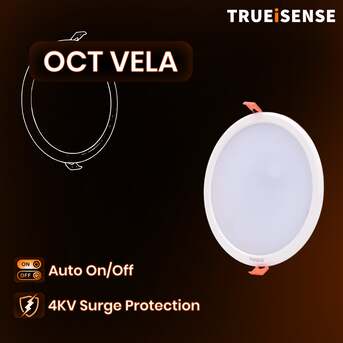
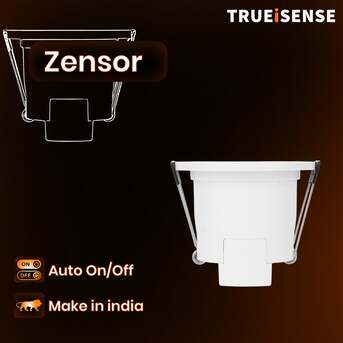
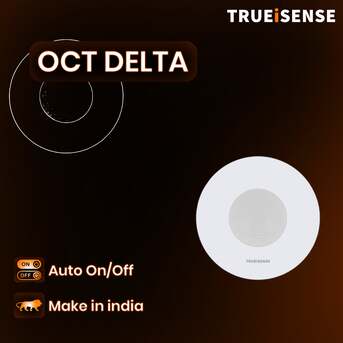
Motion sensors generally provide the highest energy savings in corridors, staircases, parking areas and low-occupancy zones because lights operate only when movement is detected. Occupancy sensors and TRUEiSENSE True Presence Sensors deliver better overall performance in offices, meeting rooms and workspaces where people remain seated for long periods. The best commercial lighting solution often combines both technologies in different building zones.
TRUEiSENSE Occupancy & Motion Sensor Products
(i) ORO PRO 360° Motion Sensor
Technology: Motion Sensor
Best Application: Corridors, Parking
(ii) Motion Sensor T8 LED Tube
Technology: Motion Sensor Light
Best Application: Parking & Utility Areas
(iii) T5 Motion Sensor LED
Technology: Motion Sensor Light
Best Application: Small Offices
(iv) OCT Master Pro
Technology: True Presence Sensor
Best Application: Offices & Cabins
(v) Wave Detector
Technology: True Presence Sensor
Best Application: Meeting Rooms
(vi) Crux Detector
Technology: True Presence Sensor
Best Application: Large Office Areas
(vii) ZENSOR
Technology: True Presence Sensor
Best Application: Premium Smart Buildings
Commercial Sensor Solutions: https://trueisense.in/pages ...
True Presence Sensors: https://trueisense.in/colle ...
What Is the Difference Between a Motion Sensor and an Occupancy Sensor?
Although the terms are often used interchangeably, they operate differently.
Motion Sensor:
A motion sensor detects physical movement such as walking, running or vehicle movement.
Common Applications:
(i) Corridors
(ii) Staircases
(iii) Parking Areas
(iv) Utility Rooms
(v) Warehouses
Occupancy Sensor / True Presence Sensor
An occupancy sensor detects that a person remains inside a space even with minimal movement. Advanced TRUEiSENSE True Presence Sensors can detect breathing and micro-movements.
Common Applications:
(i) Meeting Rooms
(ii) Executive Cabins
(iii) Open Offices
(iv) Conference Rooms
(v) Commercial Workspaces
Bottom Line:
Motion sensors detect movement. Occupancy sensors detect continued presence.
Which Technology Saves More Energy?
The answer depends entirely on the application.
ENERGY SAVINGS COMPARISON:
(i) Corridor
Motion Sensor: 70–80%
Occupancy Sensor: 50–60%
(ii) Staircase
Motion Sensor: 70–80%
Occupancy Sensor: 50–60%
(iii) Parking Area
Motion Sensor: 50–75%
Occupancy Sensor: 40–60%
(iv) Open Office
Motion Sensor: 35–50%
Occupancy Sensor: 50–70%
(v) Meeting Room
Motion Sensor: 30–40%
Occupancy Sensor: 60–80%
(vi) Executive Cabin
Motion Sensor: 20–40%
Occupancy Sensor: 50–70%
Motion sensors typically outperform occupancy sensors in transient spaces where people move in and out quickly.
Occupancy sensors outperform motion sensors in offices because they prevent false switch-offs when employees remain seated for extended periods.
Bottom Line:
The highest energy savings come from matching the right sensing technology to the right space.
Which TRUEiSENSE Sensor Is Best for Each Commercial Area?
TOP PICKS BY COMMERCIAL APPLICATION:
(i) Corridor
Recommended Product: ORO PRO Motion Sensor
Why: Wide coverage
(ii) Parking
Recommended Product: Motion Sensor T8 Tube
Why: Integrated automation
(iii) Staircase
Recommended Product: OCT-X LUO PRO Bulkhead
Why: Automatic operation
(iv) Open Office
Recommended Product: OCT Master Pro
Why: Presence detection
(v) Conference Room
Recommended Product: Wave Detector
Why: Detects seated occupants
(vi) Executive Cabin
Recommended Product: ZENSOR
Why: Micro-movement sensing
(vii) Smart Building
Recommended Product: Crux Detector
Why: 360° presence coverage
(viii) Warehouse Office
Recommended Product: OCT Master Pro
Why: Occupancy monitoring
Bottom Line:
Commercial buildings achieve the best results when motion sensors and occupancy sensors are deployed together.
Why Do Motion Sensors Sometimes Turn Lights Off Too Early?
This is one of the biggest complaints from office employees.
A standard motion sensor requires movement to maintain activation. If a person remains seated while reading, working on a laptop or attending a meeting, the sensor may incorrectly assume the room is vacant.
TRUEiSENSE True Presence Sensors solve this issue by detecting:
(i) Breathing patterns
(ii) Micro movements
(iii) Seated occupancy
(iv) Stationary occupants
This ensures lights remain ON while a room is genuinely occupied.
Bottom Line:
False switch-offs reduce comfort and productivity. Presence sensing eliminates this problem.
Can These Systems Integrate with Energy Monitoring Systems?
Yes. Modern intelligent lighting solutions increasingly connect with:
(i) Energy Monitoring Systems
(ii) Smart Lighting Dashboards
(iii) Building Management Systems
(iv) Commercial Lighting Analytics Platforms
(v) Facility Management Software
This allows organizations to track:
(i) Occupancy trends
(ii) Energy consumption
(iii) Lighting runtime
(iv) Carbon savings
(v) ROI metrics
Bottom Line:
The future of commercial lighting lies in connected, data-driven building automation.
Frequently Asked Questions
Q: Which saves more energy, motion sensors or occupancy sensors?
A: Motion sensors save more energy in corridors, staircases and parking areas, while occupancy sensors deliver greater savings in offices and meeting rooms.
Q: Are occupancy sensors better than motion sensors?
A: Neither is universally better. The correct choice depends on how the space is used.
Q: What is the best sensor for office lighting automation?
A: TRUEiSENSE OCT Master Pro, Wave Detector, Crux Detector and ZENSOR are designed for office occupancy sensing and presence detection.
Q: Can occupancy sensors detect a person sitting still?
A: Yes. TRUEiSENSE True Presence Sensors detect breathing and micro-movements even when a person remains seated.
Q: How do I perform a commercial lighting energy audit?
A: TRUEiSENSE provides a Free Energy Savings Assessment for commercial buildings.
https://trueisense.in/pages ...
Conclusion
The debate between motion sensors and occupancy sensors is not about which technology is superior. It is about selecting the correct sensing solution for each commercial space.
Motion sensor lighting systems deliver exceptional savings in circulation