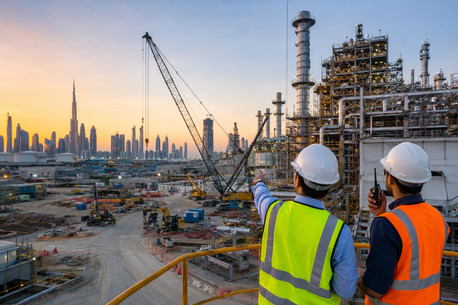
The United Arab Emirates is undergoing a significant industrial expansion, driven by diversification strategies, advanced manufacturing, and investments in energy infrastructure. This growth is evident in Dubai's logistics hubs and large-scale projects in Abu Dhabi, which are vital to the country’s long-term economic goals. As projects become more complex, contractors face challenges such as regulatory requirements, workforce limitations, supply chain issues, sustainability demands, and technological changes. Success depends on construction expertise, strong risk management, effective stakeholder coordination, and efficient project execution in challenging environments.
Understanding the Distinct Industrial Landscapes of Dubai and Ruwais
Industrial construction requirements in the UAE differ significantly between Dubai and Ruwais.
Dubai’s industrial sector focuses on logistics, manufacturing, warehousing, food processing, pharmaceuticals, and advanced technologies, with projects often located near transportation corridors and free zones. Contractors must balance functionality with environmental compliance, stakeholder coordination, and urban integration, requiring meticulous planning and minimal disruption to the community.
In contrast, Ruwais, as a key energy and petrochemical hub, features large-scale facilities and complex operations. Construction occurs near live facilities, where safety considerations are paramount, and specialized expertise in heavy industrial construction is necessary. Here, operational reliability and safety are prioritized along with schedule performance.
Both regions are essential to the UAE's industrial economy, but their project execution models vary significantly. Dubai often deals with tight schedules and regulatory challenges, while Ruwais emphasizes strict safety protocols and coordination with operating facilities. Recognizing these differences is vital for effective resource allocation, scheduling, and risk management. Continued investments in industrial infrastructure and downstream expansion projects are expected to sustain demand for specialized industrial construction services across the UAE.
Workforce Capacity: A Strategic Advantage in Industrial Construction
Effective workforce management is essential for delivering industrial projects, frequently requiring specialized personnel such as certified welders and instrumentation technicians. Effective long-term planning, training, and strategic deployment are vital for accessing these essential resources. Leading firms recognize that workforce flexibility provides a competitive advantage, allowing cross-functional teams to adapt to fluctuating demands, especially during peak maintenance periods. In the Gulf region, rising demand for specialized skills has prompted contractors to invest in workforce development and technical training. Companies with a stable pool of experienced professionals can execute complex projects more efficiently and without delays.
Shutdowns and Turnarounds: The Industry's Most Demanding Projects
Shutdowns and turnarounds are complex industrial construction projects that allow facility owners to perform inspections, repairs, and maintenance during planned outages, where downtime costs money.
Effective execution starts long before fieldwork, necessitating thorough work packages, coordination of materials and equipment, strategic manpower planning, and the identification of potential risks. Experienced contractors emphasize thorough planning, scope validation, and risk assessments. Unforeseen inspection findings may expand the scope, making contingency planning and resource flexibility vital for effective turnaround management.
Supply Chain Resilience Has Become a Core Project Discipline
Recent global supply chain disruptions have transformed procurement strategies in the industrial construction sector. Essential components such as specialized valves, instrumentation packages, and process equipment often require extended procurement schedules. In some cases, lead times for highly specialized equipment can exceed 40–60 weeks, depending on supplier location, manufacturing capacity, and specification requirements.
Procurement has evolved into a strategic discipline, with contractors adopting early procurement strategies, pre-qualifying alternative suppliers, and maintaining inventories of essential materials. In industries like oil and gas, material traceability is essential, requiring thorough documentation for compliance and asset integrity.
Incomplete traceability can lead to costly delays and project disruptions. Consequently, procurement teams are increasingly engaged in the early phases of projects to identify and mitigate risks before they impact construction schedules.
Quality Control: The Foundation of Long-Term Asset Performance
Industrial construction projects produce extensive documentation at every stage, including welding records, inspection reports, and calibration certificates, which are crucial for quality assurance and operational reliability. Experienced contractors implement independent quality assurance processes to verify construction activities, ensure compliance with industry standards, and support long-term asset reliability.
Effective quality management not only fulfills regulatory requirements but also adds long-term value by supporting maintenance activities, simplifying commissioning, reducing disputes, and maintaining asset integrity. In regulated industries, quality documentation is vital for risk management.
Sustainability Is Reshaping Industrial Project Delivery
Sustainability in industrial construction is progressing beyond just regulatory compliance to prioritize minimizing environmental impacts and improving operational efficiency. This transformation is reshaping how buildings are designed, constructed, operated, and maintained with greater sustainability.
While certifications remain an important benchmark, meaningful sustainability is achieved through practical measures integrated into every stage of project execution. Contractors are implementing practical measures like using grid-connected power instead of diesel generators, recycling water, sourcing materials locally, and improving waste management.
In Dubai, strong environmental performance can facilitate project approvals and stakeholder engagement. In areas like Ruwais, environmental controls emphasize spill prevention and emergency response, which are crucial for protecting sensitive industrial settings and ensuring safe project execution.
Technology Adoption Is Transforming Field Operations
While digital twins and AI continue to attract attention, many of the most impactful advancements in industrial construction come from practical, field-ready technologies. Technologies such as laser scanning, mobile applications, GPS tracking, and cloud-based platforms improve productivity, accuracy, and decision-making across construction projects.
Field personnel with real-time access to essential information can quickly identify issues, reducing costly rework, while project managers gain immediate visibility into progress and resource allocation. As facility owners invest in digital transformation, tech-savvy contractors can achieve greater efficiency and competitiveness.
The benefits of digital technologies go beyon