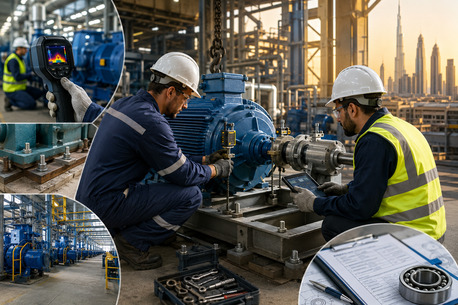
When industrial machinery fails earlier than expected, people often blame manufacturing defects or component quality issues. However, industry experience often shows that installation practices play a significant role in long-term equipment reliability. Industry studies and maintenance investigations frequently identify installation-related issues as a major contributor to avoidable breakdowns and reduced asset performance.
Understanding the Installation-Performance Connection
There is a clear correlation between the quality of installation and the lifespan of industrial equipment: the higher the installation quality, the longer and more reliably the equipment will perform. Properly installed machines operate within their intended specifications, experience only normal wear and tear, and can even surpass their expected lifespan.
Improper installation can contribute to several operational and mechanical issues, including:
High vibration levels contribute to premature bearing and seal failure
Uneven load distribution across structural components
Accelerated lubricant degradation caused by misalignment
Premature fatigue in foundation anchoring systems
Elevated operating temperatures due to excessive friction
Over time, these conditions build up. Even small alignment errors can compound over time, increasing wear, maintenance requirements, and the likelihood of major repairs.
The Cost Calculus of Installation Decisions
Selection criteria for heavy equipment installation contractors often focus solely on the project's initial cost. However, this approach is insufficient because the installation process is the most critical factor in determining the total cost of ownership over the equipment’s entire lifecycle.
Consider two identical production lines installed at similar industrial facilities in Dubai. The first system would be installed using precision alignment techniques, properly prepared foundations, and a comprehensive commissioning process.
When we take a look back after five years of steady operation, the contrasts will clearly appear:
Precision-installed system: Higher reliability, fewer unplanned shutdowns, and more consistent operating efficiency.
Poorly installed system: Increased breakdown frequency, higher emergency repair costs, and reduced operational performance.
Throughout a ten-year operational period, lifecycle costs often exceed the initial acquisition cost of the equipment. Often, this discrepancy arises not from the equipment itself, but rather from the quality of the original installation.
Dubai-Specific Installation Considerations
Several factors within the industrial environment in the Emirates make proper installation especially important. Recognizing these factors emphasizes that, beyond technical skills, local installation expertise is crucial for heavy equipment contractors.
Temperature fluctuations significantly affect equipment installation in Dubai compared to temperate regions. Machinery that is well-aligned during installation can shift over time due to variable soil conditions across industrial sites. Site-specific foundation assessments are essential to prevent failures and equipment misalignment. Furthermore, Dubai's industrial sector operates equipment for long hours under demanding conditions, which adds to the challenges.
Operational activity in Dubai’s industrial sector is typically higher than in many other regions worldwide. Many industrial facilities in the region operate equipment for extended hours under demanding environmental conditions.
Signs of Installation-Induced Problems
Facility managers and operational directors must identify signs that an installation problem is occurring with their machines. Early identification allows corrective measures to be implemented before minor issues develop into major failures.
The following signs are common:
Repeated bearing failures despite proper lubrication
Frequent loosening of foundation bolts
Abnormal thermal patterns detected through thermal imaging
Variations in production quality linked to specific equipment
Increased energy consumption without corresponding output gains
Accelerated wear of belts, chains, or couplings
If multiple symptoms occur simultaneously within a piece of machinery, the underlying cause may be improper installation rather than the quality of individual components.
The Documentation Gap
One commonly underestimated aspect of installations is proper documentation. Comprehensive documentation—including alignment data, foundation information, calibration records, and installation details—provides significant benefits throughout the equipment’s lifecycle.
Proper documentation allows for:
Benchmarking for future troubleshooting purposes
Evaluation of wear against expected wear patterns
Facilitated processing of insurance claims in case of anomalies
Rapid installation of new or better parts
Auditing to ensure regulatory compliance
Organizations that prioritize installation quality often maintain detailed documentation and structured asset management practices throughout the equipment lifecycle. In contrast, projects where installation standards are compromised frequently lack the records needed for effective maintenance, troubleshooting, and performance evaluation.
Why Contractor Selection Impacts Asset Lifespan
When evaluating installation contractors, organizations should review documented quality-control procedures, alignment methodologies, commissioning practices, and safety protocols. These processes often provide a better indication of long-term installation quality than project counts alone.
In addition to temperature fluctuations, Dubai's industrial facilities often operate in environments affected by airborne dust, humidity, and coastal corrosion. These factors can accelerate wear on improperly installed equipment, making precision alignment and protective installation measures particularly important.
FAQs
Q1. What steps can be taken to ensure installation quality before equipment is put into operation?
Independent laser alignment validation, thermal imaging during run-up tests, and vibration signature analysis all provide objective evidence of installation quality before final commissioning.
Q2. What is the cost difference between basic and precision installations on average?
While precision installation may involve higher upfront costs, many organizations find that the investment is offset by lower maintenance expenses and improved equipment reliability.
Q3. Can Installation-Related Issues Be Corrected Without Full Reinstallation?
In some situations, alignment, foundation, or vibration-related issues can be corrected without a complete reinstallation, although feasibility depends on the nature of the problem.
Conclusion
For organizations investing in industrial machinery, installation quality is not merely a project milestone—it is a long-term determinant of asset reliability, maintenance costs, and operational efficiency. Achieving these outcomes