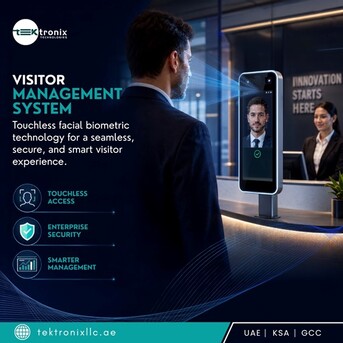
Visitor Management System for Offices: Multi-Building Campus Workflow
A multi-building corporate campus presents Visitor Management System for Offices challenges that a single-building deployment does not encounter. A visitor arriving to meet a host in Building C of a five-building campus must be registered at the campus reception in Building A, issued a credential that activates the pedestrian access gates on the route to Building C, and have their arrival notification reach the host in Building C before they complete the inter-building transit. If the host is actually in the Building C meeting room rather than their desk, the notification must reach them on their mobile device, not their desktop, with sufficient advance notice to meet the guest at the building entrance rather than leaving them waiting at a locked lobby door.
Tektronix LLC configures campus-wide visitor management architectures with building-specific zone credential activation - the visitor badge enables the precise path from the campus reception to the meeting building, without granting access to adjacent buildings, server infrastructure floors, or executive zones not relevant to the visit. Campus wayfinding integration sends the visitor a mobile link with a step-by-step map from campus reception to their specific meeting room the moment check-in completes, reducing the misdirected visitor traffic that burdens security desks in large campus environments.
Visitor Registration Software: Calendar-Driven Pre-Registration at Campus Scale
At a corporate campus hosting thousands of visitor interactions daily across dozens of host departments, Visitor Registration Software that requires manual host-initiated pre-registration for every visit creates an administrative burden that adoption rates quickly demonstrate is unsustainable. Tektronix LLC configures calendar-driven automatic pre-registration - the Microsoft 365 or Google Workspace integration monitors all calendar events with external attendees and automatically dispatches pre-registration invitations without any action required from the host.
The pre-registration invitation presents the visitor with the campus address, parking instructions, a QR code for contactless check-in, and a digital NDA or visitor agreement for advance digital signature - so that by the time the visitor arrives at campus reception, their identity is verified, their agreement is signed, their host is notified, their badge credential is pre-generated, and their wayfinding link is ready to dispatch on arrival confirmation. Campus check-in time for pre-registered visitors reduces to under 15 seconds, transforming the reception experience from a friction point into a seamless, technology-forward welcome that reflects the campus's smart building positioning.
Visitor Check-in System and Visitor Tracking System: Campus Intelligence in Real Time
Visitor Check-in System: Multi-Point Campus Processing
A smart campus Visitor Check-in System operates across multiple physical touchpoints - the main campus reception, secondary building receptions, event registration desks, and unmanned after-hours entry points - all managed by the same platform with role-appropriate staff interfaces at each location. Tektronix LLC deploys premium freestanding kiosks with Emirates ID OCR and facial recognition at the main campus reception, compact tablet terminals at secondary building receptions where space is limited and visitor volume is lower, and QR-only processing at after-hours unmanned entry points where pre-registered visitors authenticate without a staffed terminal. All touchpoints share the same visitor database and update the same access control credential in real time.
Visitor Tracking System: Occupancy Analytics for Smart Campus Operations
On a smart campus, the Visitor Tracking System serves purposes that go well beyond security monitoring. Real-time visitor presence data - derived from access control zone events as the visitor moves between campus buildings - feeds the campus occupancy analytics platform that facilities managers use to optimise meeting room allocation, HVAC zone scheduling, and catering service levels. When visitor occupancy in a conference wing exceeds a defined threshold, the BMS automatically activates supplementary cooling for the affected zone; when visitor volume drops below the threshold, HVAC returns to an efficiency setpoint. The result is a campus that is more energy-efficient precisely because it knows where its visitors are - contributing quantifiable kWh savings to the campus's Al Sa'fat or Estidama operational energy performance record.
Visitor Management Device and Software: The Smart Campus Integration Layer
The Visitor Management Device hardware on a smart campus must be specified for its role in the campus's connected ecosystem - not simply as a standalone check-in terminal. Tektronix LLC selects devices with open API profiles that publish visitor events to the campus integration bus: REST API endpoints for BMS integration, webhook connectors for meeting room booking platform updates, and MQTT event publishing for real-time occupancy data delivery to campus IoT platforms. Device form factors are specified in consultation with the campus interior architect - freestanding kiosks, wall-mounted slim panels, and reception desk integrated terminals are all available in configurations that align with the design language of premium UAE corporate campus environments.
The Visitor Management Software platform delivers the campus-level intelligence outputs that smart campus operators require beyond visitor registration: cross-building visitor movement reports for security incident investigation, visitor frequency analytics by department for resource planning, peak arrival time distributions for campus access infrastructure capacity planning, and PDPL-compliant data processing registers documenting every visitor data category, its processing purpose, and its retention period. For campuses seeking ISO/IEC 27001:2022 certification, the visitor management software audit trail satisfies Annex A Control A.7.2 (physical entry control