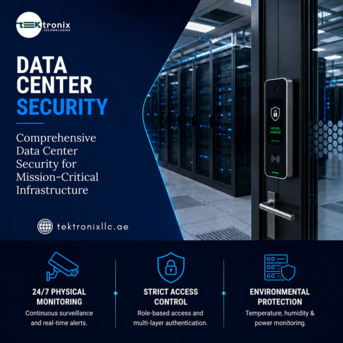
Every new hyperscale campus and colocation facility entering the market raises the stakes further: more tenants sharing infrastructure, more interconnects, more physical square footage to defend, and more regulatory scrutiny from authorities overseeing critical national infrastructure. This article looks at why the threat landscape has changed, what a modern security stack actually includes, and what UAE-specific compliance considerations shape a proper deployment.
The Rising Stakes for Data Centers in the UAE
Digital transformation initiatives across government, banking, and healthcare have pushed data localisation requirements up the priority list, meaning more regulated data now physically resides within UAE borders rather than in offshore cloud regions. That concentration of high-value data in a smaller number of physical sites makes each facility a higher-value target, whether the threat comes from a determined intruder, an insider with legitimate credentials, or a remote attacker probing the network perimeter.
At the same time, giga-projects and free-zone expansions across the Emirates are driving a wave of new data center construction, much of it built to serve international tenants who expect security postures that match — or exceed — what they'd find in Frankfurt, Singapore, or Northern Virginia. Facilities that fall short on physical or cyber controls risk losing enterprise tenancy deals before construction is even finished.
Building Blocks of a Modern Data Center Security Strategy
A resilient strategy treats physical and digital protection as one continuous system rather than two separate budgets managed by different teams. Perimeter fencing, building access, and rack-level restrictions form the outer layers; network segmentation, encryption, and continuous threat monitoring protect what's inside those walls. A gap in either layer — a propped-open service door or an unpatched management interface — can undo the value of every other control in place.
Perimeter and Facility-Level Protection
Data Center Access Control
Layered Data Center Access Control — biometric checkpoints, individually issued credentials, and mantrap vestibules between the lobby and server floor — ensures every entry is tied to a named individual, with permissions scoped tightly to the zones each person actually needs to reach.
Data Center Surveillance
Round-the-clock Data Center Surveillance across loading docks, corridors, and server aisles gives security operators a complete visual record, while AI-assisted video analytics can flag unusual dwell time or movement patterns that a human monitoring dozens of feeds might otherwise miss.
Conclusion
As more of the UAE's critical digital infrastructure moves on-shore, data center security has become inseparable from business continuity itself. Reliable Data Center Access Control and continuous Data Center Surveillance form the physical backbone, while Data Center Intrusion Detection closes the gaps a determined intruder might otherwise find.
Paired with disciplined Cybersecurity for Data Center operations, Data Center Encryption, Data Center Firewalls, and coordinated Data Center Threat Detection, these layers give operators genuine defense-in-depth rather than a patchwork of point solutions. Facilities investing in Data Center Security UAE-wide — including data center security Dubai sites serving global financial tenants and data center security Abu Dhabi facilities supporting critical national infrastructure — are best positioned to earn the trust of increasingly security-conscious enterprise and government clients.
For more information contact us on:
Tektronix Technology Systems Dubai-Head Office
[email protected]
+971 50 814 4086
+971 55 232 2390
Office No.1E1 Hamarain Center 132 Abu Baker Al Siddique Rd – Deira – Dubai P.O. Box 85955