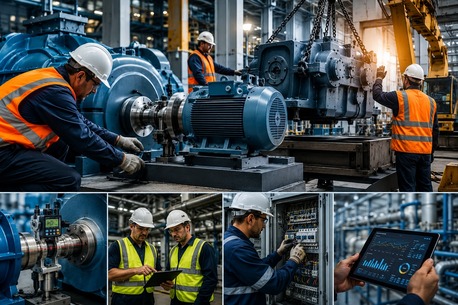
Heavy equipment installation contractors play a critical role in determining the long-term performance, reliability, and safety of industrial assets. Their responsibilities go far beyond simply placing equipment, encompassing the integration of mechanical systems, electrical components, controls, and operational requirements into a unified installation process. From a systems engineering perspective, installation serves as the critical link between equipment design and long-term operational performance.
Installation as Systems Integration
Machinery installation should be approached as a comprehensive systems integration process rather than a standalone installation activity. Most modern industrial equipment functions as part of an interconnected system rather than as standalone machinery. Pumps, compressors, conveyors, control panels, and instrumentation function as interdependent components within complex systems. Installation specialists who adopt a systems-based approach focus on ensuring seamless integration between all equipment interfaces. They verify mechanical, electrical, thermal, and control interfaces to ensure reliable interaction among all interconnected subsystems.
The following activities are fundamental to a successful systems-based installation process:
Interface mapping: defining interface details for connections, communications, and clearances in mechanical and electrical systems.
Functional sequencing: planning installation and commissioning operations to test subsystem integration at incremental loads.
Configuration documentation: Recording equipment settings, calibration data, and as-built wiring configurations for future maintenance and troubleshooting.
Foundation and Structural Dynamics
Foundations are often overlooked, yet they are among the most important factors influencing long-term equipment stability and reliability. High-speed rotating equipment generates substantial dynamic forces and vibrations that can significantly affect both the machinery and its supporting structures. Experienced installation contractors evaluate soil conditions and design foundations that support the equipment's operational requirements.
Important considerations include:
Foundation design should account for soil characteristics and load conditions to minimize differential settlement and prevent vibration-related issues.
Dynamic damping: incorporating damping systems to reduce excessive vibrations and prevent resonance amplification.
Maintainability planning: designing access points that allow maintenance tasks to be performed without compromising the integrity of the structure.
Precision Alignment and Thermal Behavior
Precision alignment is one of the most important factors affecting installation quality. Even minor misalignments—measured in microns—can lead to significant wear and efficiency losses in gears, bearings, and couplings. Thermal growth must be considered, as equipment dimensions change when operating temperatures rise above ambient conditions.
Professional installation teams commonly use the following techniques:
Laser alignment systems provide highly accurate measurements, excellent repeatability, and comprehensive digital documentation.
Thermal growth calculations and hot alignment techniques account for equipment expansion at normal operating temperatures.
Trial operating runs verify alignment stability under normal operating loads.
Mechanical Handling and Risk Control
Moving, lifting, and positioning heavy machinery present significant risks to both personnel safety and equipment integrity. Safe equipment handling depends on detailed planning, experienced personnel, and effective on-site coordination. Craning plans, rigging strategies, load simulations, and contingency measures are essential components of a safe and effective lifting process. Risk management should include engineering controls, administrative procedures, and appropriate personal protective equipment (PPE).
Effective material-handling practices include:
Pre-lift simulations help determine load paths and predict changes in the center of gravity during lifting operations.
Continuous load monitoring during critical lifting operations.
Clearly defined exclusion zones supported by effective communication throughout lifting operations.
Electrical, Control, and Instrumentation Integration
As industrial systems become more automated, the scope of electrical and instrumentation installation has significantly broadened. Heavy equipment installation contractors must ensure that electrical distribution systems, grounding, control cabling, and instrumentation are installed in accordance with operational requirements, applicable standards, and safety regulations. Nuisance tripping and signal degradation can be minimized by ensuring proper cable routing, EMC protection, and surge protection.
Recommended integration practices include:
Use modular wiring harnesses and tagged connections for faster diagnosis.
Perform comprehensive loop and signal tests to validate instrument calibration and measurement accuracy.
Document control logic, software configurations, and baseline operating parameters where applicable.
Commissioning: From Static Checks to Dynamic Validation
Commissioning goes beyond basic compliance checks by validating equipment performance under realistic operating conditions. Commissioning should incorporate realistic operating scenarios, such as load cycling, start-up and shutdown sequences, and fault simulations, to verify system performance under real-world conditions. Effective commissioning involves baseline measurements (vibration, temperature, electrical), progressive load testing, and comprehensive acceptance tests that satisfy both manufacturer specifications and operational tolerance criteria.
Typical commissioning activities include:
Collecting baseline vibration, temperature, and electrical readings before initial operation for future trend analysis.
Increasing the load incrementally to measure thermal and mechanical behavior.
Simulating fault conditions to verify the proper operation of protection and safety systems.
Embedding Condition Monitoring from Day One
The installation stage offers an excellent opportunity to incorporate condition-monitoring technologies directly into industrial equipment. Vibration sensors, thermography access, oil sample ports, and telemetry may be installed at the time of installation; no retrofit required. Strategically positioning sensors during the initial installation phase enables the collection of high-quality data and supports the early implementation of predictive maintenance programs.
Benefits of early condition monitoring include:
Early detection of installation-related abnormalities.
Development of normal baselines for equipment health trend analysis.
Reduced Mean Time to Detect (MTTD) potential equipment issues.
Documentation and Knowledge Transfer
Comprehensive documentation distinguishes a high-quality installation from an average one. In addition to having a completion certificate, documentation must include data