Have you ever wondered why your high-speed internet suddenly stutters during a crucial video call, even though you are paying for an expensive connection? Most modern households and home offices in Jaipur are packed with multiple smart devices—smartphones, 4K streaming TVs, laptops, intelligent security cameras, and automated appliances. We upgrade our routers and install expensive mesh systems, yet erratic ping spikes and sudden freezing persist during peak evening hours. The root issue is rarely your internal Wi-Fi hardware. Instead, it is a structural imbalance in how your external internet pipeline handles data traffic.
Understanding the Upload Bottleneck: Asymmetrical vs. Symmetrical Speed
Traditional broadband plans are inherently asymmetrical. Internet service providers heavily market massive download speeds but silently throttle the upload pipeline to a tiny fraction of that capacity. While this architecture worked fine when households only consumed content, it fails completely in the modern digital era. Smart home automation is a two-way street. Your high-definition security cameras are constantly uploading live footage to cloud servers, background applications are syncing heavy storage data, and smart modules are sending continuous telemetry signals. When these multiple devices saturate your narrow, restricted upload lane, the entire network chokes. This data congestion causes your active remote work sessions or video feeds to drop frames. True network stability requires a symmetrical architecture where upload and download bandwidth match exactly at a 1:1 ratio.
Why Overhead Cables Fail the Reliability Test
The physical medium delivering internet to your property plays a decisive role in latency control. Overhead cables hanging from local utility poles are highly vulnerable to external disruptions. High-velocity summer winds stretch the lines, while heavy monsoon rains introduce immediate moisture into exposed joints, causing micro-short circuits and severe packet loss. To achieve real digital stability, your connection must rely on dedicated, deep underground pure fiber optic conduits that remain completely insulated from external weather accidents.
Upgrading Your Home’s Digital Infrastructure Baseline
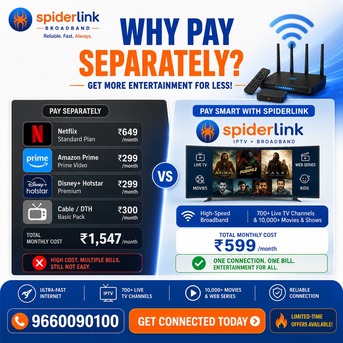
To experience seamless multi-device automation and lag-free remote work, households are transitioning to enterprise-grade grids that deliver a stable 99.9% uptime baseline. Moving your line to a premium network managed by Spiderlink Broadband ensures your smart home remains perfectly responsive. For instance, their disruptive 50 Mbps entry-level unlimited plan offers true 1:1 symmetrical performance and comes bundled with premium entertainment assets—including active IPTV and top OTT streaming tools—for just Rs. 330 per month, entirely eliminating separate cable and streaming expenses from your monthly budget with completely zero hidden costs. Secure your unshared block port today before peak seasonal bookings lock out the local grid.