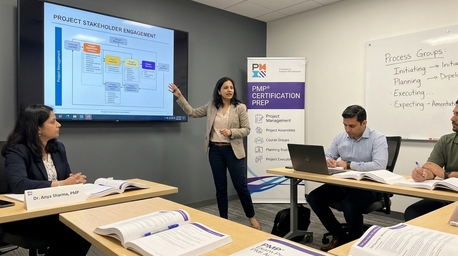
To validate these advanced capabilities, working professionals turn to the gold standard: the Project Management Professional (PMP)(https://www.icertglobal.com ... ) credential administered by the Project Management Institute (PMI)®. However, passing the rigorous exam requires more than practical experience; it demands structured education.
If you are planning to elevate your career, knowing what to expect from PMP certification training programs will help you choose the right path, optimize your study time, and ensure success on your very first attempt.
1. Fulfillment of the Mandatory 35 Contact Hours
The first and most immediate deliverable of any professional PMP training program is the fulfillment of PMI’s mandatory educational prerequisite: 35 formal Contact Hours of project management education.
[]Eligible Experience] + []35 Contact Hours Training] ➔ []PMI Application Approval] ➔ []PMP Exam]
PMI enforces strict quality compliance regarding how these hours are earned. Under recent guidelines, recorded or passive self-paced video sessions alone are heavily scrutinized. Modern training programs focus on live, instructor-led formats. Choosing an authorized provider guarantees that your certificate of completion will seamlessly clear PMI's automated application filters without triggering administrative delays or unexpected audits.
2. Mastery of the Rebalanced 2026 Examination Content Outline (ECO)
The PMP exam is entirely blueprint-driven, mapped directly to PMI’s Examination Content Outline. When enrolling in a modern training program, you should expect a curriculum that moves away from pure theoretical memorization and aligns precisely with the newly updated 2026 domain weightings.
The current exam evaluates your decision-making capabilities across three core pillars:
Domain I: People (33% of the Exam)
This domain tests your soft skills and interpersonal leadership. Training modules will prepare you to manage team conflicts, foster psychological safety, lead cross-functional development teams, and maintain clear communication pathways with diverse enterprise stakeholders.
Domain II: Process (41% of the Exam)
This is the technical backbone of project delivery. You will learn to execute scope, establish critical path schedules, manage multi-million dollar budgets, assess risk registers, and implement rigorous change control systems.
Domain III: Business Environment (26% of the Exam)
The most significant shift in modern project management is the expansion of the Business Environment domain, which surged to 26%. Training programs now place immense focus on strategic alignment. You will learn how to evaluate benefits realization, maintain regulatory compliance, navigate corporate culture, and incorporate corporate sustainability metrics into project execution.
3. Simultaneous Training in Predictive, Agile, and Hybrid Methodologies
Historically, project managers could specialize in a single execution style, such as traditional Waterfall for civil construction or Agile for software development. Today, corporate initiatives are rarely single-threaded.
A high-quality PMP certification training program prepares you to blend these methods dynamically. Expect your training to thoroughly cover:
Predictive (Waterfall): Managing defined scopes, strict baselines, and structured phase gates.
Adaptive (Agile/Scrum): Facilitating sprint planning, managing product backlogs, removing team blockers, and tracking burndown charts.
Hybrid Delivery: Blending both approaches—such as utilizing traditional governance for financial budgeting while deploying agile iterations for technical engineering.
4. Exposure to Modern Contextual Themes: AI and Sustainability
Modern project delivery does not occur in a vacuum. To ensure that certified professionals remain relevant, PMI integrates contemporary enterprise challenges directly into exam scenarios.
Modern Project Context = Core Processes + AI Tools + Sustainability (ESG)
During your training, you will learn how to leverage Artificial Intelligence tools for predictive risk analysis, resource optimization, and automated status reporting. Additionally, the coursework will teach you to evaluate Environmental, Social, and Governance (ESG) criteria, ensuring that your project decisions align with modern global sustainability standards.
5. Transition from Rote Memorization to Complex Scenario Analysis
The modern PMP exam has completely eliminated simple definition-matching questions. Instead, it places you in the shoes of an active practitioner facing a sudden bottleneck.
Top-tier PMP training programs prepare you for advanced, interactive question formats by utilizing high-fidelity mock simulators. You should expect to encounter:
Multi-Question Case Studies: You are given a comprehensive, multi-page business case followed by a sequence of 3 to 5 interconnected questions where your first decision impacts subsequent project conditions.
Graphic and Dashboard Interpretation: Questions will require you to analyze visual artifacts on the fly—such as assessing an agile velocity chart, an earned value management (EVM) S-curve, or a complex risk matrix.
Enhanced Matching and Hotspots: Drag-and-drop exercises where you sequence hybrid workflows or click directly on specific conflict points within a team lifecycle diagram.
Comparing PMP Training Delivery Formats
To maximize your study efficiency, select a delivery format that aligns with your professional schedule, learning habits, and career commitments.
Feature
Live Virtual Bootcamp
In-Person Classroom
Self-Paced On-Demand
Schedule Flexibility
Moderate (Fixed weekend/evening blocks)
Low (Requires dedicated consecutive days)
High (Learn entirely at your own pace)
Instructor Interaction
Real-time Q&A and direct mentorship
Immediate face-to-face feedback
None (Email support or forums only)
Networking Opportunity
High (Connect with global peers online)
Maximum (Local industry networking)
Low (Isolated learning environment)
Audit & Compliance Safety
Maximum (Authorized Partner backed)
Maximum (Accredited institutional hours)
Moderate (Requires careful vetting)
Conclusion
Enrolling in a PMP preparation course is far more than a step toward passing a difficult test; it is an investment in your long-term leadership maturity. By knowing what to expect from PMP certification training programs(https://www.icertglobal.com ... ), you can approach your education with a clear strategy. You will gain a standardized global vocabulary, master the integration of predictive and agile delivery models, and build