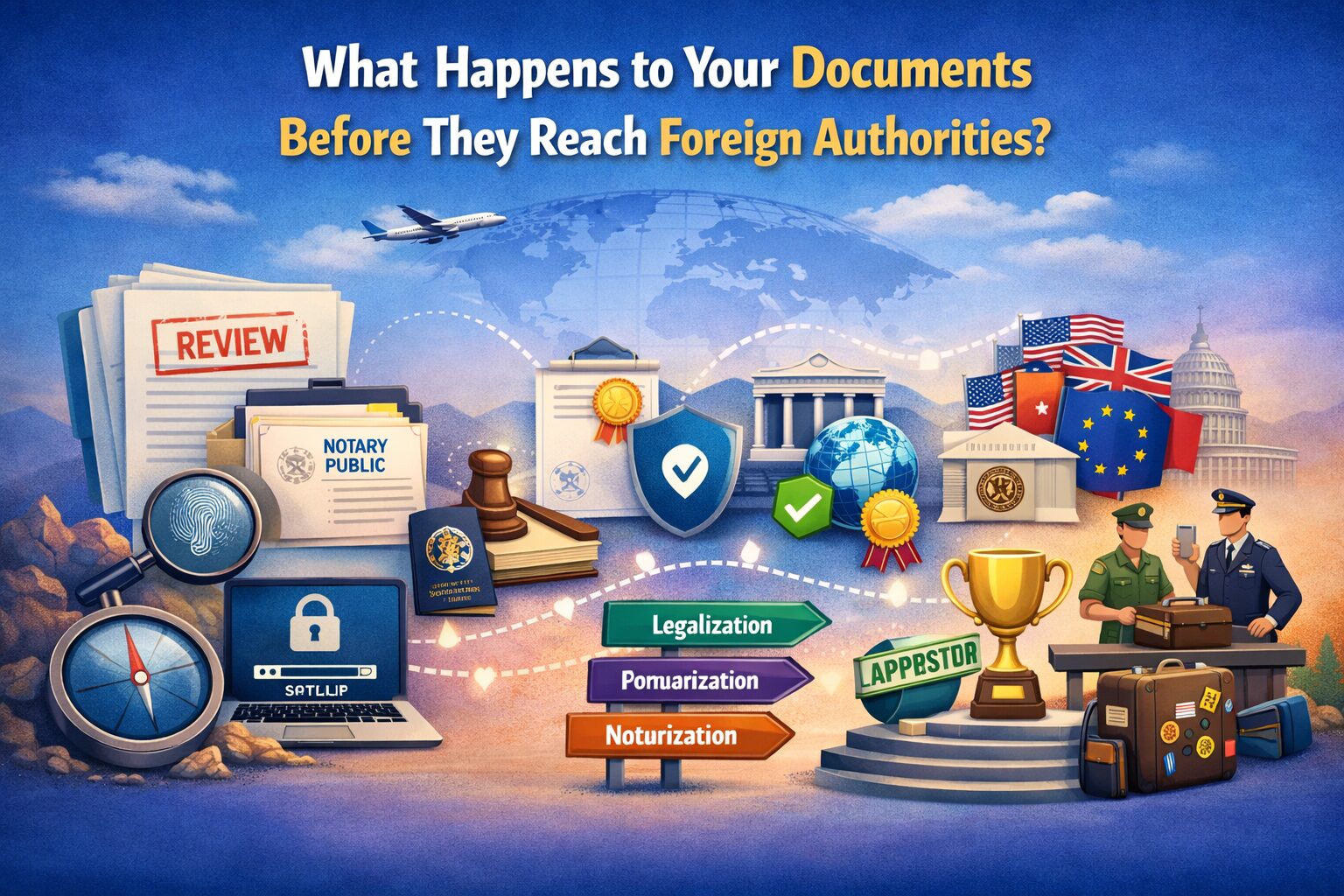
Why Documents Need Authentication
Foreign authorities cannot verify the authenticity of documents issued in another country on their own. They rely on official authentication procedures carried out in the country where the documents were originally issued. This establishes trust between governments and confirms that the documents are legitimate.
Step 1: Careful Verification of Original Documents
The journey begins with examining the original document. Every detail, including names, dates, signatures, seals, and issuing authority, is checked to ensure consistency and authenticity.
Documents that commonly undergo verification include:
- Degree and diploma certificates
- Birth certificates
- Marriage certificates
- Police Clearance Certificates (PCC)
- Commercial documents
- Medical certificates
- Experience certificates
Step 2: State-Level Authentication
Certain documents require authentication from state authorities before they can move to the national level.
Depending on the document type, the process may involve:
- Notary verification
- Home Department authentication
- Human Resource Department (HRD) authentication
- Sub-Divisional Magistrate (SDM) authentication
Step 3: Authentication by the Ministry of External Affairs
After state verification is completed, the documents are forwarded to the Ministry of External Affairs (MEA). The MEA serves as India's central authority for document authentication.
For countries that are members of the Hague Apostille Convention, the MEA issues an Apostille, making the document internationally acceptable without further embassy legalization.
For non-member countries, the authenticated documents continue to embassy legalization before they can be used abroad.
Every Stamp Represents Official Validation
Each authentication stamp added during the process is more than a formality. It represents official confirmation from the relevant authority that the document is genuine.
These validations create a secure chain of trust that allows foreign governments, universities, employers, and immigration departments to accept documents issued in India with confidence.
Ensuring Regional Accessibility
Applicants across India often choose professional assistance to simplify the documentation process. Individuals seeking Certificate Apostille in Delhi can complete the required authentication efficiently while ensuring that every document follows the prescribed verification procedures before moving to the Ministry of External Affairs. Proper handling at each stage minimizes the chances of processing delays and document rejection.
Why Accuracy Matters Throughout the Process
Small mistakes can affect the progress of document authentication. Common issues include:
- Incorrect spellings
- Name mismatches
- Missing signatures
- Damaged certificates
- Unclear photocopies
- Expired supporting documents
Authentication Before International Acceptance
Documents are never sent directly to foreign authorities immediately after collection. They first pass through multiple verification stages to establish their authenticity.
Applicants choosing Certificate Apostille in Mumbai benefit from following the correct sequence of verification, ensuring that their educational, personal, or commercial documents are prepared according to international documentation standards before overseas submission.
Secure Handling During Processing
Professional document handling involves more than collecting certificates. Throughout the authentication journey, documents are tracked, organized, and processed according to official requirements.
This includes:
- Reviewing document completeness
- Maintaining proper documentation records
- Coordinating with relevant authorities
- Following prescribed authentication procedures
- Preparing documents for international acceptance
Final Preparation Before Reaching Foreign Authorities
Once all required authentication stages are completed, the documents become ready for submission to universities, employers, immigration offices, business organizations, or government departments abroad. Every verification completed in India contributes to the document's international credibility and legal recognition.
Applicants opting for Certificate Apostille in Chennai can ensure that their documents complete every required stage before reaching foreign authorities. Following the official authentication process improves acceptance while providing confidence that the documents meet international documentation requirements.
Conclusion
Understanding what happens to your documents before they reach foreign authorities allows you to appreciate the importance of accurate documentation, proper verification, and following the correct procedure. A well-prepared document not only speeds up international processing but also helps avoid unnecessary complications during overseas applications.
For More Information Visit Here:- https://www.talentattestati ...
https://www.talentattestati ...
https://www.talentattestati ...