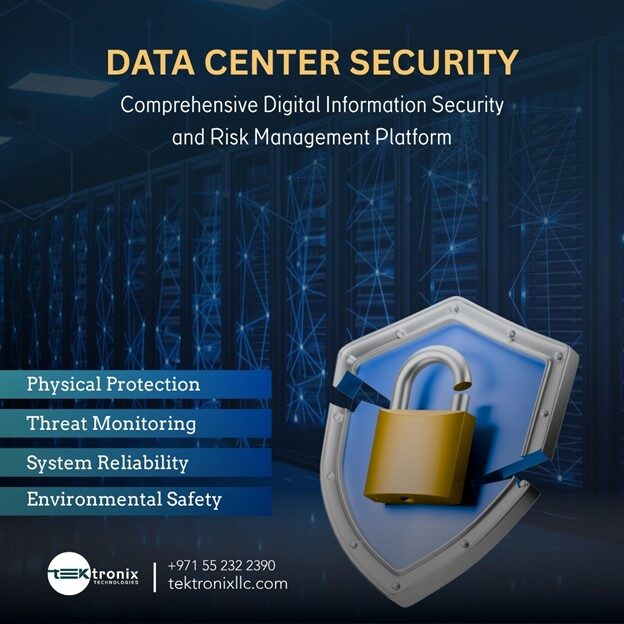
Why Data Center Security Is a Strategic Priority Across the GCC
The GCC's data center market is one of the fastest-growing in the world, with Saudi Arabia, the UAE, and Qatar collectively committing billions of dollars to next-generation digital infrastructure. Hyperscale campuses, carrier-neutral colocation facilities, and sovereign cloud projects are proliferating at a pace that outstrips legacy security models. At the same time, the threat surface has expanded dramatically: ransomware gangs, nation-state actors, and insider threats now specifically target critical infrastructure.
Modern facilities require a holistic, multi-layered approach — one that integrates physical perimeter controls, network-layer defenses, real-time analytics, and zero-trust architecture into a single, auditable security posture. The six-layer security model pioneered by industry leaders addresses each attack vector systematically, ensuring that a breach at one layer does not cascade into a facility-wide compromise.
The Six Pillars of Next-Generation Facility Protection
1. Advanced Data Center Threat Detection
Data Center Threat Detection has evolved from perimeter-based signature matching to behaviour-driven, AI-augmented analysis. Modern threat intelligence platforms correlate logs from network sensors, endpoint agents, physical access systems, and environmental monitors to identify anomalies in near real-time. In the GCC context, where facilities often support government workloads and financial systems, the consequence of a missed threat can be catastrophic. Next-generation Security Operations Centers (SOCs) deployed across Riyadh, Abu Dhabi, and Dubai leverage SIEM (Security Information and Event Management) platforms combined with SOAR (Security Orchestration, Automation and Response) to cut mean time to detect (MTTD) from days to minutes.
Key capabilities that define world-class threat detection in the region include machine learning-driven anomaly detection, deception technology (honeypots and honeynets), dark web monitoring for stolen credentials, and OT/IT convergence monitoring for facilities that also house operational technology assets. For Saudi Arabia's NEOM and similar mega-projects, threat detection must also account for supply-chain vulnerabilities introduced by hundreds of contractors and technology vendors.
2. End-to-End Data Center Encryption
Data Center Encryption is the last line of defense when physical or logical perimeters are breached. Modern GCC operators implement encryption at multiple layers simultaneously: data-at-rest encryption using AES-256 for all storage arrays and backup media; data-in-transit encryption via TLS 1.3 and MACsec for internal east-west traffic; and application-layer encryption for sensitive workloads such as healthcare records and financial transactions governed by SAMA (Saudi Arabian Monetary Authority) and CBUAE regulations.
Hardware Security Modules (HSMs) deployed on-premises provide FIPS 140-2 Level 3 validated key management, ensuring that even cloud-connected workloads retain sovereign cryptographic control — a critical requirement under Saudi Arabia's National Cybersecurity Authority (NCA) Essential Cybersecurity Controls (ECC-2:2022) and the UAE's Information Assurance Standards.
Conclusion
The data center security landscape in Saudi Arabia and the GCC is at an inflection point. Driven by Vision 2030, UAE digital economy strategies, and a maturing regulatory framework, the region is investing at a scale and pace that demands world-class protective infrastructure. Facilities that embrace multi-layered, AI-augmented security architectures — combining sophisticated threat detection, robust encryption, next-generation firewalls, biometric access control, AI-powered surveillance, and proactive intrusion detection — will be the foundations upon which the region's digital economy is built.
Whether you are an enterprise evaluating colocation options in Dubai, a government agency planning sovereign cloud infrastructure in Abu Dhabi, a hyperscale operator breaking ground in Riyadh, or a mid-market business seeking resilient disaster recovery in Sharjah, the security posture of your facility is your ultimate competitive advantage. Partner with experienced specialists who understand both the technical depth and the regional regulatory nuance required to protect your most critical assets.
For more information contact us on:
Tektronix Technology Systems Dubai-Head Office
[email protected]
+971 55 232 2390
Office No.1E1 Hamarain Center 132 Abu Baker Al Siddique Rd – Deira – Dubai P.O. Box 85955