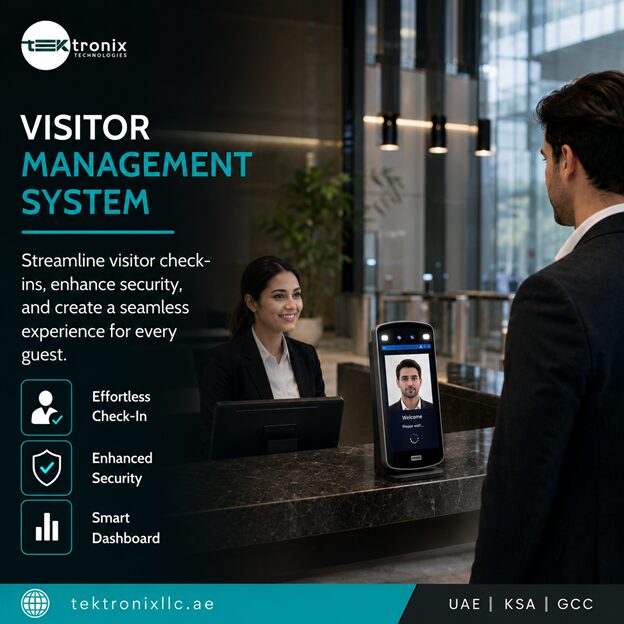
UAE hospitals manage visitor populations that are categorically more complex than any corporate or government facility. A typical DHA-licensed Dubai hospital on a busy weekday receives dozens of different visitor categories simultaneously: in-patients' family members with ward-specific visiting hours restrictions; outpatients checking in for appointments; medical representatives seeking access to clinical staff; external specialist consultants attending surgical cases; pharmaceutical delivery drivers with dock access; linen and waste contractor personnel with service corridor access; medical equipment maintenance engineers with clinical area access; and facility management contractors covering electrical, HVAC, and plumbing maintenance across multiple floors and zones. Each category has different access entitlements, different time restrictions, and different documentation requirements.
A Hospital Visitor Management System structured to manage this complexity must do more than log arrivals at a single reception desk. It must enforce ward-level visiting hours policies at ward entry barriers, issue time-limited credentials that automatically restrict family visitors to the correct ward and expire at the end of visiting hours, log contractor access to clinical areas for infection control contact tracing purposes, and generate the compliant audit trail that JCI accreditation standard MM.6 (medication management), EC.02.06 (facility management) and other patient safety controls reference when assessing physical access to sensitive clinical areas.
Platform Capabilities for UAE Hospital Visitor Management
Visitor Management
Effective Visitor Management in a UAE hospital context is fundamentally a patient safety and infection control discipline as much as a security function. Every individual who accesses a clinical area is a potential vector for healthcare-associated infection (HAI) - and the COVID-19 pandemic established the principle, now embedded in UAE hospital infection control protocols under DHA Infection Prevention and Control (IPC) Standards, that visitor access to inpatient wards should be documented, time-limited, and health-screened. A smart visitor management platform enables all of these controls simultaneously: health status questionnaire completion on the check-in kiosk touchscreen before the badge prints; automatic visiting hour enforcement through the badge credential's time window; and contact tracing capability that allows infection control nurses to identify every individual who accessed a specific ward on a specific date within seconds of an exposure incident being reported.
Visitor Registration Software
The Visitor Registration Software layer manages the multiple visitor category registration workflows that UAE hospital environments require - each with different data capture requirements, access zone authorisations, and time restrictions. Family visitor registration captures the patient name and ward, issues a ward-specific access credential valid for the current visiting hours window, and logs the visit against the patient record. Medical representative registration captures the company and product category, routes an approval request to the relevant clinical department head, and issues a credential valid only for the approved meeting location. Contractor registration captures the company, site induction certification status, and work order number, and issues a credential restricted to the zones covered by the active maintenance work order.
All category-specific registration workflows are configured in the registration software by the hospital security and administration team - without requiring software development engagement from Tektronix LLC after the initial deployment - allowing the hospital to add new visitor categories, adjust visiting hours policies, and modify access zone restrictions in response to seasonal operational changes, infection control directives, or accreditation audit findings.
Visitor Check in System
The Visitor Check in System for UAE hospitals is deployed across multiple entry points rather than a single main reception - reflecting the reality that UAE multi-building hospital campuses have main entrances, emergency department entrances, outpatient clinic entrances, staff and service entrances, and specialty building entries that all receive visitor traffic. Each entry point runs the same platform instance with a check-in interface calibrated to the visitor profile most likely to use that entry: main entrance kiosks guide family visitors through ward selection and health screening; outpatient clinic kiosks integrate with the hospital's appointment scheduling system to auto-populate patient visit records from confirmed appointment data; emergency department reception terminals focus on expedited patient companion check-in with minimal data entry required during a distressing arrival experience.
Visitor Tracking System
The Visitor Tracking System live dashboard gives the hospital security operations centre and nursing management team’s continuous real-time visibility of which visitors are on site, which wards they are authorised to access, and whether they have departed at visiting hours end. Overstay alerts - generated when a visitor's badge credential expires and no check-out event has been recorded - are routed to the ward nursing station and the main security desk simultaneously, prompting a floor check before the visitor's continued presence becomes a safety concern. For UAE hospitals managing visiting hours enforcement across dozens of wards simultaneously, the automated overstay alert workflow replaces the manual ward sweep that nursing staff would otherwise need to conduct at the end of every visiting session.
Contact tracing functionality within the tracking system generates a complete list of every individual who accessed a specific ward, room, or clinical area during a defined time window - a capability that UAE hospital infection control teams used extensively during the COVID-19 pandemic and that remains embedded in DHA and SEHA IPC protocol as a required capability for managing future exposure incidents within the facility.
Visitor Management Device
The Visitor Management Device hardware for UAE hospital deployments is specified to meet the specific environmental and operational demands of the healthcare setting. Kiosk cabinets are specified in smooth, non-porous materials that can be wiped down with standard hospital-grade disinfectant solutions between visitor interactions - satisfying DHA IPC Standards surface decontamination requirements for shared public-contact equipment. Touchscreen displays are specified with anti-microbial glass coatings rated for repeated chemical disinfection. Badge printers produce credentials that clearly display the patient ward, visiting hours window, and a photograph of the visitor - enabling ward nursing staff to identify visiting authorisation at a glance without requiring a card reader at every ward entry point.
Touchless Visitor Management System
A Touchless Visitor Management System modality is particularly valuable in UAE hospital environments where infection control protocols prohibit shared surface contact. The touchless workflow delivers the health screening questionnaire and visiting hours consent