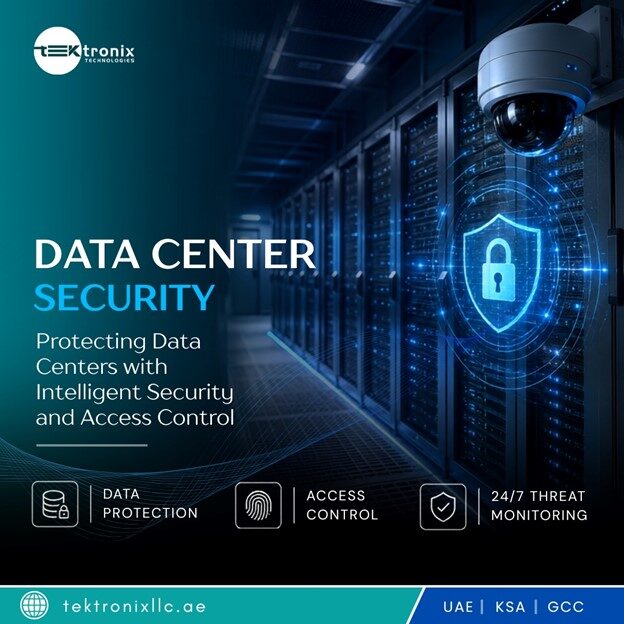
The UAE's data center market has matured quickly, and with that maturity has come a corresponding rise in what "secure" actually means. A facility running the same access control and surveillance setup it installed at launch several years ago is likely falling behind competitors who've continued to invest, even if nothing has technically failed yet.
The Gap Between Basic and Advanced Data Center Security
Basic security checks a box — a badge reader at the door, cameras recording to local storage, a firewall at the network edge. Advanced security treats each of those same components as part of an integrated, actively monitored system that generates evidence, not just deterrence.
That distinction matters increasingly to the people evaluating a facility from the outside. Enterprise tenants conducting security due diligence, auditors reviewing compliance documentation, and insurers assessing risk all now expect to see active, analytics-driven controls rather than a basic checklist of hardware present on-site.
What "Advanced" Actually Means at the Physical Layer
Data Center Access Control Beyond a Simple Badge Reader
Basic Data Center Access Control stops at a card reader granting or denying entry. Advanced implementations add multi-factor verification, individually logged entries, and permission structures that automatically expire or adjust based on role changes, rather than requiring manual updates that are easy to forget.
Data Center Surveillance with Analytics, Not Just Recording
Basic Data Center Surveillance records footage for later review. Advanced surveillance analyses that same footage in real time, flagging loitering or unusual movement the moment it happens rather than only providing evidence after an incident has already occurred.
Data Center Intrusion Detection That Covers More Than the Front Door
Basic Data Center Intrusion Detection covers the main entrance. Advanced deployments extend coverage to roofs, service corridors, and perimeter fencing — the less obvious points a determined intruder is more likely to target precisely because they're less heavily monitored.
Conclusion
The bar for what counts as adequate Data Center Security keeps rising, and facilities that haven't reassessed their setup recently are likely further behind than they realise. Moving from basic to advanced Data Center Access Control, analytics-driven Data Center Surveillance, and perimeter-wide Data Center Intrusion Detection closes physical gaps that determined intruders specifically target. On the network side, robust Cybersecurity for Data Center practices, unconditional Data Center Encryption, segmented Data Center Firewalls, and correlated Data Center Threat Detection close the corresponding digital gaps. As Data Center Security UAE expectations continue climbing — including Data Center Security Dubai competitive tenant markets and Data Center Security Abu Dhabi critical infrastructure standards — every UAE data center operator now has a clear choice: invest in advanced security proactively, or explain the gap to the next tenant, auditor, or insurer who asks.
For more information contact us on:
Tektronix Technology Systems Dubai-Head Office
[email protected]
+971 50 814 4086
+971 55 232 2390
Office No.1E1 Hamarain Center 132 Abu Baker Al Siddique Rd – Deira – Dubai P.O. Box 85955