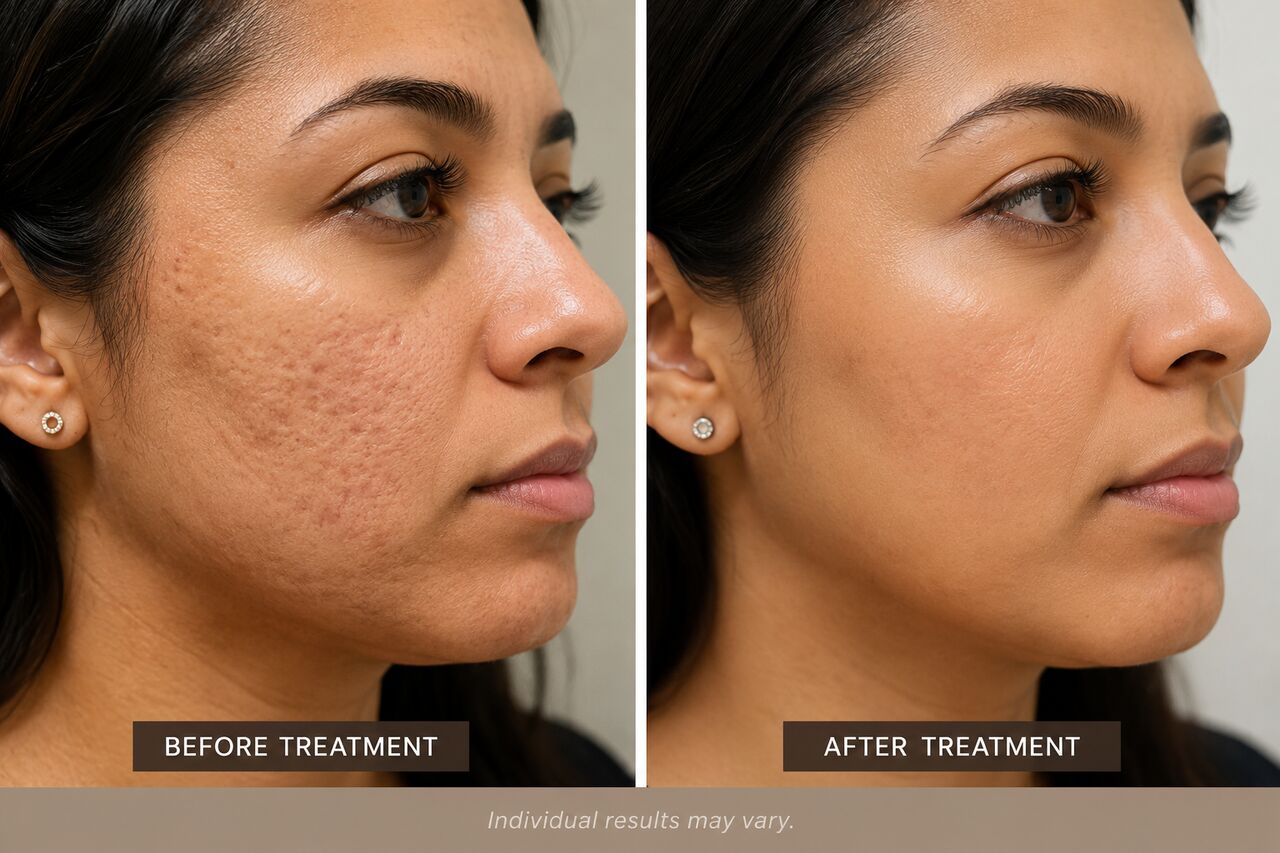
For many people in Dubai, acne doesn't end when the breakouts disappear. The marks left behind can affect skin texture for years, making many wonder why some treatments work well while others produce only modest results.
Why the Same Scar Type Responds Differently Across Individuals
Even when boxcar scars appear similar, treatment outcomes can differ significantly due to individual biological and structural factors that are often overlooked in marketing. Scar tissue varies by body location, such as the forehead versus the cheeks. Areas with better blood circulation often heal faster, which is one reason treatment results can vary from person to person. Factors like age, hormones, nutrition, and smoking habits influence the skin's ability to remodel.
What Happens During the Initial Acne Scar Assessment
Successful acne scar treatment begins with a comprehensive clinical assessment to determine scar type, skin characteristics, and treatment suitability. To determine the most appropriate treatment plan, the following aspects are usually evaluated:
Scar assessment under specialized lighting enables accurate classification of scars into ice pick, boxcar, rolling, or mixed types, which is essential for treatment planning.
Skin elasticity assessment helps determine whether scars are tethered to deeper tissues, which influences whether procedures such as subcision are required.
Your dermatologist also evaluates your skin tone because higher melanin levels can increase the risk of post-treatment pigmentation.
Acne activity assessment – Checking if there is any inflammation to worsen the treatment procedure
Review of medical history – For checking keloid formation, bleeding problems, or drug interactions
The above assessment process determines what treatments will be used. Laser therapy alone is typically ineffective for tethered rolling scars because the underlying fibrous bands that cause the skin depressions remain intact.
Treatment Mechanisms: What Each Modality Actually Does
Understanding how different technologies work clarifies why multiple treatment methods are often combined.
Subcision uses a specialized needle to release the fibrous bands that tether scars to deeper tissues. By releasing the underlying fibrous bands, subcision addresses the structural cause of depressed scars and often delivers better results than treatments that work only on the skin's surface.
Microneedling creates micro-channels in the skin, triggering collagen production and the body's healing response, which fills depressed areas. Adding radiofrequency technology boosts collagen remodeling and tightens the skin.
Fractional lasers create small thermal injury zones that promote healing by stimulating the surrounding healthy tissue and promoting collagen restoration. Ablative lasers resurface the skin by removing thin outer layers, while non-ablative lasers work deeper in the skin without removing the surface. This distinction affects the treatment's effectiveness and recovery time.
Chemical peels are effective for superficial exfoliation and can help with uneven skin texture and post-inflammatory hyperpigmentation. However, they are not recommended as a standalone treatment for deep acne scars.
Fillers help instantly correct the problem by lifting the depressed scar, but only temporarily.
Why Combination Therapy Outperforms Single Approaches
Research has demonstrated that a multi-step approach is significantly more effective than single treatments for atrophic scars. An example may consist of:
Subcision for releasing the adhesions
Fractional laser or RF microneedling for remodeling of the tissue
Injection of filler for instant lift
Timing is crucial in acne scar treatment. It's advised to wait four to six weeks between subcision and laser therapy to prevent excessive swelling and allow for healing. In Dubai, patients should expect the process to take several months. Many believe laser treatment can resolve all scars, but tethered rolling scars often need subcision first for effective results.
The Reality of Downtime and Recovery Across Procedures
Different expectations for recovery depending on the degree of therapy required include:
Microneedling without radiofrequency usually causes mild redness and light skin flaking, which typically resolve within 24 to 48 hours.
Radiofrequency microneedling typically causes temporary redness and pinpoint crusting that resolves within 2–4 days.
Non-ablative fractional laser – Redness and swelling for 2-5 days
Ablative fractional laser – Redness, weeping, and peeling for seven to fourteen days
Chemical peels (medium-depth) – Peeling for three to seven days
Clients should plan for recovery time after skin resurfacing and ensure strict sun protection due to Dubai's intense sunlight. Acne scar treatments are generally safe when performed by qualified and experienced professionals, provided appropriate patient selection and technique are followed. However, potential side effects such as redness, swelling, hyperpigmentation, infection, or prolonged healing can occur, depending on the treatment chosen and the aftercare provided.
Cost Factors Beyond Per-Session Pricing
Cost is another important consideration, but focusing only on the price per session rarely reflects the true investment required for successful acne scar treatment. Per-session costs typically range from a few hundred to over two thousand dirhams, but the total expense depends on the number of sessions needed. In cases of mild scarring, many patients require three to four microneedling sessions. For severe ice pick or boxcar scars, six or more combined treatment sessions may be necessary to achieve optimal results.
It is worth noting that some patients may require regular follow-up sessions after six months or even a year.
Signs of Appropriate Treatment Selection
A thorough clinical assessment is vital for selecting the best treatment for different scar types. Non-tethered rolling scars respond well to microneedling or non-ablative lasers, while tethered scars typically require subcision. Deep ice pick scars may need high-energy ablative lasers or punch excision, and boxcar scars benefit from intensive resurfacing techniques. Clinics offering only one treatment might lack the expertise needed for effective scar management.
FAQs
Q1. When should acne scar treatment begin after active acne?
It is advisable to wait until the acne problem is effectively managed, usually three to six months after the last active breakout, to prevent new irritation.
Q2. Does insurance cover acne scar removal treatments in Dubai?
Acne scar treatments are typically not covered by insurance, as they are classified as cosmetic procedures and are not associated with functional impairment.
Q3. Are laser scar treatments good for darker skin?
Yes—laser scar treatments are safe and effective for darker skin tones, as long as the correct laser wavelength and parameters are carefully selected.
Q4. How much improvement should be expected?
A thirty to seventy percent improvement is