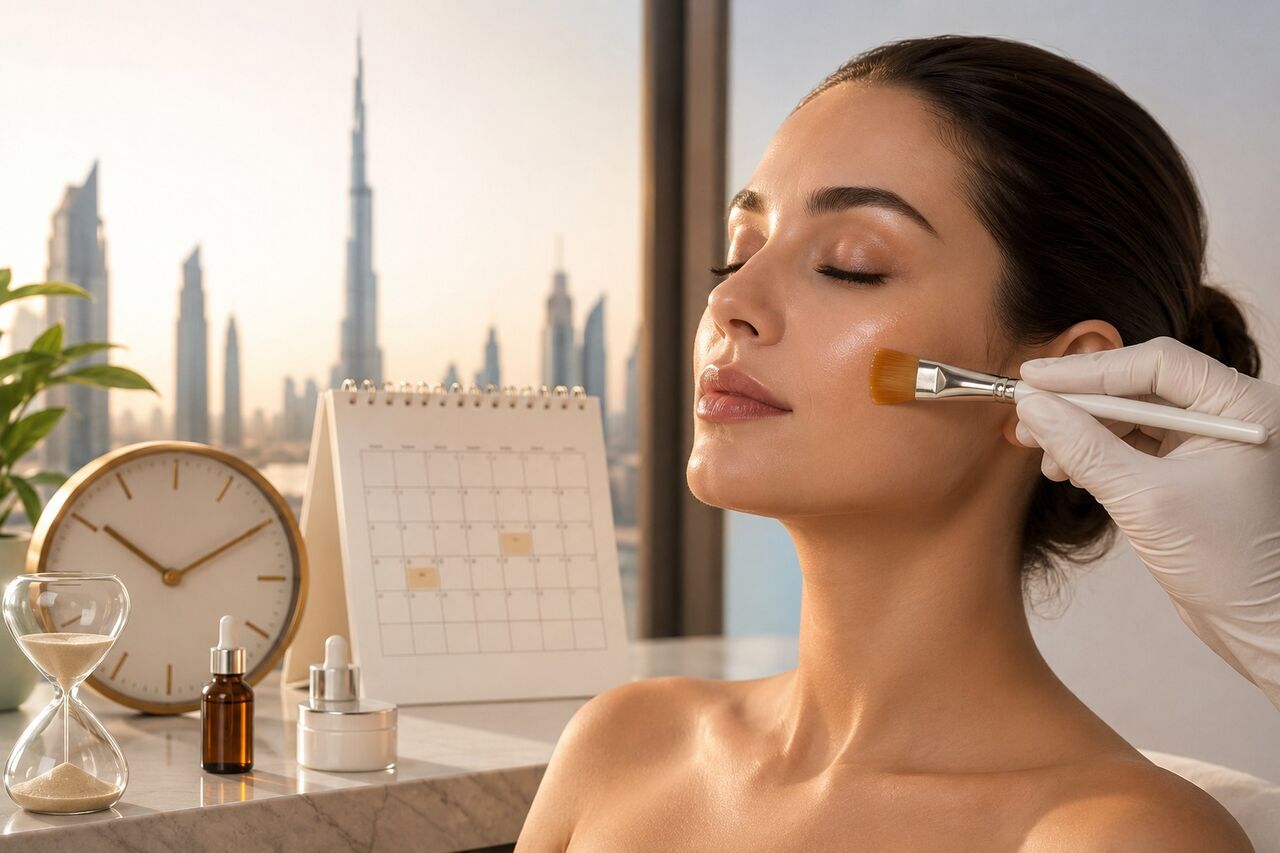
Many people considering chemical peels assume the strongest treatment will always deliver the best results. In reality, especially in Dubai's sunny climate, choosing the right time for treatment is often just as important as selecting the peel itself.
Who Benefits Most from a Chemical Peel in Dubai?
Chemical peels may be particularly beneficial for individuals experiencing:
Dull or tired-looking skin
Mild to moderate pigmentation
Uneven skin texture
Early signs of ageing
Acne marks and post-inflammatory pigmentation
Sun-related skin damage
However, the most appropriate type of peel depends on an individual's skin type, lifestyle, and ability to follow post-treatment care instructions.
Why timing matters more than strength
There is often an assumption that the stronger the peel, the more effective it will be. However, in many cases, treatment timing and consistency have a greater impact on outcomes than the depth of the peel itself. For individuals who cannot take extended time away from work or social activities, superficial and medium-depth peels often provide an excellent balance between results and recovery.
Key timing considerations:
Event-driven schedule: For an upcoming event, a light peel scheduled 3 to 5 days in advance can refresh the complexion with little or no visible peeling. Medium peels involve a recovery period of 7–14 days, during which visible peeling gradually diminishes.
Seasonal planning: Winter, with its lower UV index, is ideal for a series of medium peels, while summer calls for gentler treatments and diligent sun protection.
Because Dubai experiences high levels of sun exposure throughout the year, many practitioners recommend scheduling medium or deeper peels during cooler months, when UV exposure is easier to manage. Individuals who spend significant time outdoors may benefit more from superficial peels that involve minimal recovery time.
Flying and working routine: Frequent travelers should avoid intensive peels right before long flights, as cabin dryness and time zone changes can increase skin irritation. Conversely, a gentle peel after travelling may help restore skin radiance and hydration.
Adapting peels to urban exposures
Urban environments present unique skin challenges, including increased UV exposure, pollution, air-conditioned indoor climates, and airborne particulates. These factors not only contribute to premature aging and pigmentation but may also affect the skin's recovery following resurfacing procedures.
Modifications for Dubai-like stresses:
Pre-conditioning: Using hydrating ingredients before treatment may reduce excessive scaling and irritation after the procedure.
Antioxidant conditioning: Applying topical antioxidants for one to two weeks before treatment may help reduce oxidative stress and support healthy skin recovery.
Restoring the skin’s barrier: Moisturizing agents such as glycerin and hyaluronic acid are essential for maintaining skin hydration and barrier function.
Matching peel chemistry to lifestyle
Different peeling agents are suitable for different skin concerns and lifestyle requirements. Here are some practical combinations:
Glycolic and lactic acids (AHAs): Ideal for maintenance and treating mild pigmentation, these acids are well-suited for those with busy lifestyles, offering gradual improvement with minimal downtime.
Salicylic Acid (BHA): Especially effective for oily or congested skin, salicylic acid can benefit those experiencing breakouts related to pollution, extended mask use, or air-conditioned environments.
TCA blends: Often used to address texture irregularities and pigmentation concerns when sufficient recovery time can be incorporated into the treatment schedule.
Common chemical peel options include superficial peels, medium-depth peels, and deeper resurfacing procedures. The most suitable approach depends on an individual's skin concerns, lifestyle demands, and tolerance for downtime.
Importantly, combination treatments—such as pairing a superficial peel with targeted boosters—can help achieve effective results while accommodating a busy lifestyle.
Realistic expectations and maintenance
Chemical peels should not be viewed as a one-time solution. Peels are most effective when incorporated into a regular skincare regimen. They are designed to support the skin's natural renewal process rather than provide instant or permanent results. Expectations:
Immediate: Skin brightening and increased hydration within a few days.
Short-term (1-3 peels): Texture improvements, line reduction, and improvement of superficial pigmentation.
Long-term: Progressive improvements in skin tone, texture, and pigmentation can be achieved through maintenance treatments performed every few months.
Safety in an area of high ambient UV
High ambient UV levels increase the risk of pigmentation changes following resurfacing procedures. Preventive factors:
Avoid undergoing a peel immediately after significant sun exposure or on recently tanned skin
Apply sunscreen SPF 30-50+ daily and reapply when outside.
Schedule treatments during periods when sun exposure can be effectively minimized. (for example, soon after spending much time indoors or during holidays when there is less time spent outdoors).
Practical pre- and post-care checklist
Pre-treatment care list (7-14 days before treatment)
Discontinue retinoids and other potent active ingredients as recommended by the clinician.
Introduce hydrating ingredients and antioxidants into your skincare routine.
Do not wax, exfoliate aggressively, or use sunbeds.
Post-treatment care list (1st 2 weeks)
Apply a broad-spectrum sunscreen daily and avoid prolonged exposure to the midday sun.
Use gentle cleansers and barrier-repairing moisturizers.
Do not touch peeling skin.
Avoid saunas, steam rooms, intense exercise, and excessive heat exposure for 48 to 72 hours.
When deeper peels make sense
Deeper peels are generally more appropriate for individuals with significant sun damage, deeper pigmentation, or pronounced texture concerns. Individuals with hectic lifestyles may benefit from combination treatments, which can deliver comparable results with minimal disruption to their daily routines.
Who should be careful
Individuals taking medications that increase photosensitivity.
Patients with active skin infections, eczema flare-ups, or significant skin inflammation.
Individuals who cannot follow strict post-treatment sun-protection measures.
People who have recently used isotretinoin should seek professional advice before treatment.
FAQs
Q1. When should I book a peel before the event?
A light peel is usually best scheduled three to five days before an event. Medium-depth peels require a recovery period of 7 to 14 days.
Q2. Is traveling after a peel possible?
Light peels are generally compatible with travel, provided that proper hydration and sun protection are maintained. After a medium or deep peel, it’s best to avoid long journe