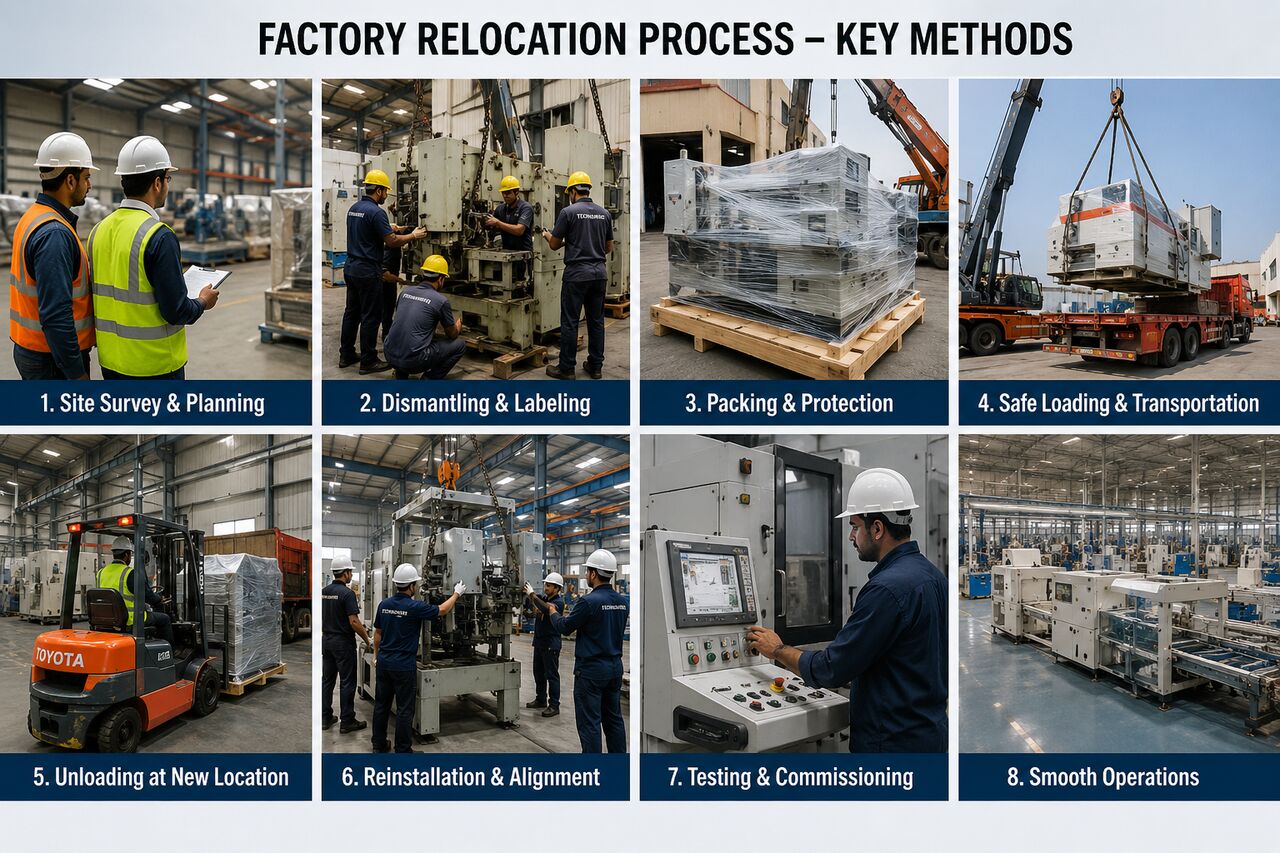
Factory relocation is a complex process that requires careful planning, technical expertise, and precise execution to minimize operational, financial, and logistical risks. The process requires the careful dismantling, transportation, and reinstallation of heavy machinery and production lines, where even minor errors can lead to costly disruptions and extended downtime. In Dubai, where industrial development and manufacturing activities continue to expand, the expertise of experienced factory relocation contractors is essential to ensure a safe, efficient, and compliant transition.
The Factory Relocation Lifecycle
Factory relocation involves far more than transporting machinery from one location to another. It is a highly engineered process that requires meticulous planning, technical expertise, and precise execution across multiple phases.
1. Pre-Relocation Planning and Auditing
Any equipment movement requires an initial audit. At this stage, contractors evaluate the receiving facility's floor load capacity, ceiling height, utility infrastructure, equipment access routes, and regulatory requirements. They also verify the accuracy of layout drawings. During this stage, it is important to evaluate the receiving facility for its capacity, ceiling height, utility presence, and other aspects that could be required by authorities, e.g., Dubai Municipality. Risk assessment is a critical component of the planning phase, enabling businesses to identify operational, logistical, financial, and supply chain risks before the move begins. The risk assessment for the production transfer framework is a way of identifying risks associated with the transfer object, the receiver, supplier relations, and profits.
2. Controlled Dismantling and Documentation
The dismantling phase requires exceptional precision and careful coordination to ensure all systems can be reassembled without errors. Experienced engineers and technicians systematically dismantle machinery while documenting every component, utility connection, and alignment point. All cables, pipes, and sensors are systematically tagged and documented to ensure error-free installation. Take note of the following tasks:
Tagging and Photographic Recording: Making sure to tag all the connection points and wires.
Disassembly Process: Typically, the production line is dismantled in a carefully planned sequence, enabling select operations to continue uninterrupted.
Critical Spare Parts: Ensuring that the critical spare parts are included in the packing process.
3. Specialized Packing and Transportation
Industrial machinery requires specialized logistics solutions that go far beyond conventional transportation methods. Contractors utilize custom-designed wooden crates, anti-vibration packaging systems, and moisture-resistant materials to protect equipment during transportation.
Climate-Controlled Transport: Where temperature-sensitive items such as electronics and PLCs are concerned.
Specialized Lifting Equipment: Including crane lifts and flatbed trucks equipped with RTA permits for transporting oversized cargo.
Vibration Testing: Where shock gauges are fitted on sensitive machines.
4. Reinstallation and Precision Alignment
In the new location, the pictures and documents gathered during dismantling form the template for installation. Reinstallation is typically performed in the reverse order of the dismantling sequence to ensure efficient and accurate reconstruction of the production line. For industries requiring micron-level tolerances, such as CNC machining and semiconductor manufacturing, contractors rely on laser alignment systems to achieve the highest precision. The relocation process also provides an opportunity to optimize the factory layout, improve material flow, and enhance operational efficiency.
5. Testing, Calibration, and Commissioning
The final stage of factory relocation focuses on testing, calibration, and commissioning to ensure every system operates safely, accurately, and at peak performance before production resumes. Before full-scale production resumes, every system undergoes comprehensive inspections and performance testing to ensure it operates at the same or an improved level of efficiency. This usually involves the following procedures:
Utility Check: To confirm whether all the utilities (power, water, compressed air, gas) have been correctly installed and are working.
Motor Rotation and Signal Tests: Verifying correct motor rotation and ensuring all signals are functioning as intended.
Re-Calibration: To ensure that all machines are calibrated correctly and produce high-quality products.
Commissioning: To conduct load tests on the system and increase production gradually.
The Consequences of Poor Planning
Relocation of factories is a high-risk process. The outcomes of failure in planning may be serious and will include the following:
Financial Losses: Unplanned downtime can result in significant production losses, missed delivery deadlines, and increased operational expenses.
Damage to Equipment: Improper handling, inadequate packing, or incorrect lifting techniques during relocation can result in costly damage to high-value industrial machinery and extended production downtime.
Regulatory and Compliance Issues: Failure to obtain required permits or comply with safety standards set by authorities such as Dubai Municipality and Trakhees can halt operations and lead to significant financial penalties.
Business Disruption and Reputational Damage: Production delays and service interruptions can weaken customer relationships, lead to contract losses, and negatively impact brand reputation.
Tekzone's Approach to Factory Relocation
Selecting an experienced factory relocation partner is essential for minimizing risks and ensuring a smooth, efficient transition. Tekzone is renowned for its expertise in industrial relocation and its engineering-driven approach to every project. This engineering-driven approach helps businesses minimize operational risks, reduce downtime, and ensure a smooth transition to the new facility.
Pre-Move Audit: This involves a comprehensive evaluation of all equipment and systems to identify critical components and potential issues.
Dismantling and Reassembly: This involves a well-documented, step-by-step process.
Compliance with Standards: Adherence to all local regulations, including requirements set by Dubai Municipality and free zone authorities.
Project Management: End-to-end coordination of planning, dismantling, transportation, installation, and commissioning activities.
The engagement of the industrial relocation company will provide businesses with a chance to convert a challenging logistics process into a business advantage by ensuring a smooth resumption of activities without any risks to the budget.
FAQs
Q1. What are the potential dangers associated with improper planning when relocating a plant?
The dangers include downtime, costly machinery damage, non-compliance with regulations that results in penalties, lawsuits against suppliers, and damage to your company's reputation among your clientele.