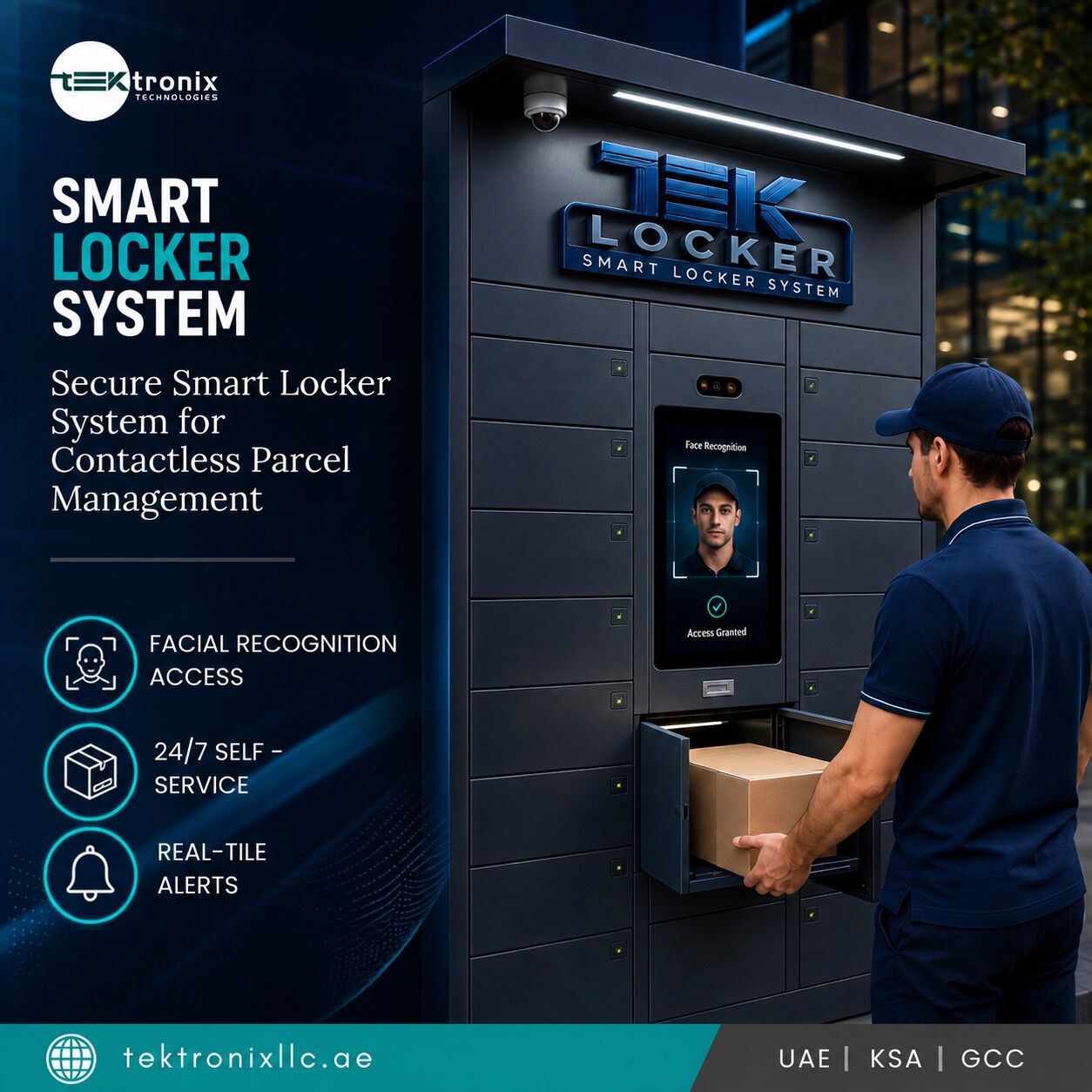
The UAE’s position as a global hub for tourism, trade, and government-delivered services creates a uniquely diverse user population. A locker bank installed at Dubai International Airport Terminal 3 must accommodate Emirati nationals authenticating with their Emirates ID, international business travellers preferring QR code redemption from a booking confirmation email, and airport staff using biometric credentials registered in the HR system. A single-method locker that serves only one of these groups creates queues, frustration, and operational inefficiency. The TekLocker platform by Tektronix LLC is engineered from the ground up to eliminate this constraint, offering every access modality on a single unit — allowing institutions to deploy one hardware standard across every use case rather than managing multiple incompatible locker ecosystems.
UAE federal and emirate-level government initiatives reinforce this direction. The UAE Digital Government Strategy 2025 mandates contactless, digitally enabled service delivery across all public touchpoints. The Smart Dubai initiative and Abu Dhabi’s Department of Government Enablement (DGE) digital transformation programmes both explicitly prioritise self-service, app-enabled infrastructure that reduces dependence on attended service counters. A multi-modal intelligent locker is not simply a storage convenience — it is a physical node in the UAE’s broader smart city and digital government ecosystem.
Face Recognition Locker Access: Biometric Security Without Contact
Of all available authentication modalities, biometric verification delivers the highest level of identity assurance. Face Recognition Locker Access uses an embedded AI-powered camera with liveness detection to verify a user’s identity in under one second, with false acceptance rates below 0.001% — a security threshold that exceeds card-based and PIN-based systems by orders of magnitude. Liveness detection algorithms distinguish a live face from a photograph, video replay, or 3D mask, preventing spoofing attacks that could compromise high-value storage environments such as evidence lockers in UAE police facilities, pharmaceutical sample storage in hospital research units, or confidential document lockers in DIFC law firms.
For UAE government and critical infrastructure deployments, face recognition locker access aligns with the national biometric identity framework administered by the Federal Authority for Identity, Citizenship, Customs and Ports Security (ICP). Users can be enrolled during onboarding at HR or visitor management touchpoints, with facial templates stored in encrypted form — either on-device for air-gapped security environments or in the cloud for enterprise-wide identity federation. Crucially, TekLocker’s biometric processing is fully compliant with the UAE Personal Data Protection Law (PDPL, Federal Decree-Law No. 45 of 2021), which classifies biometric data as sensitive personal data requiring explicit consent, purpose limitation, and secure processing controls.
QR Code Smart Locker Access: Frictionless Redemption for Every User
Not every use case demands biometric authentication. For retail parcel collection, event cloakrooms, co-working day-pass storage, and visitor locker banks, speed and simplicity of access matter more than the highest-assurance identity verification. QR Code Smart Locker Access delivers exactly this: a unique, time-limited QR code is generated and dispatched to the user’s email or mobile phone at the point of reservation — whether through a mobile app, a web portal, a property management system, or an integrated kiosk — and scanned at the locker unit’s integrated barcode reader to release the assigned compartment instantly.
QR code tokens are cryptographically signed and time-bounded, expiring automatically at the end of the reserved session to prevent reuse. For high-throughput environments such as mall parcel collection points in Dubai Mall or Yas Mall, or baggage storage at Abu Dhabi Cruise Terminal, the QR modality eliminates the need for users to remember PINs, carry physical cards, or interact with any staff member — reducing average collection time to under fifteen seconds and enabling the locker bank to handle peak demand volumes without service degradation.
OTP Secure Locker Access: Dynamic Credentials Over Any Channel
One-time password authentication combines the universality of SMS delivery with the time-bounded security of dynamic credentials. OTP Secure Locker Access is the modality of choice for deployments where users cannot be pre-enrolled biometrically and do not have a smartphone application installed — making it the most inclusive access method for walk-up, unregistered users. When a user requests locker access through a web portal, interactive kiosk, or call centre agent, a six-digit OTP is generated and delivered via SMS to the registered mobile number. The code is valid for a configurable window — typically five to fifteen minutes — after which it expires and cannot be reused, even if intercepted.
In UAE government service centres — Amer centres, Tasheel offices, typing centres, and Federal Authority for Nuclear Regulation (FANR) document submission facilities — OTP locker access provides citizens and residents with a familiar, low-friction mechanism to collect completed documents from a self-service locker without requiring face-to-face handover with a government employee. This directly supports the UAE’s target of delivering 100% of government services digitally and the Ministry of Human Resources and Emiratisation (MOHRE) strategy of reducing counter attendance requirements across labour and immigration services.
National ID Locker Authentication: Trusted Identity for UAE Residents
The Emirates ID — issued by the Federal Authority for Identity, Citizenship, Customs and Ports Security (ICP) and carried by every UAE resident — is one of the most trusted identity documents in the GCC, embedding a chip that stores the cardholder’s verified biographic and biometric data. National ID Locker Authentication leverages this existing trusted credential by integrating a certified smart card reader into the locker kiosk panel, allowing any UAE resident to tap their Emirates ID to authenticate locker access without prior enrolment in a separate system.
For public sector deployments — court complexes, health authority buildings, municipalities, land department offices, and the General Directorate of Residency and Foreigners Affairs (GDRFA) service halls across Dubai, Abu Dhabi, and Sharjah — Emirates ID authentication provides an audit trail that is legally attributable to a specific verified individual, satisfying the evidentiary requirements that government agencies need to maintain chain-of-custody records for documents stored in or retrieved from lockers. The modality also accommodates GCC national ID cards from Saudi Arabia, Qatar, Kuwait, Bahrain, and Oman, making the system natively inclusive for the large GCC expatriate professional community working across UAE free zones and financial districts.
Smart Locker UAE: Deployment Environments and Use Cases
The versatility of TekLocker’s multi-modal authent