For years, “getting veneers” meant one look: bright, blocky, and unmistakably white. It was dramatic, it photographed well from a distance, and it became a kind of visual shorthand for “I had cosmetic dental work done.” That's exactly the problem. As more people spend their days on video calls and in front of phone cameras, a smile that reads as artificial up close has started working against the confidence it was supposed to build.
The Trouble With the Old Hollywood-White Look
Uniform veneers were designed to be seen from a stage or a magazine cover, not a Zoom window three feet from your face. At that distance, the flatness shows: real enamel has subtle color gradients, slight translucency near the edges, and small variations between teeth that our eyes read as natural without consciously noticing. Remove all of that variation and the brain picks up on it immediately, even if it can't articulate why a smile looks “off.”
There's also a durability issue nobody talks about enough: older veneer techniques required removing a significant amount of natural enamel to fit a thick, opaque shell. That's a permanent trade-off, and it's part of why so many patients approach veneers cautiously - the results were dramatic, but the process wasn't reversible.
For more dental suggestion:
https://pikedistrictsmiles. ...
What “Perfectly Imperfect” Actually Means
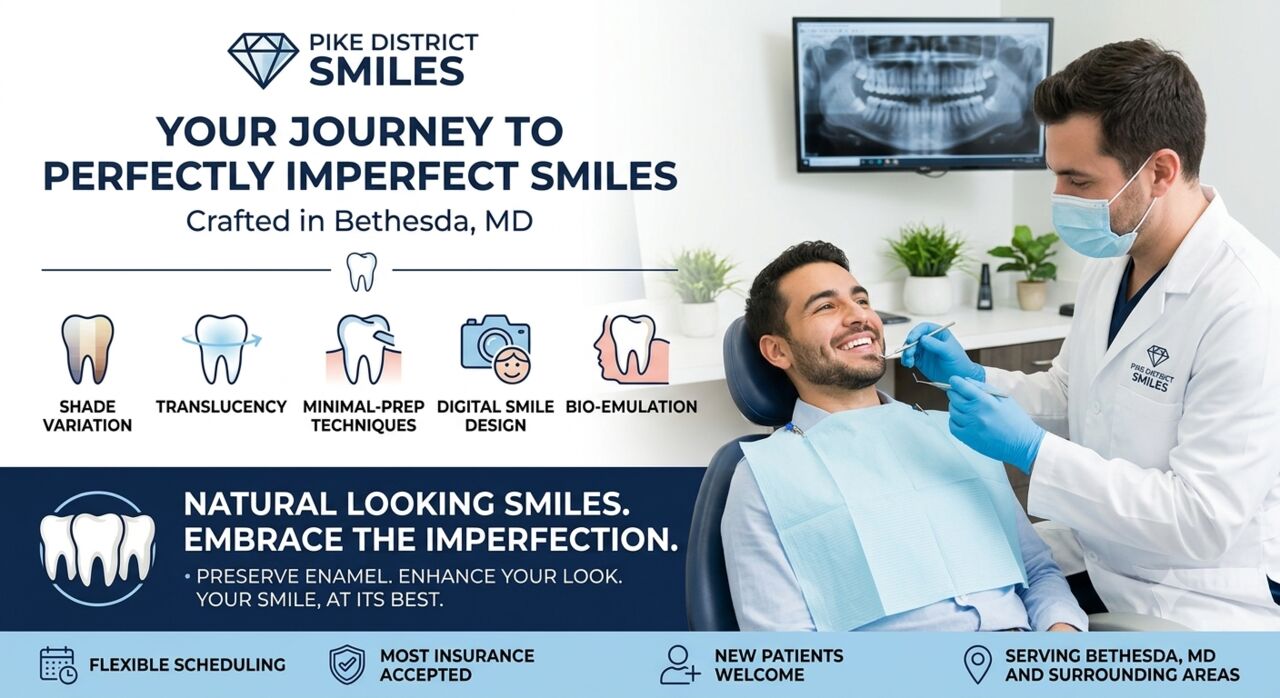
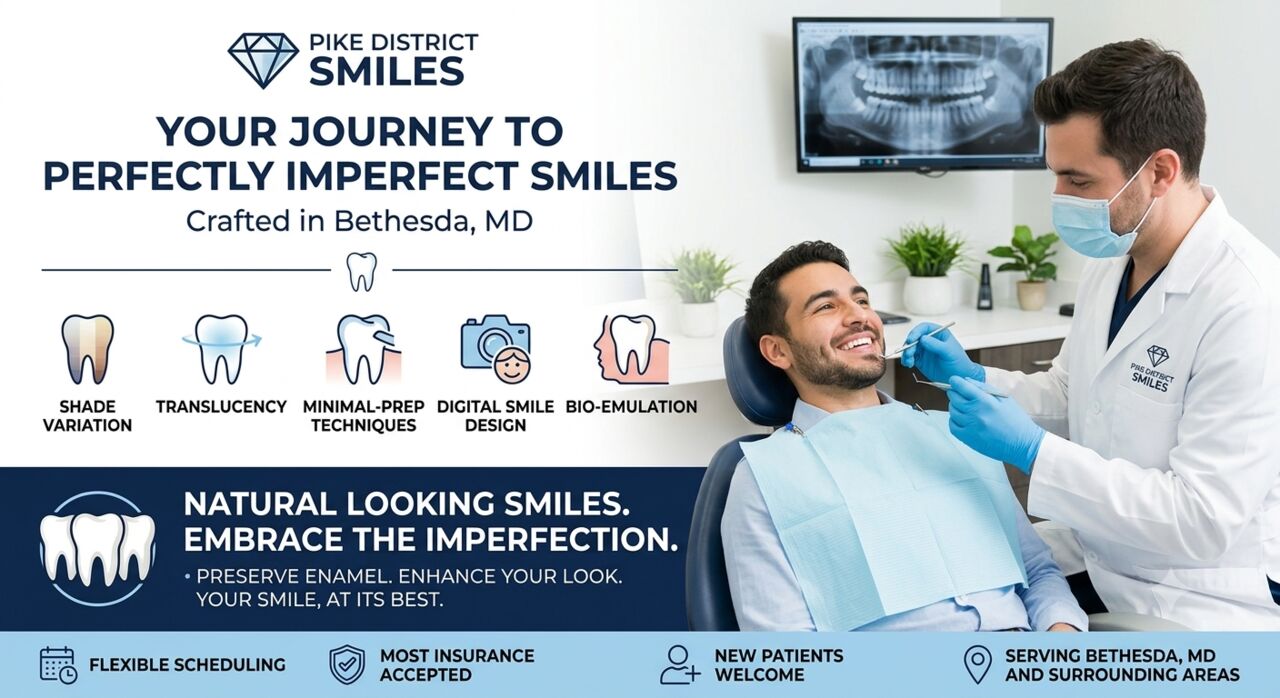
The current approach, sometimes called bio-emulation, starts from the opposite premise: match the restoration to the patient's natural teeth, age, and facial features rather than replacing them with a generic ideal. In practice, that means:
Shade variation between individual teeth instead of one flat color across the whole arch.
Translucency at the edges so light passes through the tooth the way it does with real enamel, instead of reflecting off a solid surface.
Minimal-prep or no-prep techniques that preserve more of the natural tooth underneath, which matters both aesthetically and for long-term oral health.
A cosmetic dentist Bethesda MD patients see for this kind of work will typically start with digital smile design - photographing and scanning your existing smile, then building the proposed changes on top of your actual facial proportions rather than a stock template. You see the result before any tooth is touched, which also means fewer surprises and fewer redos.
For more dental suggestion:
https://pikedistrictsmiles. ...
Why the Shift Is Happening Now
Two things converged to make this the moment for naturalism in cosmetic dentistry. First, ceramic and composite materials have genuinely improved - newer options mimic the light-reflecting properties of real enamel in a way older porcelain couldn't, so “natural-looking” stopped being a compromise and became achievable without sacrificing durability. Second, patients simply see their own faces more than any generation before them, between video calls, selfies, and social media, and that constant self-viewing has made subtle imperfections in cosmetic work far more noticeable than they used to be.
The result is that a Bethesda cosmetic dentist fielding consultations today hears a very different request than the same practice heard ten years ago: not “make it as white as possible,” but “make it look like it was never done at all.”
Is This Approach Right for You?
Naturalism isn't a downgrade from the dramatic Hollywood look - it's a different goal entirely, and it tends to suit most patients better in daily life. If your priority is a visible, camera-ready transformation for a single event, the traditional approach still has a place. But for anyone who wants results that hold up under the scrutiny of a laptop camera every day, hold up over years without looking dated, and preserve more of their natural tooth structure, a consultation with a cosmetic dentist in Bethesda, MD who works in minimal-prep, shade-matched veneers is worth the conversation before committing to anything more dramatic.
For more dental suggestion:
https://pikedistrictsmiles. ...
Frequently Asked Questions
Do “perfectly imperfect” veneers cost more than traditional veneers?
Pricing is typically comparable and depends more on the number of teeth treated and the lab's craftsmanship than on the aesthetic style chosen. The bigger cost difference usually comes down to material quality and whether the case requires minimal-prep versus traditional preparation.
Will natural-looking veneers still look white enough?
Yes - the shade is still brighter than most patients' natural teeth, just not flat or uniform. The goal is a shade and translucency that reads as “your teeth, at their best,” rather than a visibly different material sitting on top of them.
How do I know if I'm a candidate for minimal-prep veneers specifically?
It depends on your current tooth alignment, shape, and the amount of correction needed. A consultation with digital imaging is the only reliable way to know - patients with significant misalignment or damage may still need traditional veneers or a combination approach.
For more dental suggestion:
https://pikedistrictsmiles. ...