Healthcare access control carries a distinct weight compared to almost any other sector. A corporate office managing a security lapse typically faces a financial or reputational cost. A hospital managing an access control failure risks patient safety directly — an unauthorised individual reaching a controlled substance store, a maternity ward, or a restricted clinical area carries consequences that go well beyond what a typical commercial security incident involves. That elevated stakes profile is reshaping how UAE healthcare facilities specify access control, with facial recognition increasingly viewed as the appropriate response rather than a premium add-on.
Why Healthcare Facilities Need a Different Standard of Access Verification
Card-based access control in a hospital setting carries a specific, well-documented weakness: credential sharing among busy clinical staff during a hectic shift, particularly when a colleague is genuinely rushing between patients and simply borrows a badge rather than tracking down their own misplaced one. That informal sharing, while rarely malicious, quietly undermines the entire audit trail a hospital's access control system is meant to provide.
Facial recognition removes that vulnerability structurally rather than relying on staff discipline alone. A face cannot be lent to a colleague running late, cannot be left behind in a locker, and ties every single access event unambiguously back to the specific individual who actually passed through that door — a meaningfully stronger audit trail than any card-based system can offer, regardless of staff intentions.
The Touchless Advantage in Clinical Environments
Beyond the security case, touchless verification carries a genuine infection control benefit specific to healthcare settings. A shared card reader touched by dozens of staff throughout a shift represents a contact surface that facial recognition eliminates entirely, removing one small but real vector in a hospital's broader infection prevention protocol.
This benefit gained particular attention following heightened global awareness of infection control following recent public health experiences, and many UAE healthcare facilities now specifically evaluate touchless access as a genuine clinical consideration rather than purely a convenience feature, reflecting a broader shift in how hospital infrastructure decisions weigh infection prevention alongside traditional security criteria.
How HID Amico Secures Sensitive Healthcare Zones
HID Amico Facial Recognition for Clinical Staff Verification
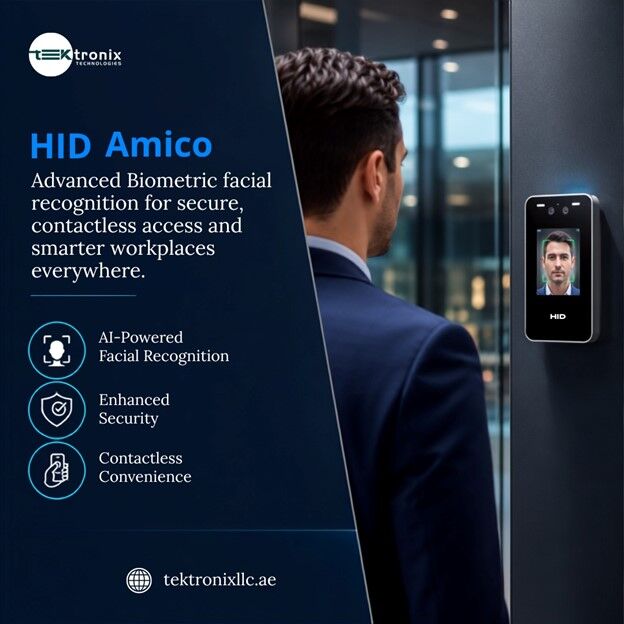
At the centre of the platform, HID Amico Facial Recognition verifies clinical staff identity in real time at ward entrances, pharmacy doors, and restricted treatment areas, matching a face against an enrolled profile within a fraction of a second without requiring a busy nurse or physician to stop and interact with a reader mid-shift.
HID Amico Facial Recognition Reader Built for Infection Control Environments
The physical HID Amico Facial Recognition Reader is suited to clinical deployment through housing designed to withstand frequent disinfection protocols, maintaining reliable recognition performance even as the unit undergoes the same rigorous cleaning cycles applied throughout the rest of a hospital environment.
HID Aero Controller for Coordinated Hospital-Wide Door Management
Behind the reader, the HID Aero Controller manages door logic and credential validation across a hospital's often sprawling, multi-building layout, giving security and facilities teams unified visibility over every controlled door from a single management platform rather than fragmented, building-by-building oversight.
Conclusion
Healthcare access control carries a weight few other sectors face, and HID Amico addresses that reality directly rather than treating hospitals as just another commercial deployment. HID Amico Facial Recognition and an infection-control-appropriate HID Amico Facial Recognition Reader verify clinical staff reliably, while the HID Aero Controller coordinates access across a hospital's often sprawling, multi-building footprint. Broader HID Access Control secures pharmacies and controlled substance storage, and HID Mobile Access simplifies credential management for clinical staff rotating across multiple facilities. AI-Powered Anti-Spoofing and Liveness Detection protect against fraud in an environment where the consequences genuinely matter more than in most other sectors. As HID Amico UAE adoption grows across healthcare — including HID Amico Dubai DHA-regulated facilities and HID Amico Abu Dhabi DOH-regulated deployments — hospitals that invest in genuinely healthcare-appropriate access control now protect both patient safety and institutional trust.
For more information contact us on:
Tektronix Technology Systems Dubai-Head Office
[email protected]
+971 50 814 4086
+971 55 232 2390
Office No.1E1 Hamarain Center 132 Abu Baker Al Siddique Rd – Deira – Dubai P.O. Box 85955