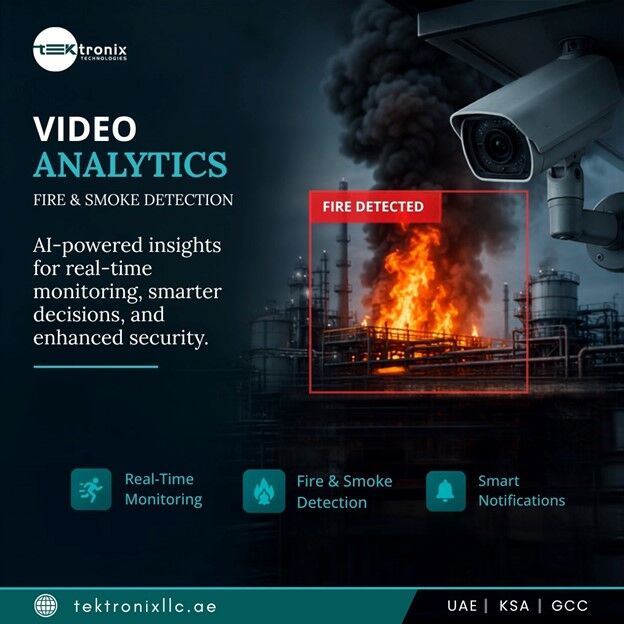
Tektronix LLC brings this next-generation detection capability to UAE hospitals through deep integration expertise and a regional deployment track record across Dubai's and Abu Dhabi's most demanding healthcare environments. Explore our video analytics solutions for UAE hospitals and healthcare facilities and discover how AI-driven fire and smoke detection protects every patient, every ward, and every critical clinical zone in your facility.
Why Traditional Fire Detection Falls Short in UAE Hospital Environments
UAE hospital fire safety standards — governed by Dubai Civil Defence (DCD) for Dubai facilities and Abu Dhabi Civil Defence Authority (ADCDA) for Abu Dhabi — mandate fire detection, alarm, and suppression systems across every licensed healthcare facility as a baseline building code requirement. The UAE Fire and Life Safety Code of Practice (DCD Technical Guideline TG-002) specifies detection, notification, and suppression standards that every new hospital must satisfy before licensing and every existing facility must maintain to retain its operating licence. These standards are comprehensive and non-negotiable — but they were written for conventional point-detection technology: ionisation detectors, photoelectric smoke detectors, heat sensors, and linear beam detectors that respond to the physical arrival of combustion products at the sensor element itself.
The fundamental limitation of point detection in a hospital setting is the delay between ignition and alarm. A photoelectric smoke detector mounted on a ceiling in a hospital corridor detects smoke when smoke particles reach it — by which time the fire source may already be producing combustion gases and radiant heat that are affecting the clinical environment below. In a general office this delay is inconvenient. In a hospital bay containing non-ambulatory patients on oxygen therapy, or in an operating theatre where the surgeon cannot pause mid-procedure at the first whiff of smoke, that delay is potentially catastrophic. AI-powered video fire and smoke detection identifies the visual signatures of incipient combustion — the earliest wisps of smoke, the first glow of a developing flame, the thermal radiation plume visible to infrared cameras before any particle concentration is detectable — and initiates the response chain at that earlier moment, providing the additional minutes that make the difference between a controlled clinical evacuation and an uncontrolled emergency.
How AI-Powered Video Analytics Detects Fire and Smoke in Hospital Environments
Tektronix LLC's AI-Powered Video Analytics platform continuously processes every monitored camera feed using deep learning models trained specifically on fire and smoke visual signatures across the full range of healthcare facility environments — hospital corridors, clinical ward bays, pharmacy storage areas, operating theatre suites, central sterile services departments, kitchen and catering areas, plant rooms, and electrical infrastructure rooms. The AI models distinguish between genuine fire and smoke signatures and the visual phenomena that generate false alarms in hospital environments: steam from autoclaves and sterilisation equipment, vapour from clinical humidifiers, dust disturbed during maintenance works, condensation from air conditioning diffusers near cameras, and the visual noise generated by high-traffic corridor environments where people, equipment, and trolleys create constant movement.
This contextual intelligence is what makes AI video detection fundamentally different from motion-triggered video analytics or simple pixel-change detection, which treat any visual change as a potential alarm and generate the alert volumes that cause security and facilities teams to develop the alert fatigue that defeats the purpose of an automated detection system. The deep learning models analyse flame flicker characteristics, smoke plume behaviour, temporal spread patterns, and colour spectrum signatures that distinguish genuine combustion events from environmental false triggers with documented accuracy that Tektronix LLC's hospital deployments consistently demonstrate across Dubai and Abu Dhabi's diverse healthcare facility environments.
Core Platform Capabilities for Hospital Fire Safety
Video Analytics Software: Processing Every Camera Feed Simultaneously
Tektronix LLC's Video Analytics Software processes every connected camera feed in real time — simultaneously, continuously, and without the attention degradation that affects human monitoring of multi-screen surveillance systems after sustained periods of vigilance. For a large UAE hospital with several hundred cameras covering wards, corridors, plant rooms, car parks, and specialist clinical departments, the software maintains full analytical attention on every feed around the clock, applying fire and smoke detection models alongside the facility's other video analytics applications — intruder detection, access control verification, equipment movement monitoring, and patient safety analytics — from a single unified platform. The software's processing architecture is optimised for hospital network infrastructure, using edge-processing capability where available to reduce bandwidth requirements and ensure that detection latency remains below the five-second threshold required for the earliest possible alarm initiation.
Conclusion
UAE hospitals cannot afford to rely solely on conventional fire detection technology when the patients in their care cannot self-evacuate and when every additional minute of early warning represents a measurable reduction in clinical risk. Tektronix LLC's AI-driven Video Analytics platform addresses that gap definitively — delivering visual fire and smoke detection that responds to incipient combustion signatures before any particle or heat sensor would register a threshold crossing. The platform's continuously processing AI-Powered Video Analytics engine and intelligent Video Analytics Software give hospital security operations teams the earliest possible visual confirmation of a developing fire event, while proven Video Analytics Solutions architecture ensures every detection trigger flows through a fully co-ordinated Automated Emergency Response sequence without human relay delay. The result is Real-Time Hazard Detection that initiates the clinical protection response minutes earlier than co