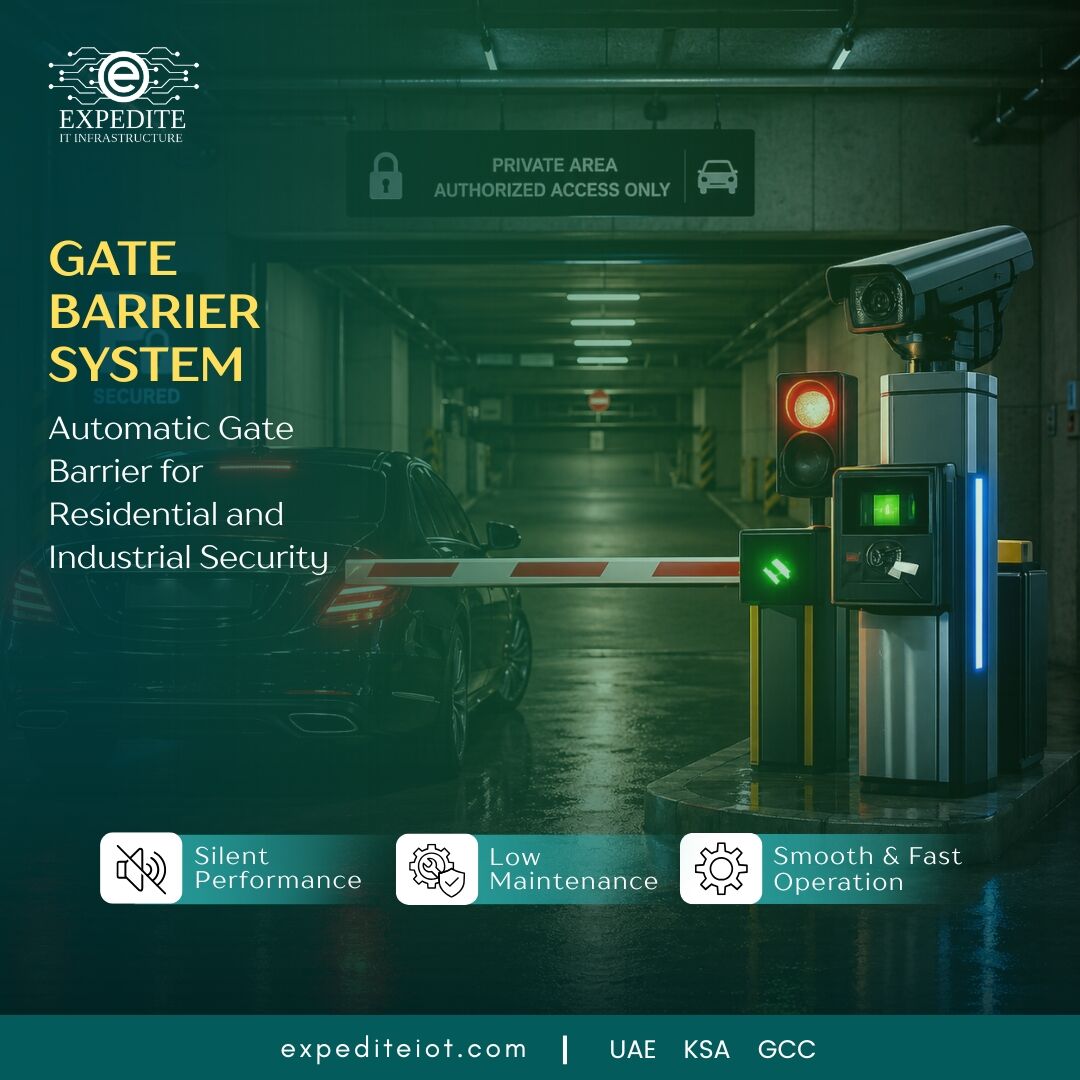
Intelligent Gate Barriers differentiate Expedite IoT’s platform from commodity hardware suppliers through the depth of connectivity and analytical capability embedded in every installation. Each barrier controller connects to Expedite IoT’s cloud-based access management platform via encrypted MQTT and HTTPS protocols, enabling real-time remote monitoring, configuration, and override from any authorised device regardless of geographic location. IoT telemetry streams include barrier operational state, vehicle detector loop status, motor health metrics, power supply voltage, and environmental sensor readings — all fed into a centralised dashboard that provides facilities managers with live situational awareness across every vehicle access point simultaneously. Predictive maintenance algorithms analyse motor cycle count and current draw trends to generate maintenance alerts before mechanical failure occurs, reducing unplanned downtime to near zero across Expedite IoT’s managed service client base. For multi-site operators such as pan-Bahrain retail chains, hospital groups, or government ministry networks, this connected intelligence capability translates directly into reduced operational costs, faster incident response, and demonstrable compliance with the access control audit requirements of the Information and eGovernment Authority (iGA) and the Central Bank of Bahrain (CBB) operational risk frameworks.
Expedite IoT’s Boom Barrier System range is engineered for the high-cycle demands of corporate car parks, residential compound entries, and commercial loading bay access points where barrier arms operate hundreds of times per day across multi-year service lives. Our boom barriers utilise brushless DC motors with precision counterbalance mechanisms, achieving arm rise-and-fall cycles in as little as 1.5 seconds while maintaining smooth, jolt-free motion that extends mechanical component life beyond 10 million operational cycles without major servicing. Boom arm lengths from 3 metres to 6 metres accommodate single-lane to dual-carriageway entry configurations, with articulated arm options available for installations where overhead clearance constraints exist. Integration with license plate recognition (LPR) cameras, RFID long-range readers, and intercom units enables fully automated vehicle identification and access decisions at barrier approach speeds, eliminating the queuing that degrades user experience and undermines the credibility of access control programmes. LED-illuminated boom arms with retro-reflective banding ensure visibility in Bahrain’s low-light early morning and evening peak periods, reducing vehicle contact incidents and the associated maintenance costs.
Toll Gate Barriers serve a dual function in corporate and institutional environments: enforcing vehicle access authorisation and capturing the transactional data required for parking revenue management, fleet cost allocation, and contractor vehicle billing. Expedite IoT’s toll barrier configurations integrate with cashless payment terminals accepting Benefit Pay, Apple Pay, and card payments, enabling paid parking programmes at commercial developments, hospital visitor car parks, and airport ground transport zones to operate without cash handling infrastructure or manned booth staffing. For large industrial facilities such as Khalifa Bin Salman Port’s logistics campus and the Bahrain Logistics Zone, toll gate integration with fleet management systems enables precise measurement of contractor vehicle dwell times, facilitating accurate billing, turnaround time KPI tracking, and capacity utilisation reporting that supports both commercial and operational management objectives. All transaction data is encrypted in transit and at rest in compliance with Bahrain’s Personal Data Protection Law (PDPL) and Payment Card Industry Data Security Standards (PCI-DSS).
Urban corporate facilities across Manama face increasing pressure to maximise parking space utilisation efficiency as land values rise and vehicle populations grow. Expedite IoT’s Parking Gate Barriers are deployed as the enforcement layer in comprehensive Parking Guidance Systems (PGS) that combine barrier entry and exit control with ultrasonic bay occupancy sensors and dynamic signage to guide drivers directly to available spaces, reducing average parking search time by up to 40 percent and cutting the vehicle circulation traffic that contributes to car park congestion during peak periods. Barrier integration with occupancy data enables automatic capacity management — closing entry lanes when a car park reaches a configurable occupancy threshold and reopening them dynamically as spaces become available — eliminating the frustration of drivers entering a full facility. For the Seef Mall complex, Bahrain City Centre, and comparable mixed-use developments in Manama’s urban core, this intelligent capacity management capability directly supports the quality visitor experience that anchor tenants and property managers prioritise as a competitive differentiator.
Bollards address a threat category that conventional barrier arms cannot: deliberate vehicle ramming attacks against pedestrian zones, building facades, or critical infrastructure perimeters. Expedite IoT supplies both fixed and retractable hydraulic bollard systems tested to PAS 68 and IWA 14-1 impact test standards, confirming their rated resistance to vehicle impacts at specified speeds and masses. Fixed bollards are deployed as permanent perimeter hardening at government ministry buildings, central bank facilities, embassy compounds, and critical infrastructure sites across Manama where vehicle-borne threat assessments identify an elevated risk profile. Retractable hydraulic bollards provide the flexibility to enforce vehicle exclusion zones during specified periods — such as pedestrian market days in Manama’s heritage Bab Al Bahrain precinct or public events at the Bahrain International Circuit — while permitting authorised vehicle access at other times without the visual intrusion of permanent fixed infrastructure. All bollard installations are designed in coordination with Bahrain Civil Defence Directorate requirements for emergency vehicle access clearance, ensuring that life safety response routes are preserved within any anti-vehicle perimeter configuration.
Effective vehicle access control is not a peripheral security concern — it is the outermost layer of a corporate facility’s integrated