Why UAE Government Facilities Are Moving to Facial-First Access Control
Card credentials share a structural weakness that no amount of encryption fixes: they can be lent, lost, or copied, and the reader has no way of knowing whether the person holding the card is the person it was issued to. For a municipal office this is an inconvenience; for a judicial complex, a police headquarters, or a federal ministry archive, it is a genuine security gap. Facial recognition closes that gap by tying access directly to a biometric trait rather than a physical token, and the UAE's public sector — already operating under SIRA licensing requirements and NCEMA's guidance on critical infrastructure — is increasingly specifying this class of reader for its highest-security entry points.
What Is HID Amico?
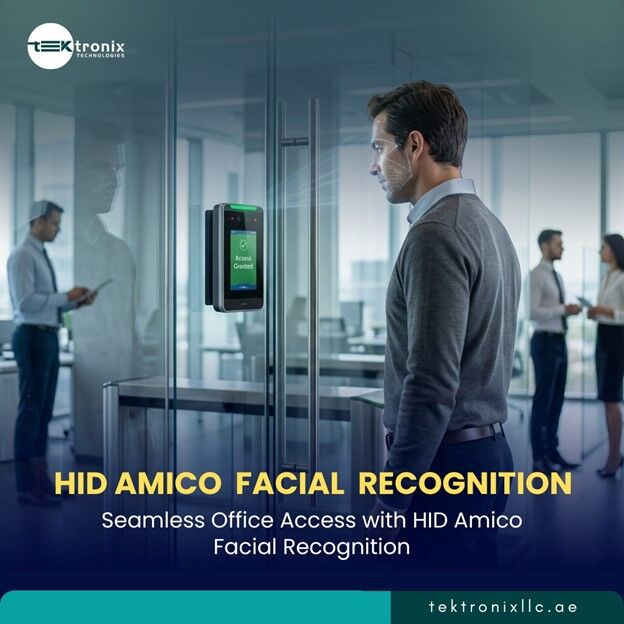
HID Amico is a facial recognition reader line from HID Global, built to authenticate identity at the door using a person's face as the credential rather than a card or mobile pass. It's designed to sit at the same entry points that previously held a proximity or smart-card reader, but instead of waiting for a badge tap, it captures and matches a face against an enrolled template in real time, granting or denying access without the visitor or employee touching the device at all. For government sites managing large daily footfall, that touchless, near-instant verification removes one of the more common bottlenecks at a busy security lobby.
Inside HID Amico Facial Recognition Technology
The underlying HID Amico Facial Recognition engine maps a set of unique facial characteristics into a mathematical template at enrollment, then compares that template against whoever stands in front of the reader on each subsequent attempt. Because the comparison happens locally and in milliseconds, throughput at a busy entrance stays high even as accuracy stays strict — a meaningful distinction for a ministry lobby processing hundreds of staff and visitors during a single morning rush, where a slow or error-prone reader quickly becomes a queue rather than a security control.
The HID Amico Facial Recognition Reader: Hardware Built for High-Security Entry Points
Software accuracy only matters if the physical device performing the scan is built for the environment it's deployed in. The HID Amico Facial Recognition Reader is engineered with wide-angle imaging and adaptive lighting compensation so it performs consistently whether it's mounted in a shaded indoor corridor or a glass-fronted lobby with strong daylight glare — a common condition at UAE government buildings designed around large windows and open atriums. The reader's form factor is built for wall or turnstile mounting at exactly the height and angle a typical entry point requires, rather than needing custom bracketry to fit government-standard door frames.
Real-World Use Case Patterns Across UAE Public Sector Sites
Across completed deployments, a consistent pattern emerges regardless of which emirate or authority is involved: the highest-value doors for facial recognition are the ones where a fast, mistaken, or fraudulent entry would be hardest to reverse. Archive rooms holding case files, server rooms hosting sensitive government systems, and executive floors with limited legitimate traffic tend to be prioritized first, followed by staff entrances at busy public counters where touchless entry meaningfully reduces morning congestion. Public-facing lobbies, by contrast, are more often left on card, mobile, or supervised visitor check-in, since the volume and variability of walk-in traffic make facial enrollment impractical for anyone other than regular staff and pre-cleared visitors.
Implementation Best Practices for Amico Deployments
● Sequence rollout by risk — archives, server rooms, and evidence storage before general staff floors.
● Pair Amico with HID Aero controllers on an IP backbone to simplify multi-door, multi-building wiring.
● Maintain a mixed-credential policy, using mobile or card access for lower-risk doors rather than facial recognition everywhere.
● Set biometric template retention periods in line with the facility's own records policy, not a vendor default.
● Test anti-spoofing and liveness performance under the facility's actual lighting conditions before final sign-off, not only in a demo environment.
Conclusion
Facial-first entry has moved from a novelty to a practical answer for UAE government facilities that need identity assurance stronger than a card or PIN can offer. HID Amico delivers this through HID Amico Facial Recognition matching on a purpose-built HID Amico Facial Recognition Reader, backed by AI-Powered Anti-Spoofing and Liveness Detection that keep the door closed to photos, masks, and recordings. Paired with a HID Aero Controller and folded into a broader HID Access Control strategy alongside HID Mobile Access, it gives ministries, courts, and critical infrastructure sites a defensible answer to who is really standing at a restricted door. Facilities planning a HID Amico UAE, HID Amico Dubai, or HID Amico Abu Dhabi rollout can review Tektronix LLC's HID access control solutions for the hardware, compliance framework, and support model behind completed government deployments.
For more information contact us on:
Tektronix Technology Systems Dubai-Head Office
[email protected]
+971 50 814 4086
+971 55 232 2390
Office No.1E1 Hamarain Center 132 Abu Baker Al Siddique Rd – Deira – Dubai P.O. Box 85955