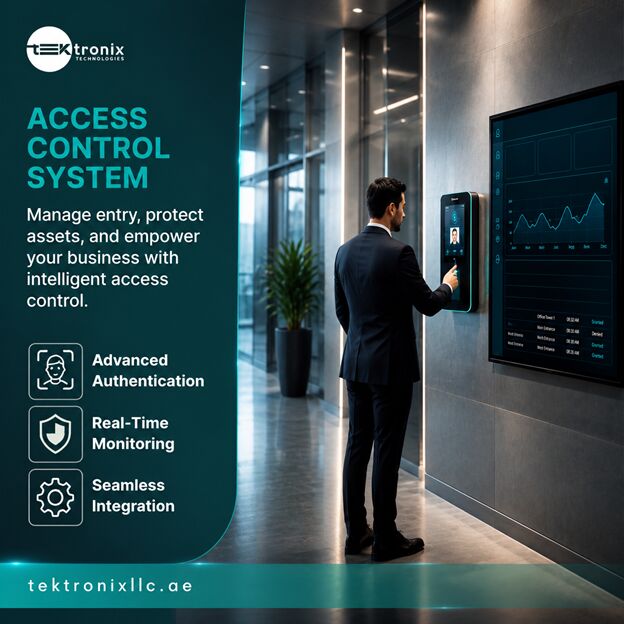
Why UAE Public Institutions Need Layered Physical Security
A government building rarely has one uniform security requirement. A licensing counter needs to stay open and welcoming to the public, while an evidence room two floors up needs to stay closed to almost everyone. Treating the whole building as a single security zone either locks out staff who need frequent access or leaves sensitive areas reachable by anyone who gets past the lobby. Facilities aligned with SIRA licensing requirements and NCEMA's guidance on critical infrastructure protection are expected to show that each zone carries its own, deliberately configured level of restriction - not a blanket policy applied everywhere.
What an Access Control System Delivers for Government Buildings
At its foundation, an Access Control System ties together card or biometric readers, door controllers, and a central management platform so that every door in a facility can be governed from one dashboard rather than a collection of standalone locks. Administrators can grant, restrict, or revoke access to any door instantly, review a time-stamped log of every entry attempt, and tie permissions to shift patterns so a cleaning contractor's credential works only during an assigned window rather than around the clock.
Engineering a Security Access Control System for High-Risk Public Sites
Ministries and judicial complexes typically need more than a single-factor badge tap at the door. A Security Access Control System designed for these sites layers risk-tiered zones - public lobby, staff floors, archives, server rooms — each requiring a progressively stronger form of verification. Anti-passback logic prevents one credential from being used to let in a second person immediately behind it, and integration with CCTV and intrusion alarms means a forced door or a repeated failed access attempt triggers an alert rather than going unnoticed until the next patrol.
Biometric Access Control Dubai: Moving Beyond Cards and PINs
Cards can be lent out, and PINs can be shared over a phone call - neither guarantees that the person standing at the door is the person the credential belongs to. Biometric Access Control Dubai deployments address this directly, using fingerprint or facial recognition at judicial complexes, police buildings, and other high-security government sites across the emirate, so that access is tied to a physical identity rather than an object that can change hands unnoticed.
Door Access Control for Sensitive Zones and Restricted Wings
Not every door in a public sector building should open to the same group of people. Door Access Control configured at the individual door level lets administrators set separate permissions for server rooms, evidence storage, archive wings, and executive floors, rather than relying on a single building-wide access level. This granularity matters most during an internal investigation, when knowing precisely who could - and did - open a specific door becomes the difference between a quick resolution and an open-ended one.
Access Control Solutions Built Around Ministry and Municipal Workflows
Individual readers and controllers only deliver value when they're assembled into a coherent, department-specific rollout. Comprehensive Access Control Solutions bundle credential issuance, zone configuration, visitor and staff permission tiers, and integration with existing CCTV or visitor management platforms into one project, configured around how a specific ministry, municipality, or judicial complex actually operates day to day, rather than a generic template applied to every site regardless of layout.
Access Control System Dubai: Localized Deployment Considerations
Dubai's public sector facilities carry their own set of practical demands - high daily footfall at municipal service counters, coordination with Dubai Municipality and utility providers, and an expectation that new security infrastructure fits into the emirate's broader smart-city direction. An Access Control System Dubai authority deploy needs to handle dense walk-in traffic at public counters without slowing service, while still enforcing strict, tiered restrictions on the floors and rooms the public never sees.
Access Control Integration with Visitor Management and Video Surveillance
A door reader working in isolation only tells half the story. Government facilities get considerably more value when access events are cross-referenced with visitor records and camera footage automatically, rather than pulled from three separate systems after the fact. When a badge is used at a restricted door, an integrated platform can pull the matching CCTV clip and, if the credential belongs to a pre-registered visitor rather than staff, flag that context immediately for the reviewing officer. This kind of correlation shortens investigations considerably compared with manually cross-checking timestamps across unrelated systems.
Conclusion
Securing a UAE public sector building today means moving well past a single locked door and a shared key. An Access Control System combined with a Security Access Control System for high-risk zones, Biometric Access Control Dubai for identity-verified entry, precise Door Access Control at sensitive rooms, Mobile Access Control for a modern workforce, and the right Access Control Device at every checkpoint, together form Access Control Solutions that give ministries, municipalities, and judicial complexes a defensible answer to who can enter their buildings and why. Facilities evaluating an Access Control System UAE or an Access Control System Dubai authority already trust can review Tektronix LLC's access control system for the hardware, compliance framework, and support model behind completed public sector deployments.