Kuwait's Security Landscape: Why the Future of Entry Has Already Arrived
Kuwait's economy is anchored by Kuwait Petroleum Corporation (KPC) and its downstream entities - Kuwait Oil Company (KOC), Kuwait National Petroleum Company (KNPC), and EQUATE Petrochemicals -whose operational facilities, administrative headquarters, and contractor management programmes represent some of the Gulf's most demanding physical security environments outside of Saudi Arabia's giga-project corridor. Alongside the petroleum sector, Kuwait's financial services industry - regulated by the Central Bank of Kuwait (CBK) - its healthcare network anchored by the Ministry of Health's hospital estate, and its government ministry compound in Kuwait City's central administrative district collectively operate environments where access governance failure carries regulatory, operational, and in some cases national security consequences.
Kuwait's Communications and Information Technology Regulatory Authority (CITRA) has progressively tightened the cybersecurity framework requirements applicable to critical infrastructure operators, with physical access governance documentation increasingly expected as a component of facility security compliance submissions. The Kuwait Fire Force's occupancy and emergency access requirements, the Ministry of Interior's commercial facility physical security guidelines, and the CBK's information security circular requirements for licensed financial institutions together create a compliance environment where an Advanced Access Control System that generates timestamped, verifiable, exportable audit documentation is not an optional enhancement but the governance baseline that Kuwait's most closely regulated organisations need to demonstrate during inspection visits and regulatory examinations.
The Technology Architecture Behind Kuwait's Most Secure Facilities
Biometric Access Control System: Credentials That Cannot Be Transferred
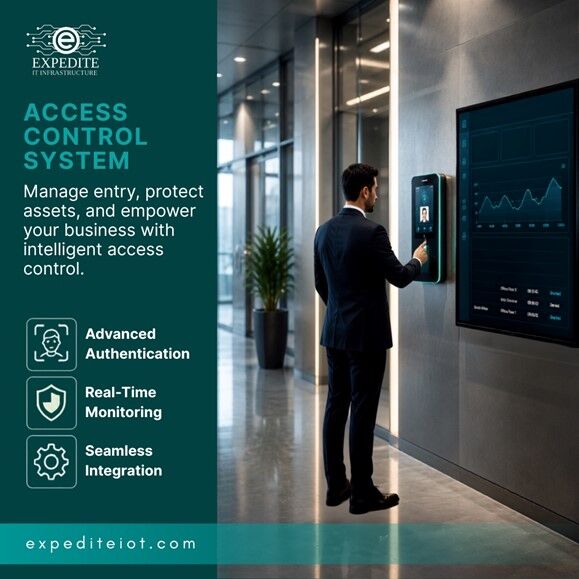
The most consequential evolution in Kuwait's access control landscape is the shift from transferable credentials - cards, PINs, and fobs, all vulnerable to sharing, loss, and duplication - to biometric verification that is inseparable from the authorised individual. Expedite IoT's Biometric Access Control System supports fingerprint recognition, facial recognition, iris scanning, and palm-vein authentication, with credential selection guided by the operational context: facial recognition terminals at high-throughput lobby entrances, fingerprint readers for general staff access zones, palm-vein readers for hygiene-sensitive environments including Kuwait's hospital clean rooms and pharmaceutical storage areas, and iris scanning for the highest-security zones where zero-tolerance identity confidence is required. All biometric templates are encrypted at AES-256 standard at capture, stored in secured local infrastructure or Expedite IoT's GCC-hosted cloud environment, and governed under Kuwait's data privacy principles consistent with CITRA's cybersecurity framework.
Security Access Control System: Zone Governance Across Complex Facilities
Expedite IoT's Security Access Control System delivers multi-tier zone-based permission management that assigns each employee, contractor, and authorised visitor a credential profile defining exactly which zones they may enter, during which hours, and through which entry points. For Kuwait Oil Company's operational campuses - where permanent Kuwaiti national employees, expatriate technical staff, subcontractors, international equipment vendors, and ministry inspection teams may all require simultaneous but differentiated access to overlapping areas - this granular permission architecture is the only governance model that simultaneously satisfies security requirements, operational efficiency, and the contractor management accountability that KPC's security standards mandate. Real-time occupancy dashboards give security supervisors instant zone-level headcounts, supporting Kuwait Fire Force emergency mustering requirements for large commercial and industrial facilities.
Door Access Control System: Scalable Coverage for Every Entry Point
From a single secured office to a multi-building compound spanning Kuwait City's commercial districts and the Ahmadi industrial zone, Expedite IoT's Door Access Control System scales without architectural compromise. Electric strikes, magnetic locks, motorised deadbolts, vehicle barrier arms, pedestrian turnstiles, and lift access controllers are all supported, with fail-safe configurations for Kuwait Fire Force fire exit compliance and fail-secure configurations for bonded storage areas and server infrastructure rooms where unauthorised entry during a network outage represents a regulatory or security violation. The system manages every controlled opening - from the main building entrance and car park barrier through internal zone doors to server room and executive floor access - from a single unified management console that provides the security team a coherent operational picture regardless of facility size or structural complexity.
Hardened Access Control Device for Kuwait's Environment
At every controlled entry point, an Expedite IoT Access Control Device - available in wall-mount biometric terminal, floor-standing pedestal kiosk, vehicle-rated barrier controller, and multi-technology card-and-biometric reader formats - captures credentials and communicates access decisions within milliseconds of presentation. Outdoor-rated models carry IP65 or IP67 ingress protection, ensuring reliable performance across Kuwait's extreme summer heat - regularly exceeding fifty degrees Celsius - high coastal humidity, and the dust and sand exposure common at industrial facilities in the Ahmadi and Shuaiba industrial areas. Vandal-resistant stainless-steel housings protect external perimeter gate readers, tamper detection triggers immediate security alerts if any device is physically attacked, and offline operational resilience ensures access decisions continue executing locally at each reader during network interruptions, with all events queued and synchronised to the central platform upon reconnection.
Access Control System Kuwait: Configured for the Local Compliance and Cultural Context
Deploying