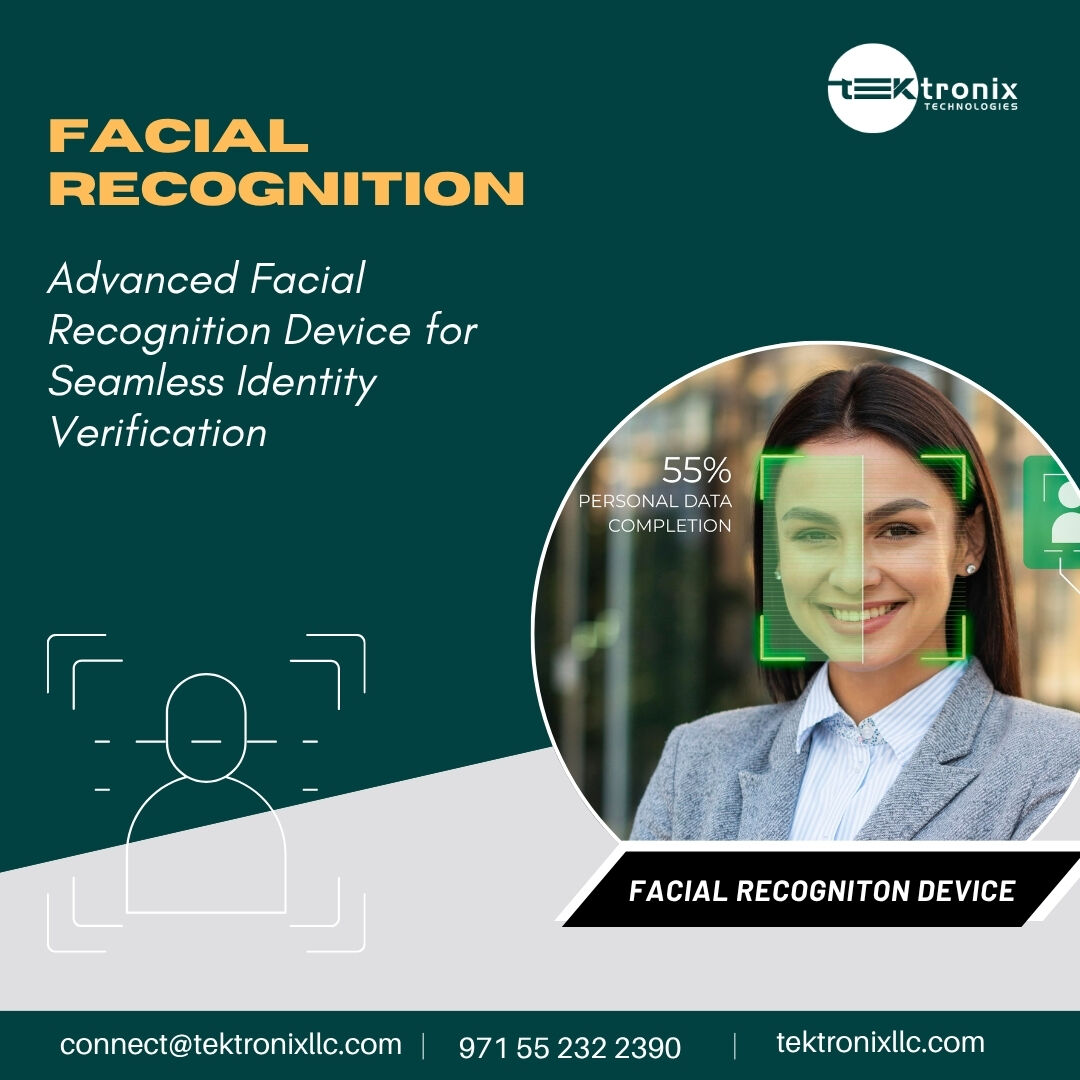
Face Detection is the foundational first step in the biometric verification pipeline — the process by which the system’s camera and image processing algorithms identify the presence and location of a human face within the camera’s field of view. Before any identity comparison can occur, the system must accurately locate the face, assess its quality (sufficient resolution, adequate lighting, acceptable angle), and extract a standardised facial region image for submission to the matching engine.
Modern face detection algorithms based on deep convolutional neural networks achieve detection speeds under 50 milliseconds and maintain reliable performance across a wide range of challenging real-world conditions: partial occlusion by glasses, scarves, or face coverings; significant variation in ambient lighting including the harsh direct sunlight common in GCC building approaches; faces presented at angles up to 45 degrees from perpendicular to the camera; and simultaneous detection of multiple faces within a wide-angle camera frame. For corporate access control deployments in Oman and across the GCC, where camera placement options may be constrained by lobby architecture, detection robustness across varied presentation angles is a particularly important performance criterion to verify during system evaluation.
Facial Identification is the one-to-many biometric search process that compares a newly captured facial image against an entire enrolled database to determine who the individual is, without any prior claim of identity from the subject. In a corporate access control context, facial identification is used at primary building entry points where the system must determine — from the full enrolled population of thousands of employees, contractors, and registered visitors — who is approaching the barrier.
The computational challenge of performing a one-to-many search across a database of tens or hundreds of thousands of enrolled templates in under 500 milliseconds has been solved through a combination of hardware acceleration (dedicated neural processing units on modern edge computing devices), algorithmic efficiency (approximate nearest-neighbour search methods that dramatically reduce the comparison space without sacrificing accuracy), and intelligent gallery management (pre-filtering the search population based on access point location, time of day, and expected presence). For GCC corporate campuses with large enrolled populations — a major oil company campus with 5,000 registered personnel, for example — these optimisations ensure that identification speed remains within acceptable bounds as the enrolled population scales over time.
Facial Authentication is the one-to-one biometric verification process that confirms whether a specific individual — who has declared their identity through a prior action such as presenting an employee ID or entering a PIN — is actually who they claim to be. Rather than searching across the entire enrolled database, the system retrieves the single enrolled template corresponding to the claimed identity and compares it against the newly captured facial image.
Facial authentication is the appropriate verification method for high-security corporate zone access where the additional layer of declared identity provides a second factor of assurance beyond the biometric match alone. A financial institution’s treasury department, a pharmaceutical company’s-controlled substance storage room, or a technology company’s data centre server floor may each require employees to both present a credential (a smart card or mobile token that declares their identity) and pass a biometric facial authentication check before the door releases. This two-factor approach — something you have plus something you are — achieves the highest identity assurance level available in physical access control and is increasingly required by the international security standards that GCC enterprises are aligning with.
Selecting the right Facial Recognition Device for a GCC corporate deployment requires evaluating hardware specifications against the specific environmental and operational challenges of the region. A device that performs flawlessly in a Northern European office building may deliver significantly degraded performance in a Muscat lobby where direct sunlight creates extreme contrast ratios, or in a Riyadh outdoor security checkpoint where summer air temperatures exceed 50°C.
Purpose-built GCC-grade facial recognition devices incorporate active infrared (IR) illumination that maintains consistent facial image quality regardless of ambient light variation — enabling reliable recognition from full darkness to direct sunlight without camera adjustment. Near-infrared (NIR) dual-sensor configurations capture both visible-light and infrared images simultaneously, providing the liveness detection engine with the multi-spectral data needed to defeat spoofing attacks while maintaining recognition performance under all lighting conditions. Thermal management systems — passive heat dissipation fins, active cooling where required, and motor controller thermal protection — ensure stable operation through the Gulf’s extreme summer heat cycles. IP65 or higher environmental sealing protects electronics from the fine particulate matter (dust and sand) that affects outdoor and semi-outdoor installations across the region.
Facial Recognition System Oman deployments operate within a regulatory framework that combines national data protection legislation — Royal Decree No. 6/2022, Oman’s Personal Data Protection Law — with sector-specific physical security requirements from the Royal Oman Police, the Ministry of Interior, and industry regulators including the Central Bank of Oman for financial institutions and the Telecommunications Regulatory Authority (TRA) for telecommunications operators. Responsible deployment requires establishing a lawful basis for biometric data processing under the PDPL, conducting a Data Protection Impact Assessment (DPIA) before go-live, and implementing technical controls including encryption, access control, and data minimisation that satisfy both the letter and the spirit of the law.
A well-deployed Facial Recognition System is the most significant upgrade an Oman or GCC corporate workplace can make to its physical security posture — delivering