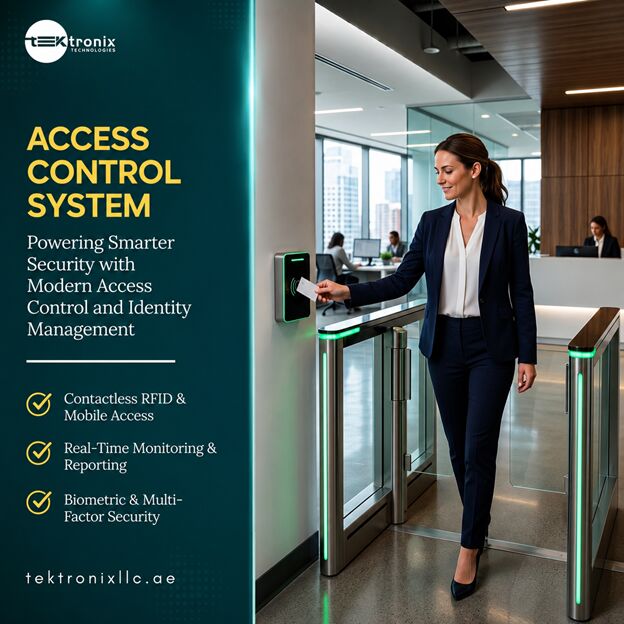
How Access Control Configuration Changes by Industry
The same underlying access control platform can be configured very differently depending on context, which is what allows one system to serve genuinely different operational needs across sectors rather than forcing every organization into an identical security model.
Corporate Offices and Multi-Tenant Towers
In shared office buildings, access control typically centers on restricting each tenant to their own floor and server room, with instant credential revocation supporting frequent staff turnover across dozens of independent companies sharing one building.
Healthcare Facilities
Hospitals and clinics prioritize restricting entry to operating theatres, pharmacy stores, and neonatal units, often layering biometric verification on top of card access for the most sensitive clinical zones.
Educational Campuses
Schools and universities emphasize campus perimeter control and restricted access to areas like laboratories or IT server rooms, with a strong safeguarding focus on knowing exactly which adults are present on-site at any given time.
Manufacturing and Industrial Facilities
Factories and warehouses often pair access control with safety certification tracking, ensuring only workers who have completed required safety training can badge into hazardous zones such as chemical storage or heavy machinery areas.
Government and Financial Institutions
These sectors typically demand the strictest verification standards of any industry, often requiring dual-factor or biometric authentication for even routine access, alongside extended audit log retention for regulatory review.
Core Technologies Behind a Modern Access Control Deployment
Despite these sector differences, several core technologies remain consistent building blocks across nearly every industry deployment.
Biometric Access Control Dubai Organizations Are Adopting for High-Risk Zones
Across sectors, Biometric Access Control Dubai organizations increasingly specify uses fingerprint, iris, or facial recognition to verify identity in a way that cannot be shared, borrowed, or duplicated. Whether protecting a hospital pharmacy, a bank vault, or a corporate data center, biometric verification addresses the same core weakness that card-only systems share across every industry.
Security Access Control System for Layered, Risk-Proportionate Protection
A well-designed Security Access Control System applies different verification levels to different zones within the same facility - simple card access for general staff areas, biometric checks for sensitive rooms, and dual-factor authentication for the most critical spaces, regardless of whether that facility is a hospital, a factory, or a corporate headquarters.
Door Access Control for Zone-Specific Restrictions
At the individual door level, Door Access Control hardware enforces the specific policy set for that space - a factory's hazardous materials store might remain locked to all but certified staff, while a school's general classroom corridor stays open to all approved personnel during school hours and locks automatically afterward.
Mobile Access Control for a Credential-Free Workforce
Increasingly common across sectors, Mobile Access Control lets staff unlock approved doors directly from a smartphone app, reducing the administrative burden of issuing and revoking physical badges - particularly valuable for industries with high staff turnover, such as retail, hospitality, and industrial contracting.
Choosing the Right Access Control Device for Different Facility Types
Hardware selection should reflect both the traffic volume and risk profile of each entry point, which varies considerably by industry. A busy hospital or corporate lobby needs a fast, durable Access Control Device capable of handling thousands of daily reads without failure, while an industrial hazardous materials store or a bank vault benefits more from a slower, higher-assurance biometric reader that prioritizes verification accuracy over speed.
Environmental factors also influence device selection by sector - a factory floor reader needs to withstand dust and vibration, while an outdoor industrial gate reader must tolerate the UAE's high ambient temperatures, considerations that rarely apply to a climate-controlled corporate office lobby.
Key Benefits of Access Control Solutions Across Every Industry
Deploying comprehensive Access Control Solutions delivers consistent value regardless of sector, even though the specific driver differs. Organizations across industries typically report:
● Real-time visibility into who accessed which zone, and when
● Instant credential revocation supporting staff turnover in any sector
● Reduced risk of unauthorized entry into sector-specific sensitive areas
● Stronger compliance posture through detailed, exportable audit trails
● Lower long-term costs compared to repeatedly rekeying mechanical locks
● A defensible security position when facing insurance or regulatory review
Access Control System UAE: Regional Deployment and Compliance Considerations
Rolling out Access Control System UAE-wide involves accounting for both sector-specific regulation and practical regional factors - hardware built to handle high ambient temperatures, multilingual interfaces for a diverse workforce, and alignment with UAE data protection expectations for how biometric templates are stored and retained.
For organizations operating across multiple emirates, consistency in policy enforcement matters as much as the underlying technology - a security policy rigorously enforced at one site but loosely applied at another creates a weak link that undermines the organization's overall access control strategy, regardless of how strong any single location's controls may be.
Access Control System Dubai: Meeting the Demands of a Diverse Commercial Hub
Dubai's economy spans everything from Grade A office towers to large-scale logistics operations to specialized healthcare facilities, all within the same emirate. An Access Control System Dubai organization deploy needs to support this diversity, whether that means dense multi-tenant floor management in a corporate tower or hazardous zone certification tracking on an industrial site.
For businesses expanding across sectors within Dubai specifically, choosing a platform proven across multiple industry verticals - rather than one built narrowly for a single use case - provides more flexibility as the organization's footprint and risk profile evolve over time.
Conclusion
Access Control System technology adapts to nearly any sector's needs. Biometric Access Control Dubai organizations trust protects the most sensitive zones, while layered Security Access Control System design, reliable Door Access Control, and flexible Mobile Access Control work across every industry. Backed by the right