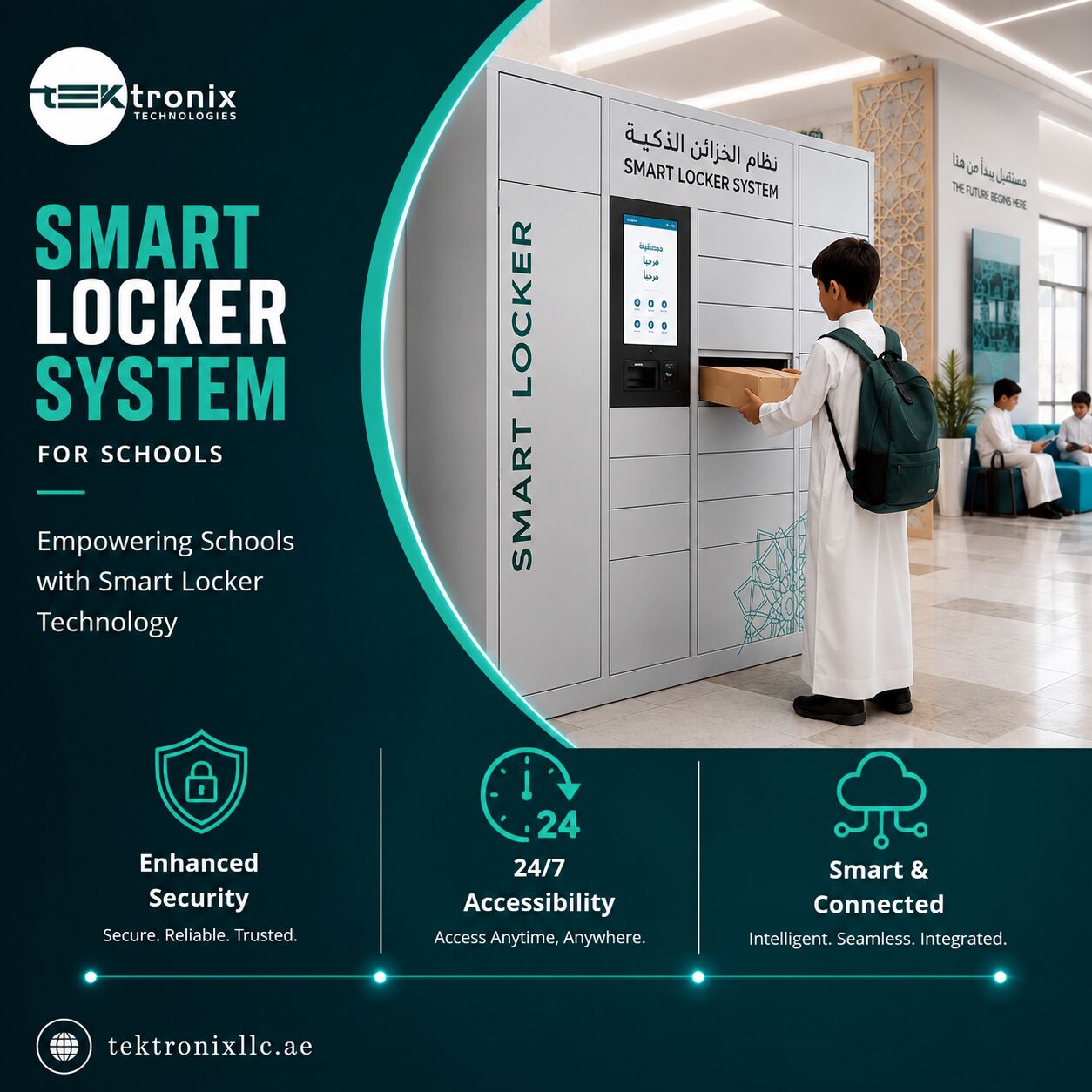
Student locker rooms face a specific set of everyday pressures: hundreds of students need quick access to their belongings between periods, lost keys and forgotten combinations generate a steady stream of facilities tickets, and school administrators want a documented record of who accessed which compartment and when, particularly for shared sports or science equipment. A well-specified locker bank answers all three at once, provided it is built for the pace and durability a school corridor actually demands rather than the lighter-duty hardware designed for offices or gyms.
Tektronix LLC has supplied and commissioned self-service technology for developments linked to G42, DIFC, RTA Dubai, and EXPO 2020, giving the company practical experience with high-footfall public environments long before education became a dedicated focus. That background carries over directly into school deployments, where durability, safeguarding-conscious data handling, and integration with existing student information systems matter as much as the physical locker cabinet itself.
Understanding the Smart Locker for Schools Category
A Smart Locker for Schools differs from a standard hallway locker in three ways: it authenticates a student electronically rather than relying on a physical key or memorized combination, it logs every open and close event for accountability, and it typically ties into the school's student information system so a locker assignment automatically expires at the end of a term or upon a student's transfer.
This category spans several physical formats, from small personal-item lockers in a homeroom corridor to full-height compartments for sports kits and musical instruments near a gymnasium or hall. The common thread across formats is that a student, not a staff member, performs the retrieval, which removes a recurring administrative burden from facilities and pastoral care staff while giving students a sense of ownership over their own belongings.
Core Technology: Electronic Locker System Architecture
Underneath the student-facing panel sits an Electronic Locker System responsible for the actual locking, unlocking, and event logging for every compartment in a bank. Unlike a mechanical padlock, each door is driven by a solenoid or motorized latch controlled by a central board, allowing remote release, scheduled lockouts outside school hours, and instant status reporting back to facilities staff.
Locking Mechanisms Built for School Durability
Electronic strike locks and motorized latches are chosen for durability under the repeated, sometimes forceful daily use typical of a busy school corridor, with reinforced housings that hold up better than the lightweight combination padlocks common in older locker installations.
Power, Connectivity, and Scheduled Lockouts
Locker banks typically run on a low-voltage power supply with battery backup, and administrators can schedule automatic lockouts outside school hours so compartments are not accessible overnight or during holidays, an added layer of campus security beyond simple convenience.
Digital Locker System Design for Student-Facing Environments
A well-designed Digital Locker System has to work for students across a wide age range, from younger children who may struggle with a multi-step process to older students who expect a fast, app-like interaction similar to the technology they already use daily.
Age-Appropriate Interface Design
Larger touch targets, simple icon-based prompts, and short confirmation steps reduce hesitation and errors for younger students, while the same underlying platform can present a faster, more streamlined flow for older students who need less on-screen guidance.
Multi-Language Support for Diverse Student Populations
Given the international student mix typical of UAE schools, interfaces commonly support English, Arabic, and other languages spoken across the student body, helping younger or newly arrived students navigate the system confidently from their first day.
Face Recognition Locker Access for Frictionless Retrieval
For students who forget cards or codes easily, Face Recognition Locker Access removes the need for any physical token at all. A student simply approaches their assigned compartment, and the system authenticates them against a profile created with parental consent at enrollment, releasing the correct door without a card, code, or fob.
Consent-Based Enrollment and Safeguarding
Because this involves minors, schools typically require explicit parental or guardian consent before enrolling a student's facial template, alongside a clearly communicated policy on how the data is stored, who can access it, and when it is deleted, usually at the end of the academic year or upon the student leaving the school.
Anti-Spoofing Safeguards
Liveness detection prevents a photograph from triggering a false match, while templates are stored as encrypted data rather than raw images, reducing the exposure if a school's broader IT systems were ever compromised.
QR Code Smart Locker Access for Contactless Convenience
Where schools prefer not to introduce facial enrollment for younger students, QR Code Smart Locker Access offers a simpler alternative: a unique code generated for each student at the start of term that they scan with a school-issued device or ID card reader to release their assigned compartment, with no facial data collected at all.
Term-Linked, Automatically Expiring Codes
Codes can be generated automatically at the start of each term and tied to that student's enrollment record, so a locker assignment expires the same day a student moves up a grade, transfers schools, or graduates, without staff needing to manually revoke access.
Staff Override for Lost Codes
A staff-facing override, tied to a teacher or administrator credential, handles the common case of a younger student losing or forgetting their code, ensuring a child is never left without access to their own books or belongings during the school day.
Locker Management Software and Backend Integration
None of the student-facing convenience works reliably without capable Locker Management Software running behind the scenes to track compartment assignments, student enrollment status, and access history across every bank on campus.
Student Information System Integration
Linking the locker platform to the school's student information system means a locker assignment can be created and revoked automatically alongside a student's enrollment record, rather than requiring a separate manual entry by administrative staff at the start of every term.
Reporting for Facilities and Pastoral Care Teams
Centralized dashboards give facilities teams visibility into compartment utilization and any door that has failed to latch correctly, while pastoral care staff can review access history for a specific student if a safeguarding or lost-property concern is raised.
Industry Use Cases Across UAE School Campuses
Personal Item and Textbook Lockers
Standard corridor lockers for books, bags, and personal items benefit from fast, self-service retrieval between periods, reducing the corridor congestion and lost-key incidents common with traditional padlock-based