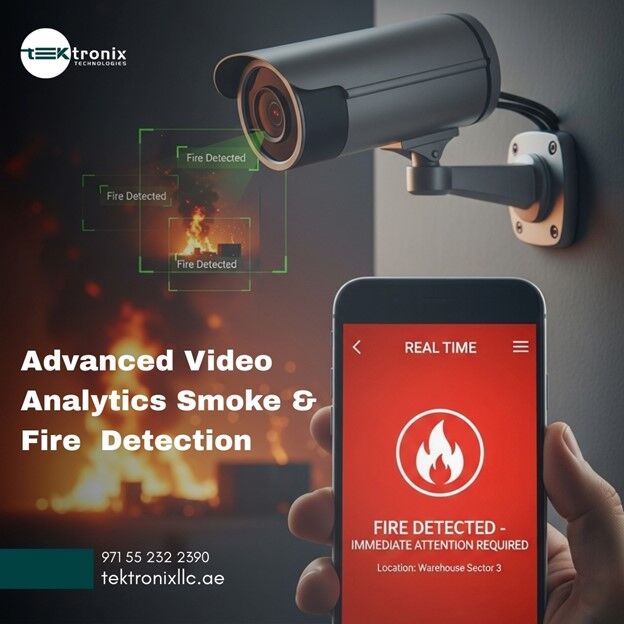
For buildings with dense occupancy, complex floor plans, and high-value equipment, that earlier warning changes the outcome of an incident. This guide explains how the technology works, what it delivers for UAE facilities, and what to look for when choosing a provider.
The Fire Safety Challenge in Modern UAE Buildings
Dubai and Abu Dhabi's skylines have grown faster than almost anywhere else in the region, packing offices, retail floors, server rooms, and multi-level car parks into single towers. Conventional smoke detectors and heat sensors were built for simpler layouts — they react only once smoke or heat physically reaches the device, which in an open-plan office, atrium, or basement car park can mean several critical minutes of delay before an alarm sound.
High ambient temperatures, heavy air-conditioning loads, and a fast-growing number of electric-vehicle charging points in basement parking have all added new ignition risks. Facility owners across the region are responding by layering camera-based detection on top of their existing fire systems, rather than relying on point sensors alone.
What Is AI-Powered Video Analytics for Fire & Smoke Detection?
AI-Powered Video Analytics uses computer vision and machine learning models trained on real fire and smoke footage to recognise flame colour, smoke density, and heat distortion directly from existing CCTV or IP camera feeds. Instead of waiting for particles to drift into a sensor, the video analytics software analyses every frame continuously, comparing it against trained fire-and-smoke patterns and issuing an alert within seconds of a genuine event.
How the Detection Pipeline Works
● Existing or new IP cameras capture continuous video across offices, lobbies, warehouses, and plant rooms.
● An AI engine screens each frame for flame colour signatures, smoke plumes, and thermal distortion patterns.
● Detections are cross-checked against motion and context to filter out steam, dust, or sun glare.
● Verified alerts are pushed instantly to security control rooms, mobile devices, and the building management system.
● Each event is logged with a time-stamped video clip for post-incident review and audit purposes.
Implementation Best Practices for UAE Facilities
● Conduct a site walkthrough to map coverage gaps in offices, lobbies, warehouses, basements, and car parks.
● Prioritise high-risk zones first: server rooms, kitchens, EV charging bays, and electrical switchgear areas.
● Integrate the detection engine with the building management system, fire alarm panel, and access control before go-live.
● Calibrate detection sensitivity on-site to account for lighting, glare, and steam sources unique to each floor.
● Train security and facilities staff on alert workflows, escalation paths, and evacuation triggers.
● Schedule periodic testing and firmware updates to keep detection accuracy aligned with evolving AI models.
Conclusion
Video Analytics and AI-Powered Video Analytics are becoming a standard layer of protection for offices and towers across the UAE, closing the response gap that conventional smoke and heat sensors leave open.
built around Real-Time Hazard Detection give facility teams earlier warning and clearer visibility into every incident as it unfolds.
From Video Analytics Dubai towers to wider Video Analytics UAE deployments, the combination of Automated Emergency Response and Reduced False Alarms is helping building owners protect people, reduce disruption, and meet rising regional safety expectations.
For more information contact us on:
Tektronix Technology Systems Dubai-Head Office
[email protected]
+971 50 814 4086
+971 55 232 2390
Office No.1E1 Hamarain Center 132 Abu Baker Al Siddique Rd – Deira – Dubai P.O. Box 85955