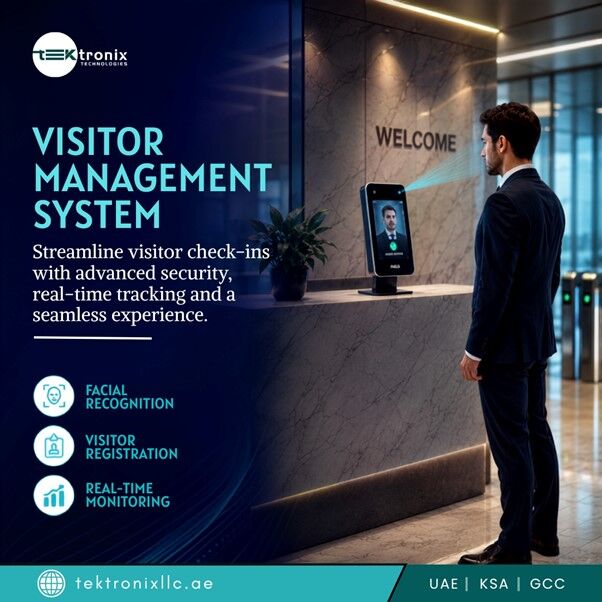
What Is Visitor Registration Software and How Does It Work?
At its core, Visitor Registration Software is a digital platform that replaces the paper logbook with pre-registration, ID capture, host notifications, and instant badge printing. Visitors can be invited in advance, their details verified against a watchlist, and their arrival logged automatically the moment they scan a QR code or present an Emirates ID at reception. For facilities managers, this turns what used to be a manual, error-prone process into a searchable digital trail that can be pulled up in seconds for an audit or an incident review.
Core Capabilities Facilities Managers Should Look For
● Pre-registration and automated host notification via SMS or email
● Instant badge and pass printing with photo capture at the point of entry
● Real-time dashboards and reporting for security and reception teams
● Integration with existing access control, turnstiles, and CCTV infrastructure
● Multi-language support, including Arabic and English, for the UAE's diverse workforce
The best-configured platforms also keep a distinction between contractors, interviewees, couriers, and VIP guests, routing each through a slightly different check-in flow rather than treating every arrival the same way. A courier dropping off a package doesn't need the same host-approval step as a candidate arriving for a final-round interview, and building that logic into the front desk saves receptionists from having to make judgment calls on the fly.
Touchless Visitor Management System: The New Standard for Health-Conscious Workplaces
Since 2020, contactless interaction has moved from a nice-to-have to an expectation, and a Touchless Visitor Management System answers that expectation without slowing anyone down. QR-code check-in, facial recognition kiosks, and mobile pre-registration mean a guest never has to touch a shared screen or pen to get through reception. For healthcare facilities, data centres, and corporate headquarters in the UAE, this touchless layer has become as much about hygiene and guest comfort as it is about speed and throughput.
A touchless flow also tends to move faster at peak times. A guest who pre-registers on their phone and simply scans a code on arrival skips the queue entirely, which matters in busy lobbies shared by several tenants, or at conference and event check-in desks where dozens of people arrive within the same few minutes.
Choosing the Right Visitor Management Device for the Front Desk
The software is only half the story; the hardware at reception matters just as much. A well-specified Visitor Management Device, whether a tablet kiosk, a facial recognition terminal, or a badge printer bundled into one unit, determines how smoothly the first thirty seconds of a visit go. Businesses in Dubai and Abu Dhabi increasingly favour all-in-one kiosks that combine ID scanning, photo capture, and badge printing in a single footprint, reducing both desk clutter and staff workload during peak arrival hours.
Local climate and building conditions matter more than most specification sheets admit. Reception areas in the UAE often sit next to glass frontages with heavy sun exposure, so screen brightness, glare resistance, and reliable performance in air-conditioned-to-outdoor temperature swings are practical considerations, not afterthoughts, when selecting hardware for a lobby that runs from early morning through late evening.
From Check-In to Continuous Oversight: Check-In and Tracking Together
A strong Visitor Check in System covers the moment of arrival, verifying identity, capturing a photo, and issuing a pass, but the value of the platform does not stop there. Pairing it with a Visitor Tracking System means security teams can see, in real time, which zones a guest is authorised to enter, how long they have been on-site, and whether they have checked out. That continuous visibility matters most in facilities with restricted areas, data centres, or shared office towers where multiple tenants rely on the same lobby entrance.
This combination also earns its keep during an emergency. In an evacuation, a live headcount of everyone checked in but not yet checked out, visitors included, gives fire wardens and security staff a far more reliable picture than a paper sheet that was last updated an hour ago and may not reflect who has since left the building.
Key Industries Benefiting from Digital Visitor Registration
While corporate towers are the most visible adopters, the same underlying technology serves a much wider range of facilities across the UAE. Government and semi-government buildings use it to enforce strict identity checks before granting entry. Hospitality groups use it to streamline back-of-house and vendor access without disrupting the guest experience. Data centres and telecom facilities rely on it to keep a tight, auditable record of every third-party engineer who steps onto the floor. Healthcare providers use it to screen visitors against health and safety protocols before they reach a ward. And logistics and warehousing operators use it to log drivers and couriers moving through loading docks all day long.
Implementation Steps for a Smooth Rollout
Moving from a paper logbook, or a legacy system that no longer fits the business, tends to go more smoothly when it follows a clear sequence rather than a single big-bang switch:
● Audit the current visitor flow, entry points, and any existing access control or CCTV already in place
● Decide whether the site needs a single lobby kiosk or a multi-branch enterprise deployment
● Configure host notification rules, watchlist screening, and badge templates before go-live
● Pilot the platform at one entrance or floor to catch workflow issues before a full rollout
● Train reception and security staff, then expand to remaining entrances or branches on a set schedule
Key Industries Benefiting from Digital Visitor Registration
While corporate towers are the most visible adopters, the same underlying technology serves a much wider range of facilities across the UAE. Government and semi-government buildings use it to enforce strict identity checks before granting entry. Hospitality groups use it to streamline back-of-house and vendor access without disrupting the guest experience. Data centres and telecom facilities rely on it to keep a tight, auditable record of every third-party engineer who steps onto the floor. Healthcare providers use it to screen visitors against health and safety protocols before they reach a ward. And logistics and warehousing operators use it to log drivers and couriers moving through loading docks all day long.
Implementation Steps for a Smooth Rollout
Moving from a paper logbook, or a legacy system that no longer fits the business, tends to go more smoothly when it follows a clear sequence rat