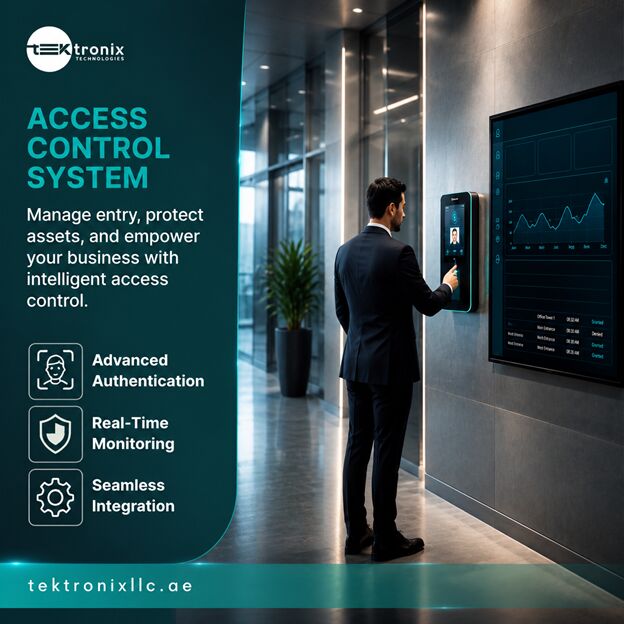
Why Offices and Corporate Towers Need a Dedicated Access Control System
A multi-tenant office tower is a fundamentally different security challenge than a standalone building. Dozens of companies, each with their own staff, confidentiality requirements, and after-hours schedules, share the same lifts, lobby, and parking structure. A single master key or shared fob system offers no way to separate one tenant's floor from another's, and provides no record of who entered which space or when.
Digital access systems solve this by assigning every employee, contractor, and visitor a unique, revocable credential tied to a specific set of permissions - floor access, lift call restrictions, and time-of-day rules. If an employee leaves a tenant company or a badge is lost, that credential can be disabled instantly across the entire building without needing to rekey a single lock, and every access event remains logged for later review.
Core Technologies Behind a Modern Corporate Tower Access Control Solution
A commercial tower's security platform typically layers several complementary technologies rather than relying on one method of verification, since different zones within the same building carry very different risk profiles.
Biometric Access Control Dubai Towers Are Adopting for High-Security Floors
For server rooms, executive suites, and finance departments, Biometric Access Control Dubai building operators are increasingly specifying uses fingerprint, iris, or facial recognition to verify identity in a way that cannot be shared, borrowed, or duplicated the way a card or PIN can. This is particularly valuable in towers hosting banks, law firms, or regional headquarters where a single unauthorized entry into a sensitive area could carry serious financial or reputational consequences.
Security Access Control System for Layered, Tenant-Specific Protection
A well-designed Security Access Control System applies different verification levels to different parts of a shared tower - simple card access for general staff corridors, biometric checks for server rooms and executive floors, and dual-factor authentication for particularly sensitive tenant areas. This layered structure lets each tenant configure security proportional to their own risk tolerance without affecting how other companies in the building manage their floors.
Door Access Control for Tenant Suites, Server Rooms, and Shared Facilities
At the individual door level, Door Access Control hardware - electric strikes, magnetic locks, and networked readers - enforces the access policy each tenant sets for their own space. A tenant's server room might remain locked around the clock to all but a handful of IT staff, while their general office entrance stays open to all employees during business hours and locks automatically after a set time each evening.
Mobile Access Control for a Card-Free Employee Experience
Increasingly, corporate tenants are moving away from physical access cards altogether. Mobile Access Control lets employees unlock approved doors and call elevators directly from a smartphone app using Bluetooth or NFC, reducing the administrative burden of issuing, replacing, and deactivating physical badges - particularly useful for larger tenant companies with frequent staff turnover or hybrid work schedules.
Choosing the Right Access Control Device for a Multi-Tenant Building
Hardware selection should reflect both the traffic volume and risk profile of each entry point across the building. A busy lobby turnstile needs a fast, durable Access Control Device capable of handling thousands of daily reads without failure, while a tenant's server room or records store benefits more from a slower, higher-assurance biometric reader that prioritizes verification accuracy over speed.
Facility managers should also weigh integration capacity when selecting devices - whether a reader can connect to the building's central management platform, feed data into portfolio-wide reporting, and support each tenant's individual access policy - rather than evaluating hardware purely on cost or brand recognition.
Choosing the Right Access Control Device for a Multi-Tenant Building
Hardware selection should reflect both the traffic volume and risk profile of each entry point across the building. A busy lobby turnstile needs a fast, durable Access Control Device capable of handling thousands of daily reads without failure, while a tenant's server room or records store benefits more from a slower, higher-assurance biometric reader that prioritizes verification accuracy over speed.
Facility managers should also weigh integration capacity when selecting devices - whether a reader can connect to the building's central management platform, feed data into portfolio-wide reporting, and support each tenant's individual access policy - rather than evaluating hardware purely on cost or brand recognition.
Choosing the Right Access Control Device for a Multi-Tenant Building
Hardware selection should reflect both the traffic volume and risk profile of each entry point across the building. A busy lobby turnstile needs a fast, durable Access Control Device capable of handling thousands of daily reads without failure, while a tenant's server room or records store benefits more from a slower, higher-assurance biometric reader that prioritizes verification accuracy over speed.
Facility managers should also weigh integration capacity when selecting devices - whether a reader can connect to the building's central management platform, feed data into portfolio-wide reporting, and support each tenant's individual access policy - rather than evaluating hardware purely on cost or brand recognition.
Conclusion
A modern access control system UAE businesses trust transforms multi-tenant corporate towers into secure, centrally managed environments with real-time visibility, automated access permissions, and complete audit trails. By integrating biometric access control, mobile access control, networked door access control, and intelligent access control devices, building operators can protect sensitive areas, streamline tenant management, and strengthen overall building security across every floor. Scalable access control solutions also support future expansion, compliance requirements, and seamless integration with visitor management, surveillance, and building management systems, making them the ideal choice for commercial towers seeking a reliable security access control system in Dubai and across the UAE.