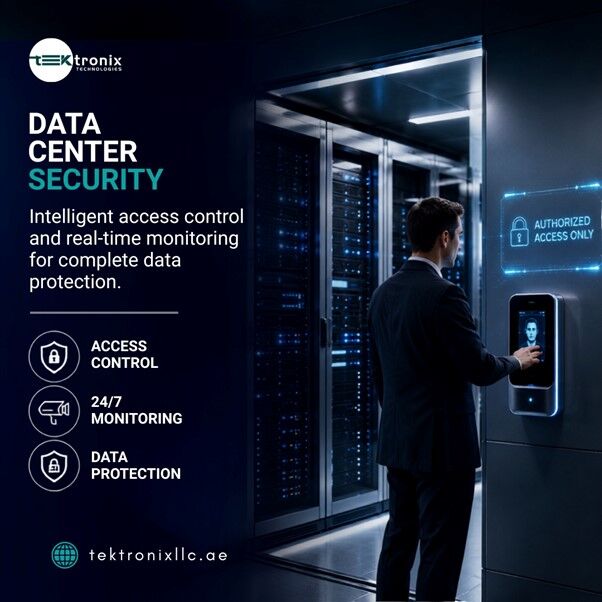
Why Data Center Security Matters in the UAE's Digital Economy
The UAE's smart-city initiatives, expanding financial services sector, and booming cloud computing market have turned data centers into critical national infrastructure. Government mandates around data sovereignty, coupled with a rising volume of sophisticated cyberattacks targeting the Gulf region, mean that facility operators can no longer treat physical security and cybersecurity as separate disciplines. A modern, converged approach to data center protection is essential for maintaining uptime, regulatory standing, and customer trust.
Financial institutions, healthcare providers, telecom operators, and oil and gas companies operating in the UAE all rely on always-on infrastructure. For these sectors, resilience isn't optional — it's a contractual and regulatory obligation, and it starts with a well-designed security architecture built around layered, defense-in-depth principles.
UAE Data Center Market Growth and Investment Trends
Dubai and Abu Dhabi have both positioned themselves as regional colocation and hyperscale hubs, with free zones such as Dubai Silicon Oasis and Dubai South actively courting infrastructure investment. As more government workloads migrate to sovereign cloud platforms and enterprises adopt hybrid IT models, the number of tier-rated facilities across the Emirates continues to expand. This growth brings welcome economic opportunity, but it also widens the attack surface that operators must defend, making a coherent, forward-looking security roadmap essential from day one rather than an afterthought bolted on after commissioning.
Facility operators are also responding to customer demand for transparency. Enterprise tenants increasingly request evidence of independent audits, uptime guarantees, and documented incident-response procedures before signing colocation agreements — pushing the entire market toward higher, more consistent security baselines across the region.
The Convergence of Physical and Cyber Security
Historically, facility guards and IT security teams operated in separate silos, using different tools and reporting lines. That separation is no longer tenable. A tailgating incident at a server room door is, in effect, a cybersecurity event, and a network intrusion can just as easily originate from a compromised badge reader as from a phishing email. Leading UAE operators now run converged security operations, where physical alarms, access logs, and network alerts feed into the same dashboard and the same incident-response playbook, allowing teams to correlate events across domains instead of investigating them in isolation.
This convergence also simplifies compliance reporting. Auditors reviewing a facility against ISO 27001 or sector-specific frameworks increasingly expect to see physical and logical controls documented together, with clear mapping between who can enter a room and what that same identity can access on the network.
Conclusion
Protecting a data center in today's threat landscape requires far more than a lock on the server room door. It demands a converged strategy spanning biometric access management, intelligent surveillance, layered intrusion detection, encrypted data pathways, and enterprise-grade firewalls — all aligned with UAE regulatory expectations. Organizations that invest in this integrated approach position themselves to operate with confidence, maintain regulatory standing, and earn the trust of the customers and partners who depend on their infrastructure. Working with an experienced regional partner ensures these layers work together as a single, well-managed security program rather than a patchwork of disconnected tools.
For more information contact us on:
Tektronix Technology Systems Dubai-Head Office
[email protected]
+971 50 814 4086
+971 55 232 2390
Office No.1E1 Hamarain Center 132 Abu Baker Al Siddique Rd – Deira – Dubai P.O. Box 85955