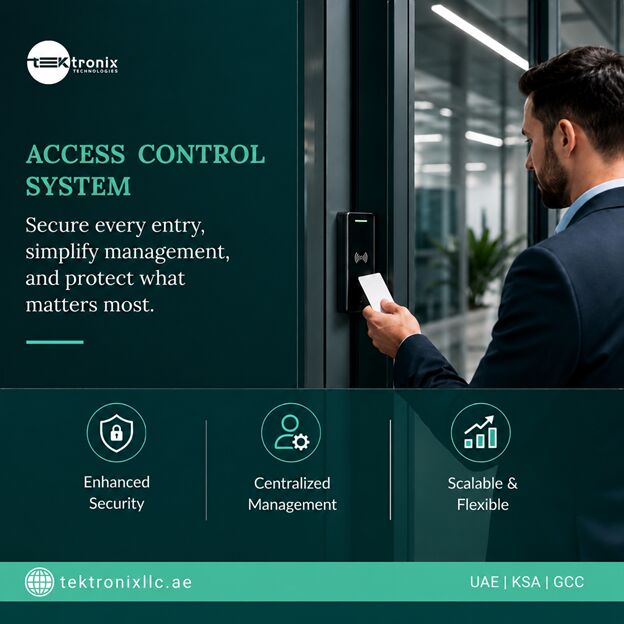
Why the UAE Is Investing in Modern Access Control
Commercial towers, government campuses, and free zone developments across the UAE share a common set of pressures: rising scrutiny over who can reach sensitive zones, a growing expectation of touchless, frictionless entry, and a genuine administrative cost tied to issuing, replacing, and revoking physical badges at scale. New developments across Dubai and Abu Dhabi are increasingly specifying access control as core digital infrastructure from day one, rather than an operational system bolted on after construction is complete.
Tektronix LLC has implemented access control infrastructure across developments linked to G42, DIFC, RTA Dubai, and EXPO 2020, giving the company direct, on-the-ground experience with the compliance expectations and traffic patterns typical of Gulf commercial and government facilities. That regional deployment history shapes how projects across the UAE are specified today, weighing hardware, network architecture, and credentialing strategy together rather than treating access control as an isolated purchase.
Understanding the Modern Access Control System
A contemporary access control platform ties together readers at every door, a controller layer enforcing policy, and centralized software managing credentials, schedules, and reporting across an entire site or portfolio of buildings.
Core Components: Readers, Controllers, and Software
Readers capture a credential, whether a card, biometric template, or mobile signal; controllers make the real-time grant-or-deny decision and drive the physical lock; and software ties every device together into a single, auditable policy engine administrator manage from one console.
From Standalone Locks to Networked Platforms
Legacy standalone locks required a technician to physically reprogram each door individually, while networked platforms push policy changes to every connected door instantly, a critical distinction for large campuses or multi-building portfolios common across the region's newer developments.
Biometric Access Control Dubai Enterprises Are Adopting
Where card credentials fall short, Biometric Access Control Dubai deployments tie every access event to a verified individual rather than an anonymous token, closing the most common failure mode of traditional card-based security.
Fingerprint, Facial, and Multimodal Options
Facilities can choose fingerprint, facial recognition, or a combined multimodal approach depending on the environment, workforce habits, and the sensitivity of the area being protected, rather than defaulting to whichever modality is currently most fashionable.
Accuracy, Speed, and Anti-Spoofing
Modern biometric readers combine fast matching, often well under a second, with liveness and anti-spoofing checks that confirm a live, present person rather than a photograph or replayed video is requesting access.
Security Access Control System Design for High-Risk Facilities
Where the consequence of unauthorized entry is especially severe, a Security Access Control System layers physical and procedural controls well beyond a single door reader, incorporating structural and monitoring elements a standard commercial installation does not require.
Layered Zones and Mantrap Doors
High-security facilities segment access into progressively restricted zones, with interlocked mantrap doors ensuring only one verified individual passes at a time into the most sensitive areas.
Integration with CCTV and Intrusion Detection
Tying access control into the same platform as CCTV and intrusion detection means a denied entry attempt or a forced door automatically raises an alarm and pulls live camera footage for the response team.
Door Access Control at the Point of Entry
At the most granular level, Door Access Control determines exactly which lock hardware, electric strike, maglock, or motorized latch, is paired with which credential type at each individual entry point across a facility.
Lock Types and Hardware Compatibility
Selecting the right lock hardware depends on door material, frame type, and whether the opening needs to support high-traffic cycling or infrequent, higher-security access, a specification detail that is easy to overlook until installation reveals a mismatch.
Fire-Safe Egress and Fail-Safe Design
Every door on an access-controlled system must default to a safe, unlocked state during a fire alarm trigger, a requirement that civil defense authorities across the region increasingly verify during facility inspections.
Mobile Access Control for Credential-Free Convenience
For staff who prefer not to carry a physical badge, Mobile Access Control turns a smartphone into a credential, using Bluetooth or NFC to communicate with a reader from a short distance without requiring a card at all.
Phone-Based Credentials via BLE and NFC
A mobile credential communicates with a compatible reader using the same short-range wireless technology found in contactless payment systems, letting an employee unlock a door without removing their phone from a pocket or bag in many configurations.
Remote Issuance and Revocation
Credentials can be issued or revoked instantly from a central platform, giving IT and security teams a fast option for visiting staff, contractors, or employees transitioning between roles without needing to physically retrieve a card.
Choosing the Right Access Control Device for Your Site
Hardware selection is where many regional projects succeed or fail. An Access Control Device chosen for a bright, glass-fronted lobby needs different optics and durability than one destined for an exposed outdoor gatehouse in a desert climate, and specifying a single hardware SKU across every door type is a common source of underperformance.
Indoor Versus Outdoor and Environmental Ratings
Devices installed at exposed entrances need dust and heat-rated enclosures suited to the region's climate extremes, while interior lobby units can prioritize a slimmer, more discreet form factor since they are shielded from direct sun and sand.
Edge Processing and Network Resilience
Devices that make access decisions locally keep door response times consistent even during a network interruption, an important consideration for large campuses or remote sites where connectivity cannot always be guaranteed.
Evaluating Comprehensive Access Control Solutions
Selecting a complete set of Access Control Solutions means looking past individual hardware specifications to the surrounding package: installation quality, software licensing terms, local support response times, and a vendor's track record on comparable regional projects.
Hardware, Software, and Support Bundles
Facilities that purchase readers, controllers, and software from separate vendors often struggle to establish accountability when something goes wrong, whereas a single-vendor bundle typically includes a unified