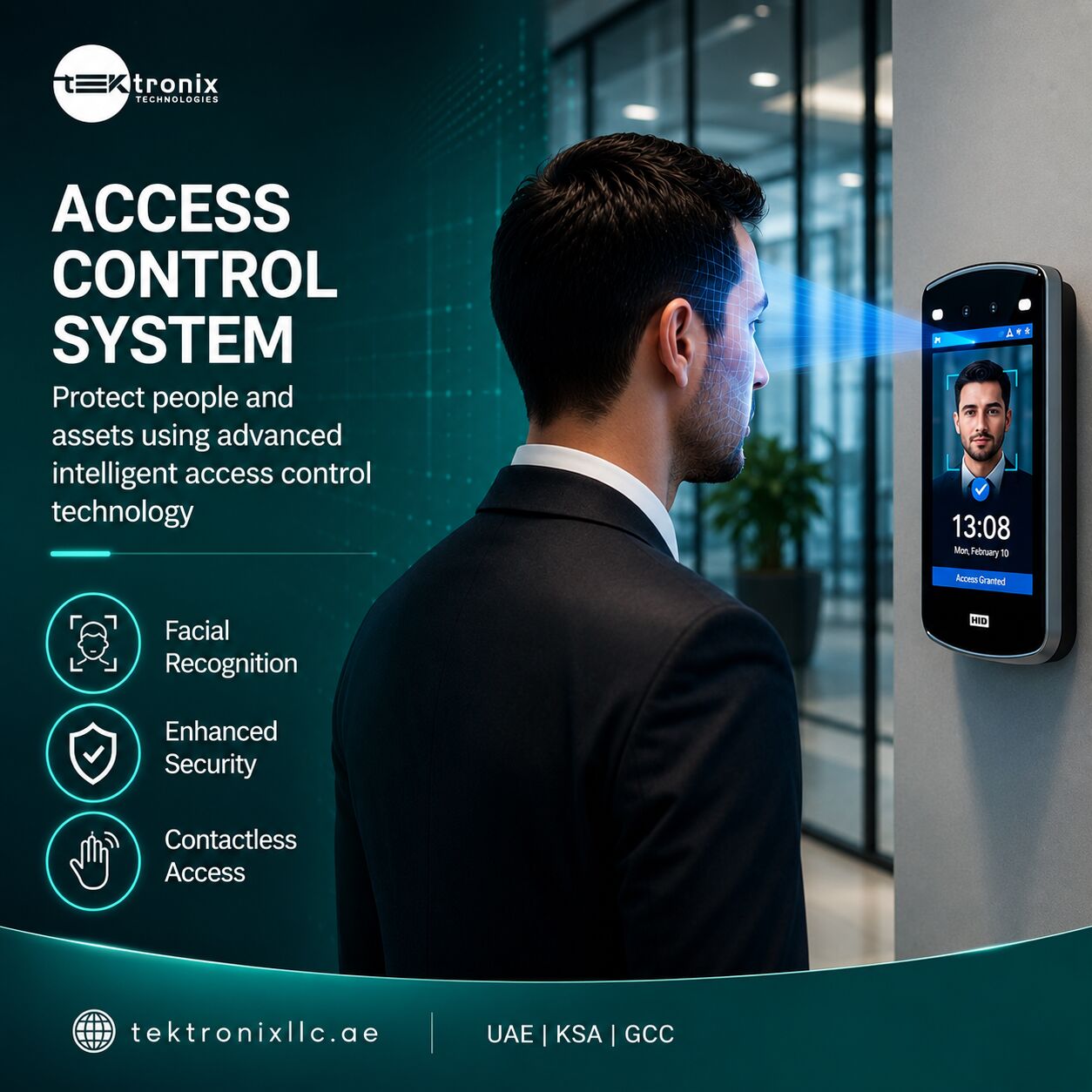
Access Control System: The Core Layer of Smart Security
At its foundation, this technology still performs the same basic job it always has — deciding who can pass through a specific door, and when — but modern platforms now expose that decision-making as data other systems can act on. A single credential event can now trigger a camera to record, a dashboard to update, and an automated report to log the activity, turning what used to be an isolated mechanical decision into a data point feeding the broader security picture.
Biometric Access Control Dubai: Where Identity Meets Infrastructure
Deployments across the emirate increasingly tie facial or fingerprint verification directly into building-wide identity infrastructure, rather than treating biometric enrollment as a separate, siloed database maintained only for door access. This convergence means a single verified identity can follow an employee from the building entrance to a restricted lab to a visitor log entry, without requiring separate credential systems for each context.
Door Access Control: The Physical Layer That Enforces Every Rule
However, sophisticated the software layer becomes, the physical hardware — strikes, magnetic locks, and door position sensors — is still what ultimately enforces every access decision at the point of entry. Selecting hardware rated for a specific door's traffic volume and security tier remains just as important as the platform managing it, since even the smartest software cannot compensate for a lock mechanism that fails under daily wear.
Mobile Access Control: Smartphones as the New Credential
As UAE workplaces lean further into mobile-first operations, smartphone-based credentials are increasingly displacing physical cards as the default method for everyday staff entry, with cards reserved as a fallback rather than the primary method. This shift also opens the door to richer context-aware access — a mobile credential can be tied to location services or scheduling data in ways a static plastic card never could.
Reader and controller hardware selection still comes down to matching the device to real deployment conditions — outdoor exposure, expected traffic volume, and integration requirements with existing building systems. Organizations exploring an access control system UAE facilities should treat hardware selection as a long-term infrastructure decision rather than a line-item cost, since replacing incompatible devices later is far more disruptive than specifying correctly the first time.
Even a well-integrated system will occasionally reject a legitimate credential due to a damaged card, a low phone battery, or a temporary biometric mismatch, and facilities need a clear fallback procedure for these moments rather than simply leaving a door propped open. A documented exception process — typically involving a manual verification step by security personnel and a logged override — keeps the audit trail intact even when the automated system cannot make a confident decision. Equally important is a clear escalation path for repeated failed attempts flagged by the platform's analytics layer, so security teams can distinguish a genuine technical glitch from a deliberate attempt to test the system's limits.
Comparing Proprietary and Open-Architecture Platforms
Conclusion
Access Control System technology in the UAE has moved from isolated door hardware to a connected security fabric, where Biometric Access Control Dubai deployments, layered Security Access Control System design, and reliable Door Access Control hardware all feed into one integrated platform. Mobile Access Control, the right Access Control Device choices, and open Access Control Solutions are what turn a building into a genuinely smart facility rather than a collection of disconnected systems. As Access Control System UAE and Access Control System Dubai deployments continue this shift toward integration, organizations that invest in open, future-ready platforms now will avoid the costly rip-and-replace projects that closed, legacy systems eventually force.
Access Control System
access control system UAE
Access Control Device