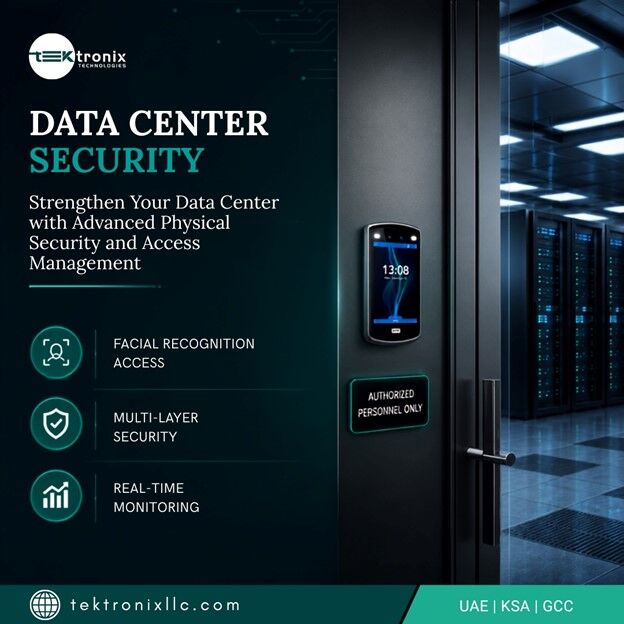
This guide examines where facility protection is heading across Bahrain and the GCC, the layered defenses every modern facility should have in place, and how operators can build a security posture that satisfies regulators, enterprise tenants, and increasingly sophisticated threat actors alike.
Why Data Center Security Is a Growing Priority for Bahrain and GCC Enterprises
Bahrain's early and sustained investment in cloud infrastructure and its position as a regional financial-services hub has placed facility protection under a level of scrutiny it never faced when data centers served purely local enterprise needs. International cloud providers, government tenants, and financial institutions now expect Bahraini and wider Gulf facilities to meet the same protection standards found in mature markets, from redundant physical barriers to continuous digital threat monitoring.
At the same time, the threat landscape has grown more complex. Nation-state actors, ransomware groups, and insider threats increasingly target the physical and network layers together, probing for the weakest link rather than attacking a single vector in isolation. A facility that hardens its firewalls but leaves a loading dock unmonitored, or that installs cameras but never encrypts data at rest, is still exposed.
Cybersecurity for Data Center Operations: Beyond the Perimeter Fence
Modern Cybersecurity for Data Center environments extends well past network firewalls and antivirus software. It now encompasses continuous vulnerability scanning across every connected system — building management platforms, HVAC controllers, and power distribution units included — because attackers have repeatedly shown they will pivot through an unpatched IoT device to reach far more sensitive systems.
Segmentation plays a central role here. Isolating operational technology networks from corporate IT, and further isolating tenant environments from one another in a colocation facility, limits how far an attacker can move laterally once they gain an initial foothold, containing an incident before it escalates into a facility-wide outage.
Best Practices for Building a Future-Ready Security Program
● Treat physical and digital security as one integrated program with shared incident-response procedures.
● Run regular penetration tests and physical red-team exercises rather than relying on point-in-time audits alone.
● Segment networks and physical zones so a single compromised credential cannot expose the entire facility.
● Maintain documented, tested disaster-recovery and incident-response plans reviewed at least annually.
● Continuously monitor emerging regional threat intelligence to adapt defenses ahead of new attack patterns.
Facilities that revisit their security architecture on a regular cycle — rather than treating a single deployment as a permanent solution — remain resilient as both regulatory expectations and attacker techniques continue evolving across the region.
Conclusion
Advanced Data Center Security for Bahrain and GCC enterprises depends on treating Cybersecurity for Data Center operations and physical protection as one system. Strong Data Center Encryption, modern Data Center Firewalls, and layered Data Center Access Control must work alongside continuous Data Center Surveillance, Data Center Intrusion Detection, and proactive Data Center Threat Detection. Enterprises pursuing Data Center Security Bahrain compliance or a coordinated Data Center Security GCC strategy achieve the strongest resilience with an experienced regional security partner.
For more information contact us on:
Tektronix Technology Systems Dubai-Head Office
[email protected]
+971 55 232 2390
Office No.1E1 Hamarain Center 132 Abu Baker Al Siddique Rd – Deira – Dubai P.O. Box 85955