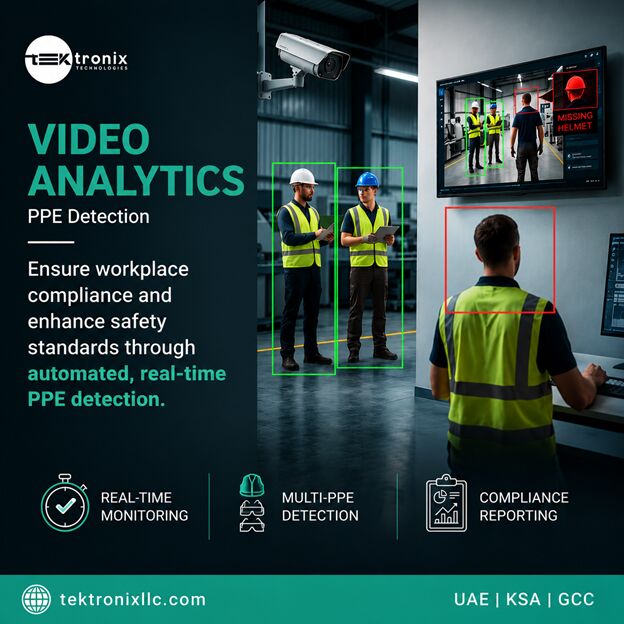
This guide explains how intelligent PPE detection works, what separates a genuinely reliable platform from a basic motion-sensing camera, and how safety leaders across Bahrain and the wider Gulf can deploy this technology to reduce workplace injuries and strengthen regulatory compliance.
Why PPE Compliance Monitoring Matters for Bahrain and GCC Industries
Construction sites, oil and gas facilities, ports, and manufacturing plants across the Gulf operate under some of the region's strictest occupational safety expectations, yet enforcing PPE compliance manually remains genuinely difficult at scale. A safety officer walking a large industrial site simply cannot observe every worker at every moment, and a missed violation — a worker without a hard hat near overhead machinery, or without safety glasses near a grinding station — can have serious, sometimes fatal consequences.
Bahrain's Ministry of Labour and equivalent occupational safety authorities across the GCC increasingly expect employers to demonstrate proactive, documented safety monitoring rather than relying on periodic manual inspections alone, making automated compliance verification both a safety imperative and a regulatory expectation.
Video Analytics Software: The Intelligence Behind Every Safety Camera
The camera itself is only the sensor; the real capability lives in the Video Analytics Software processing what it captures. Modern platforms run deep-learning models trained specifically to identify hard hats, high-visibility vests, safety harnesses, gloves, and eye protection across a busy, cluttered industrial scene — distinguishing a worker correctly wearing gear from one who is not, even amid moving machinery, variable lighting, and partial obstruction.
Edge processing has become a defining feature of leading platforms, allowing PPE detection to happen directly on or near the camera rather than routing every frame to a distant cloud server. This reduces latency for time-sensitive alerts and keeps sites operational even during a temporary network interruption common at remote industrial locations.
AI-Powered Video Analytics: From Passive Cameras to Active Safety Enforcement
For decades, a safety camera's job ended at capturing footage that someone might review after an incident had already occurred. AI-Powered Video Analytics changes that equation entirely by processing every frame as it happens, automatically identifying missing PPE and alerting site supervisors before a worker enters a hazardous zone unprotected, rather than discovering the gap during a post-incident investigation.
This shift matters enormously for Bahrain's expanding industrial and logistics sector, where large sites with hundreds of workers make manual, human-only safety monitoring practically impossible to scale consistently across every shift and every zone.
Best Practices for Deploying PPE Detection Successfully
● Pilot detection at one high-risk zone before a full-site rollout to validate accuracy under real conditions.
● Configure PPE rules specifically for each zone rather than applying one blanket policy site-wide.
● Integrate alerts directly into existing safety and incident-reporting workflows so supervisors act quickly.
● Review footage retention and worker privacy policies to ensure compliance with local regulations.
● Schedule periodic model updates to maintain detection accuracy as site conditions and PPE requirements evolve.
Sites that treat PPE detection as an evolving safety program — rather than a one-time camera installation — see the strongest long-term compliance improvement and the fewest workplace incidents.
Conclusion
Video Analytics is transforming workplace safety across Bahrain and the GCC, turning passive cameras into active protection. AI-Powered Video Analytics built on capable Video Analytics Software enables tailored Video Analytics Solutions, powered by Real-Time PPE Compliance Monitoring, High Accuracy Detection, and AI-Powered Object Recognition. Organizations pursuing Video Analytics Bahrain deployment or a coordinated Video Analytics GCC safety strategy achieve the strongest results with an experienced regional integration partner.
For more information contact us on:
Tektronix Technology Systems Dubai-Head Office
[email protected]
+971 55 232 2390
Office No.1E1 Hamarain Center 132 Abu Baker Al Siddique Rd – Deira – Dubai P.O. Box 85955