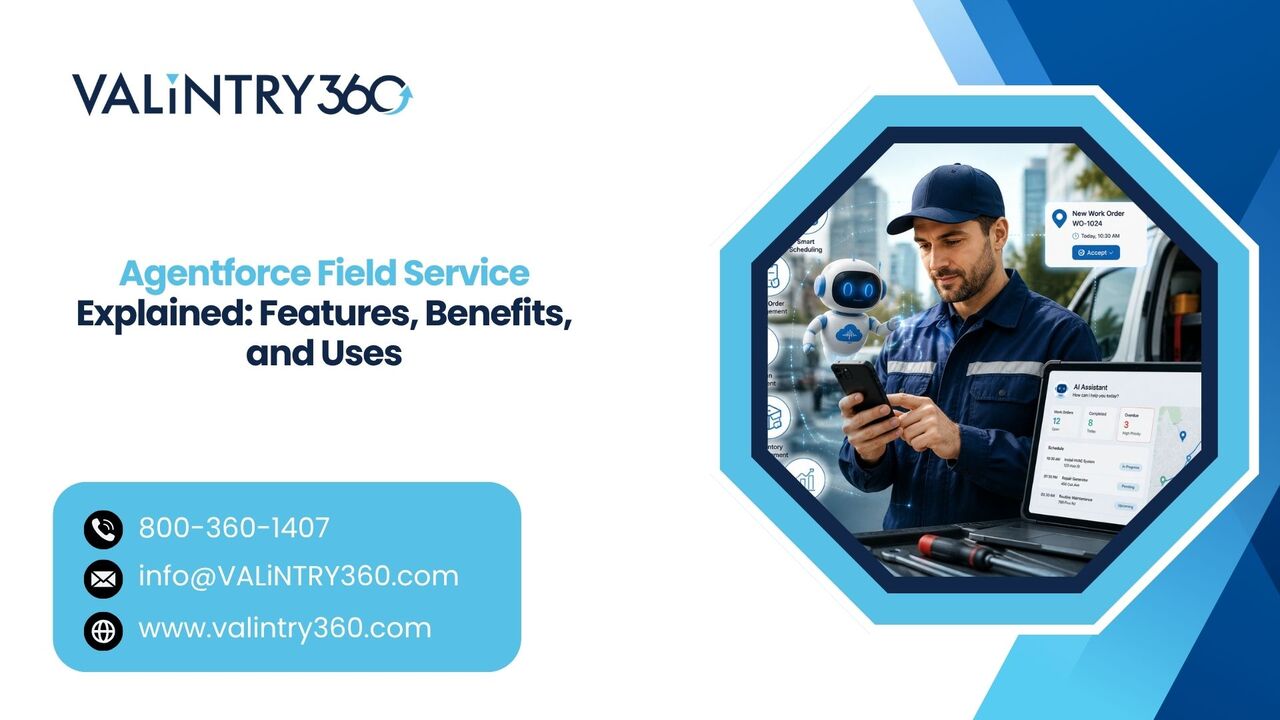
The change is easier to understand when viewed against the earlier role of field service software. Traditional Salesforce Field Service centered on work orders, service appointments, technician availability, territories, mobile access, scheduling rules, and asset records. Agentforce adds agents that can use operational context to assist with or carry out defined tasks. The result is a field-service model where scheduling logic and service records can support more automated decisions without removing the underlying operational controls.
Agentforce adds an agent layer to established field-service processes
Agentforce Field Service sits on the operational structure already used to manage field work in Salesforce. Work orders identify what has to be done, service appointments establish when work takes place, service resources represent the workforce, and territories help determine where technicians can operate. VALiNTRY360's current service page also identifies asset records, mobile execution, workflow automation, parts information, dashboards, and integrations as elements of the field-service setup.
The difference is what can happen with that information. Agentforce Field Service can place AI-assisted actions around scheduling, dispatch activity, technician support, customer updates, and post-job work. The quality of those actions still depends on the information beneath them. An agent working with incomplete skills data or inaccurate appointment rules can carry those weaknesses into its decisions, so the existing field-service foundation remains central to the system.
Scheduling and dispatch are among the clearest features
Scheduling is one of the most direct uses because field-service planning has many variables. Technician skill, location, availability, job duration, customer timing, parts, and service commitments can all affect an assignment. Salesforce says Agentforce can query possible technicians using location and required skills, consider customer constraints, offer suitable time slots, and create the corresponding service appointment.
The staffing environment makes those time savings relevant. The U.S. Bureau of Labor Statistics projects about 608,100 openings each year across installation, maintenance, and repair occupations from 2024 through 2034. The same occupational group had a median annual wage of $58,230 in May 2024. Those numbers don't prove that every field-service organization has a labor shortage, but they show the scale of workforce movement in jobs where technician time has a direct operating cost.
This is where Agentforce Field Service consulting becomes an operating-design issue rather than a feature-selection exercise. Scheduling policies need to reflect actual territories, skill requirements, operating hours, job priorities, travel constraints, and escalation rules. VALiNTRY360's page describes skill-based assignment and routing logic as part of its field-service work, which fits the dependency between agent actions and the scheduling structure underneath them.
Technician support has moved closer to the point of service
Agentforce's wider platform became generally available in October 2024, before Salesforce announced its field-specific functions in 2025. TechCrunch's October 2024 report described Agentforce as a platform for creating agents that could respond to changes in data, business rules, or existing automation. That move established the technical direction that later reached field-service work.
For technicians, the current use case goes beyond receiving a job address and work-order description. Salesforce says Agentforce can provide pre-work information, retrieve relevant manuals and previous service information, respond during troubleshooting, and help prepare post-work summaries. Its April 2025 announcement also described photo analysis and conversational troubleshooting that can adjust guidance based on what a technician has already tried.
Mobile execution therefore becomes part of Agentforce Field Service Implementation & Consulting. VALiNTRY360 lists guided tasks, real-time job information, asset details, offline access, service history, and customer information among the functions used by mobile teams. Those features matter because a field agent is only useful when technicians can reach the relevant information during the job and when their updates return to the office systems correctly.
Connected asset information gives agents more useful context
Asset-heavy service work depends on knowing what equipment is installed, where it is located, what has happened to it before, and what maintenance may be due. VALiNTRY360's current page describes service history, maintenance cycles, parts information, equipment records, and alerts as part of its asset framework. When those records are connected to work orders and technician activity, they provide context for planning future service.
This can support preventive-maintenance use cases. An organization may create work based on a maintenance schedule or a service signal, check the required technician skills, review parts availability, and then place the appointment into the scheduling process. The practical benefit is earlier coordination around known service needs. The exact result will depend on the quality of asset data and the rules used by the organization, so predictive or preventive claims should be tied to the configuration actually deployed.
Automation needs clear boundaries before agents act
Giving software permission to perform field-service actions changes the implementation risk. Appointment creation affects customers and technician schedules, while automated work-order updates can influence dispatch decisions and reporting. Organizations therefore need to define which actions an agent can perform, which information it may use, and when an employee should review the result.
The NIST AI Risk Management Framework Playbook provides a useful reference for that work. NIST organizes its voluntary AI risk guidance around Govern, Map, Measure, and Manage and applies trust considerations across AI design, deployment, and use. For a field-service project, that supports practical controls around testing, permissions, monitoring, exception handling, and ownership before an agent receives authority to change operational records.
A sound Agentforce Field Service Implementation should therefore begin with the jobs the organization wants to change and the information required to support them. VALiNTRY360's current offering covers configuration, scheduling design, mobile workforce setup, asset structures, workflow integration, and reporting. Those areas provide a useful implementation sequence because they establish