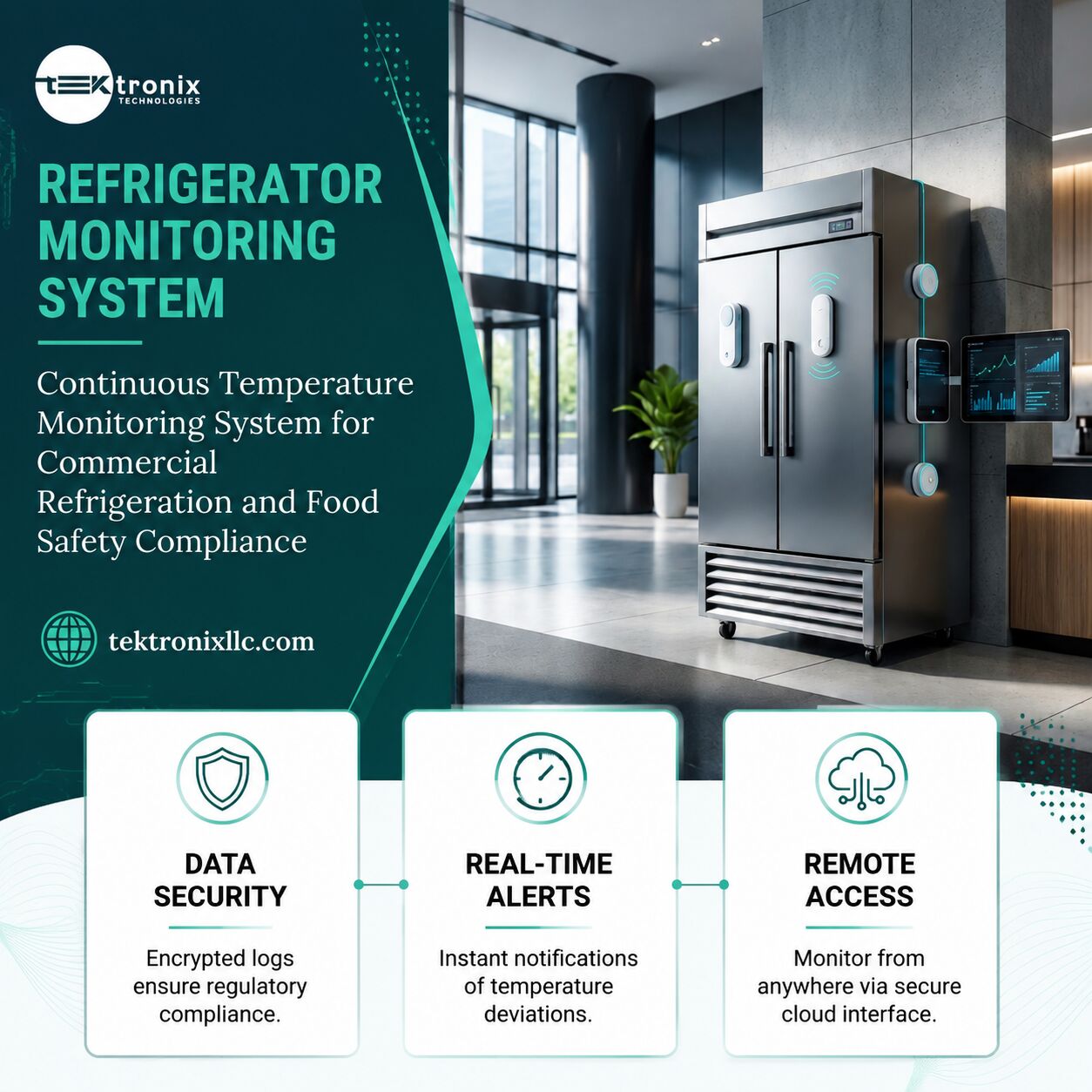
From calibrated Smart Sensors and flexible Wireless Temperature Monitoring connectivity, to continuous Remote Temperature Monitoring dashboards and tamper-evident Temperature Data Loggers, to intelligent Temperature Alerts that mobilise the right response team within seconds of an excursion — Tektronix Technology's hospital refrigerator monitoring platform delivers the complete cold chain protection infrastructure that Qatar and GCC healthcare facilities need to protect their patients, their inventory, and their accreditation standing.
FAQs
1. What is Refrigerator Monitoring and why is it critical for Qatar hospitals?
Refrigerator Monitoring is the continuous, automated measurement and recording of temperature conditions inside pharmaceutical refrigerators, freezers, cold rooms, and ambient medication storage areas — combined with real-time alerting and compliance reporting. It is critical for Qatar hospitals because the medications, vaccines, blood products, and biological specimens stored in hospital cold storage units are clinically irreplaceable within the timeframes available to respond to a refrigeration failure. Manual twice-daily temperature checks leave 22–24 hours of unmonitored exposure between readings — a window during which a compressor failure, power interruption, or door seal failure can drive storage temperatures outside safe ranges and compromise the entire unit's contents before any staff member is aware a problem exists. Qatar MOPH regulations, JCI accreditation standards, and QCHP pharmacy licensing requirements all mandate documented continuous temperature monitoring — a standard that only automated electronic monitoring can satisfy.
2. How do Smart Sensors maintain accuracy in Qatar's high-humidity hospital environments?
Smart Sensors in the Tektronix hospital monitoring platform are specified with IP67 environmental protection ratings that provide complete protection against dust ingress and temporary immersion in water — making them suitable for installation in the high-humidity cold room environments, laboratory specimen storage areas, and blood bank freezer rooms that characterise hospital cold storage infrastructure. Sensor accuracy is maintained through factory calibration against NIST-traceable reference standards at deployment, with 12-monthly recalibration services that generate new calibration certificates for inclusion in the hospital's MOPH and JCI quality documentation files. The platinum RTD or NTC thermistor sensing elements used in medical-grade monitoring sensors maintain measurement accuracy of ±0.1°C to ±0.5°C across the full monitoring range regardless of ambient humidity levels — unlike consumer-grade temperature sensors whose accuracy degrades significantly in high-humidity conditions.
3. How does Wireless Temperature Monitoring integrate with Hamad Medical Corporation's IT network?
Wireless Temperature Monitoring deployment at Hamad Medical Corporation facilities follows HMC's Medical Device Integration (MDI) security policy, which requires IoT devices connecting to HMC network infrastructure to authenticate via device certificates, transmit data exclusively over encrypted channels (TLS 1.2 or higher), and operate within defined network segments that are isolated from clinical systems including patient monitoring, infusion pump control, and imaging equipment. The Tektronix platform supports all three wireless connectivity options available in HMC's infrastructure — enterprise Wi-Fi integration for units in areas with comprehensive WLAN coverage, LoRaWAN gateway deployment for areas where Wi-Fi coverage is limited or where network separation from HMC's primary IT infrastructure is preferred, and 4G cellular for satellite locations and mobile cold chain monitoring applications. All wireless deployments are preceded by a radio frequency survey to confirm coverage adequacy and interference absence in the specific installation environment.
4. What Temperature Alerts does the system generate for blood bank and chemotherapy storage excursions?
The Temperature Alerts generated for blood bank and chemotherapy cold storage units are configured to the specific temperature limits mandated by Qatar Blood Bank standards (which follow AABB — American Association of Blood Banks — technical requirements) and QCHP/MOPH chemotherapy handling guidelines respectively. For blood product storage, alert thresholds are set at the narrow tolerances defined for each product category: red blood cells (2°C to 6°C), platelets (20°C to 24°C with agitation monitoring), and fresh frozen plasma (≤-18°C or ≤-25°C depending on product classification). For chemotherapy cold storage (typically 2°C to 8°C), alert thresholds incorporate both upper and lower deviation limits, with a configurable pre-alert warning at 80% of excursion threshold to give pharmacy staff maximum response time before a clinical quality decision is required. All alerts are delivered simultaneously via SMS, email, and mobile push notification to the designated on-call escalation chain, with automatic work order generation to facilities management and automatic escalation if the initial notification is not acknowledged within the configured response time window.
5. How do Temperature Data Loggers support JCI accreditation surveys for Qatar hospitals?
Temperature Data Loggers in the Tektronix platform generate the continuous, tamper-evident electronic temperature records that JCI surveyors review during accreditation surveys under standard MM.05.01.01 (medication management — storage). The platform's compliance reporting module produces JCI-formatted temperature logs for any storage unit over any defined date range — exportable as PDF reports with the hospital's name, unit identification, sensor calibration reference, measurement interval, temperature range limits, excursion events, and corrective actions taken. For surveyors reviewing medication storage compliance, these reports provide 12 months of continuous, uninterrupted temperature history for every monitored unit — compared to the hand-written log charts with gaps, illegible entries, and missed recording periods that manual monitoring produces. The platform also generates exception reports that specifically document all excursion events with their start time, duration, maximum temperature deviation, and the corrective action record — the specific evidence format that JCI surveyors request when reviewing a hospital's excursion management capability under the MM chapter.
Contact Us:
+971 50 814 4086