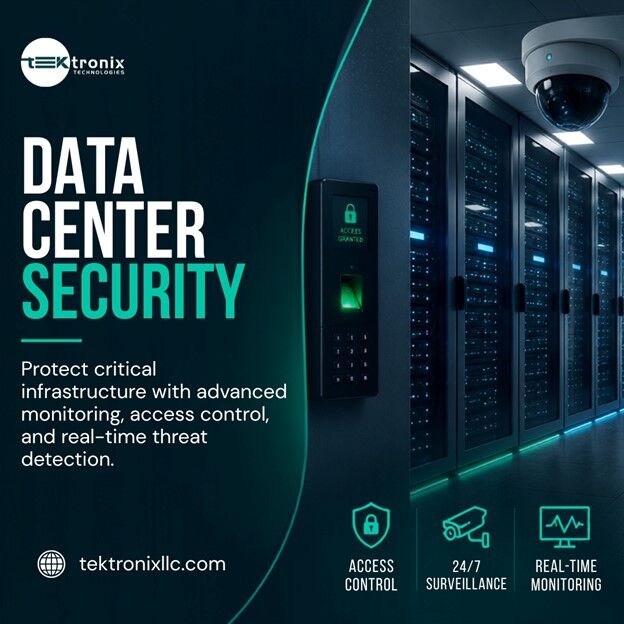
Every organisation that processes, stores, or transmits data through a data center environment — which in 2025 means virtually every organisation of any operational scale in Oman and the GCC — is exposed to the full spectrum of physical and logical threats that professional data center security architecture is designed to defeat. Tektronix LLC delivers the six-layered security framework that closes every gap. Explore our six-layered data center security solutions for Oman and the GCC and discover why every office in the Gulf depends on enterprise-grade data center protection, regardless of organisational size.
The Modern Threat Landscape Facing Oman and GCC Data Centers
The GCC has become one of the world's most actively targeted regions for cyber-physical attacks on data infrastructure, a direct consequence of the extraordinary concentration of energy sector operational technology, financial system data, and government digital transformation investment that Vision 2030 and Oman Vision 2040 have placed within digital infrastructure environments that are still maturing their security posture relative to the value of the assets they contain. Saudi Aramco's 2012 Shamoon attack — which destroyed the data on approximately thirty-five thousand corporate computers — demonstrated the consequences of inadequate cyber-physical security integration in a GCC energy sector environment. Qatar's National Cyber Security Agency (NCSA) has documented a sustained increase in threat actor activity targeting Qatari critical infrastructure since 2022. And Oman's Information Technology Authority (ITA) has progressively strengthened its cybersecurity framework requirements precisely in response to the growing sophistication and frequency of threats targeting Omani digital infrastructure across both government and private sector environments.
Why Office-Based Data Infrastructure Needs the Same Protection as Dedicated Facilities
The growth of hybrid cloud architectures, colocation facility usage, edge computing deployments, and on-premise server room infrastructure has distributed data center-equivalent security requirements across a far broader range of physical environments than the purpose-built, raised-floor, chilled-aisle facilities that traditionally defined the data center category. Oman's mid-market organisations — the professional services firms in Muscat's Al Khuwair district, the oil field logistics companies operating from Sohar's industrial zone, and the trading groups managing regional inventory from their Salalah Free Zone facilities — routinely operate server rooms, network equipment cabinets, and edge compute infrastructure in environments that receive none of the physical or logical security investment applied to a purpose-built data center, despite housing the same categories of sensitive operational and customer data.
Sector-Specific Applications Across Oman and GCC Industries
The case for enterprise-grade data center security extends differently across Oman and GCC industry sectors, each of which carries a distinct combination of regulatory obligations, threat exposure profile, and operational continuity requirements. For Oman's financial services sector — Bank Muscat, Ahli Bank, Bank Dhofar, Sohar International, and the Muscat Stock Exchange's trading infrastructure — CBO information security standards create an explicit compliance obligation for physical and logical data center security governance that directly maps to Tektronix LLC's six-layer architecture. A CBO supervisory examination finding of inadequate data center physical security controls can result in remediation requirements, operational restrictions, and reputational consequences that far exceed the investment required to deploy a compliant security architecture proactively.
For Oman's healthcare sector — Sultan Qaboos University Hospital, the Royal Hospital in Muscat, and the Ministry of Health's regional hospital network — the patient data protection obligations created by Oman's electronic health records digitisation programme create data center security requirements that align directly with the physical access audit trail, encryption governance, and surveillance documentation capabilities of Tektronix LLC's platform. For Oman's logistics and port operations sector — Port Sultan Qaboos, the Port of Salalah, and the Duqm Special Economic Zone's cargo handling infrastructure — cargo management system and supply chain data security requirements under ISO 28000 supply chain security certification create a documented security governance obligation that a professional data center security architecture directly satisfies. Across every one of these sectors, the question facing Oman and GCC organisations in 2025 is not whether data center security investment is justified but whether the cost of inadequate protection — regulatory penalty, operational disruption, reputational damage, and data breach consequence — is a risk the organisation's leadership is genuinely prepared to carry.
Conclusion
Every GCC organisation that operates data infrastructure carries a security obligation that Data Center Security architecture fulfils across six integrated layers — converged Cybersecurity for Data Center operations, AES-256 Data Center Encryption, micro-segmented Data Center Firewalls, biometric Data Center Access Control, AI-powered Data Center Surveillance, and multi-sensor Data Center Intrusion Detection.
Proactive Data Center Threat Detection identifies risks before breaches occur, and whether the requirement is ITA-compliant Data Center Security Oman architecture or a unified Data Center Security GCC framework spanning every Gulf market, Tektronix LLC delivers every layer.
Contact Tektronix LLC today — because every office in Oman and the GCC depends on enterprise-grade data center protection.
For more information contact us on:
Tektronix Technology Systems Dubai-Head Office
[email protected]
+971 55 232 2390
Office No.1E1 Hamarain Center 132 Abu Baker Al Siddique Rd – Deira – Dubai P.O. Box 85955