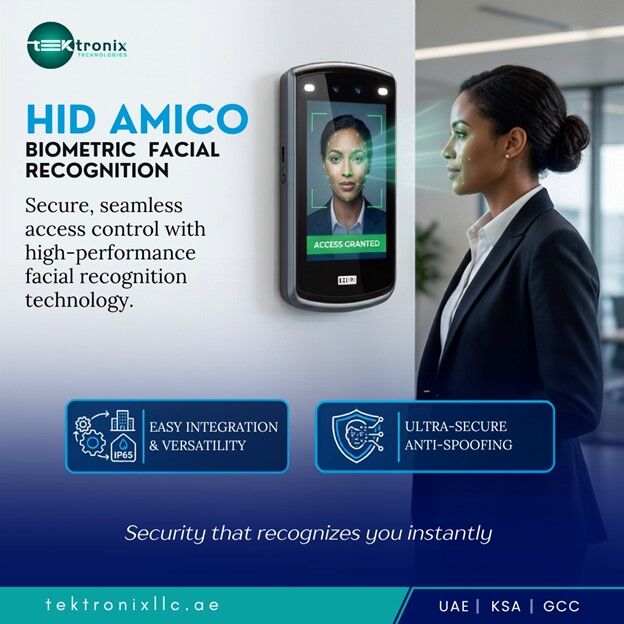
Facial recognition access has moved well past the novelty phase. What used to be a premium add-on for flagship lobbies is now a mainstream requirement for security teams that need faster throughput, stronger identity verification, and a genuinely touchless experience at the door. This article covers how the reader works, what sits behind it on the controller side, and why Tektronix has become the go-to integration partner for HID deployments across the UAE.
What Is HID Amico and Why It Matters for UAE Facilities
HID Amico is a compact, wall or turnstile-mounted terminal that combines a high-resolution camera, an infrared depth sensor, and an onboard processor capable of matching a face against an enrolled database in a fraction of a second. Unlike earlier facial recognition hardware that relied on a cloud round-trip for every match, the processing happens at the edge, on the device itself, which keeps verification fast even when network connectivity is inconsistent.
For UAE facility managers, the appeal is straightforward: no cards to issue, print, or replace when lost, no PINs to reset, and no touchpoint that hundreds of staff members share throughout the day. Main lobbies in Dubai and Abu Dhabi commercial towers were among the first to adopt this hardware precisely because it removes the queueing and hygiene concerns that badge-based turnstiles create during peak morning arrival windows.
The shift also reflects a broader change in what enterprise security teams expect from access hardware. A card can be lent, lost, or cloned; a face cannot be handed to a colleague at the door. For departments handling sensitive data, financial transactions, or regulated operations, that single distinction is often enough to justify migrating the highest-security doors to facial recognition first, before extending the rollout to general staff entrances.
HID Amico Facial Recognition: How Verification Works
HID Amico Facial Recognition matches a live camera capture against a securely stored facial template rather than comparing raw images, so the system never needs to store an actual photo of an enrolled user in a way that could be exposed or misused. Matching occurs locally on the device, which keeps response times consistent even across sites with limited bandwidth.
Enrollment itself takes seconds: a new employee stands in front of the terminal, the system captures several reference angles, and the resulting template is pushed to every authorized door on the network. This is a significant improvement over card-based onboarding, where a physical badge has to be produced and physically handed to the new starter before they can access anything.
Accuracy under real-world lobby conditions is where this generation of hardware distinguishes itself from earlier facial systems. Variable lighting, staff wearing glasses or face coverings, and fast-moving traffic all used to degrade match reliability significantly. Current-generation processing handles these variables far more gracefully, which is why facility teams no longer need to reserve facial recognition for slow, low-traffic doors and can deploy it confidently at a building's busiest entrance.
Common Rollout Pitfalls to Avoid
The most frequent delay is discovering during installation that a proposed mounting location faces direct sunlight for part of the day, degrading capture reliability. The second common pitfall is under-planning enrollment: without a dedicated rollout window, adoption drags on and staff default back to card credentials far longer than intended, delaying the operational benefits the upgrade was meant to deliver.
A third, less obvious pitfall is treating every door identically. Not every entrance needs facial recognition on day one — many successful rollouts start with the main lobby and one or two high-security interior doors, prove out enrollment and support processes at that scale, and only then extend the hardware to secondary entrances once the workflow is well understood by both IT and the front-desk team.
Measuring Success After Go-Live
Facility and security teams typically track three numbers in the first 90 days: the percentage of staff enrolled and using facial credentials as their primary method, average time-to-match at the busiest reader, and the number of fallback-credential uses at doors expected to be fully migrated. A steady rise in facial-first usage alongside a falling fallback rate is the clearest sign the deployment has taken hold.
For a tailored deployment plan covering reader selection, controller sizing, and enrollment scheduling, reach out through our HID access control solutions team.
Conclusion
HID Amico gives UAE facilities a faster, more secure alternative to card-only entry, built on the HID Amico Facial Recognition Reader and backed by the HID Aero Controller for reliable, network-resilient decision-making. As part of a broader HID Access Control platform that also supports HID Mobile Access, every credential works together, while AI-Powered Anti-Spoofing and Liveness Detection keep unattended doors genuinely secure. For organizations evaluating HID Amico UAE, HID Amico Dubai, or HID Amico Abu Dhabi deployments, Tektronix delivers proven, hands-on integration experience.
For more information contact us on:
Tektronix Technology Systems Dubai-Head Office
[email protected]
+971 50 814 4086
+971 55 232 2390
Office No.1E1 Hamarain Center 132 Abu Baker Al Siddique Rd – Deira – Dubai P.O. Box 85955