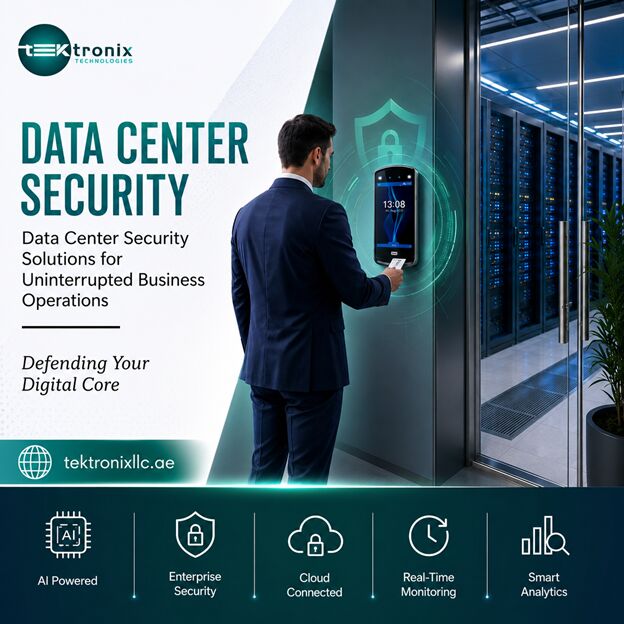
A modern data center is not defended by a fence and a security guard alone. Operators now need to coordinate physical access control, video surveillance, intrusion detection, and network-facing protections as one integrated program, because a gap in any single layer can undermine the rest. This article walks through what a complete UAE data center security deployment looks like, the technology choices involved at each layer, and why Tektronix has become a trusted implementation partner for facility operators across the Emirates.
Why UAE Data Centers Need a Layered Security Approach
Data centers sit at the intersection of physical security and information security in a way few other facility types do. A breach of the physical perimeter can be just as damaging as a network intrusion, since direct access to server racks bypasses firewalls, encryption, and every other digital control entirely. This is why serious operators design physical and digital protections together rather than treating them as separate budgets and separate teams.
UAE facilities hosting regulated workloads — banking infrastructure, government cloud tenancy, healthcare data, or multinational enterprise systems — face an added layer of scrutiny. Clients and regulators increasingly require documented evidence of physical security controls as part of vendor due diligence, and a facility that cannot produce a clear access log or incident history struggles to win or retain that business regardless of how strong its network security posture looks on paper.
Uptime commitments add further pressure. A single unauthorized entry event, even one that causes no direct damage, can trigger an incident response process that disrupts operations and damages client confidence. Facility operators increasingly treat physical security investment as directly tied to uptime SLA performance rather than a separate line item.
Insurance underwriters covering data center facilities have also become more specific in their requirements, often asking for documented evidence of layered controls — perimeter detection, access tiering, and surveillance retention periods — as a condition of coverage or a factor in premium calculation. Facility operators that can produce this documentation quickly, rather than assembling it under pressure after an incident, are in a materially stronger position both operationally and commercially.
Cybersecurity for Data Center Facilities: Where Physical Meets Digital
Cybersecurity for Data Center operations increasingly overlaps with physical security infrastructure. Access control logs, surveillance footage, and intrusion alerts all now feed into the same security operations center dashboards used to monitor network activity, giving analysts a single timeline that correlates a badge swipe or an unrecognized face at the door with any corresponding network event happening at the same moment.
This convergence matters because sophisticated attackers increasingly combine physical and digital tactics — for example, gaining brief physical access to plant a rogue device on the network rather than attempting a purely remote intrusion. Facilities that monitor physical and digital signals together are far better positioned to catch this kind of blended attack than those running the two disciplines in isolation.
Common Rollout Pitfalls to Avoid
The most frequent gap in early-stage deployments is treating physical and network security as entirely separate procurement tracks, which leads to systems that technically function but never share data with each other. The second common pitfall is under-resourcing the security operations center that monitors the resulting alerts — sophisticated sensors and cameras deliver limited value if nobody is properly trained to interpret and act on what they report.
A third pitfall specific to data centers is underestimating how quickly retention and storage requirements grow once high-resolution surveillance and detailed access logging are running across every layer simultaneously. Facilities that plan storage capacity for a fixed retention period from the outset avoid the disruptive mid-project scramble of expanding storage infrastructure after go-live, when historical footage is already at risk of being overwritten sooner than compliance requirements allow.
Measuring Success After Go-Live
Facility and security teams typically track several indicators in the months after a layered deployment goes live: the number of physical anomalies correlated with network events, mean time to respond to a confirmed multi-signal alert, and the percentage of access events successfully tied to a verified biometric or dual-factor credential. A steady improvement across these metrics is the clearest sign the layered approach is functioning as an integrated program rather than a set of disconnected point solutions.
For a tailored deployment plan covering perimeter sensor, access control tiering, and surveillance analytics, reach out through our data center security solutions team.
Conclusion
Data Center Security in the UAE now demands a layered program rather than a single control. Strong Data Center Access Control and Data Center Surveillance work alongside Data Center Intrusion Detection and Data Center Threat Detection to close gaps no single system can catch alone, while Data Center Firewalls, Data Center Encryption, and Cybersecurity for Data Center operations protect the network layer. For facilities seeking a proven Data Center Security UAE, Data Center Security Dubai, or Data Center Security Abu Dhabi partner, Tektronix delivers integrated, hands-on deployment experience.
For more information contact us on:
Tektronix Technology Systems Dubai-Head Office
[email protected]
+971 50 814 4086
+971 55 232 2390
Office No.1E1 Hamarain Center 132 Abu Baker Al Siddique Rd – Deira – Dubai P.O. Box 85955