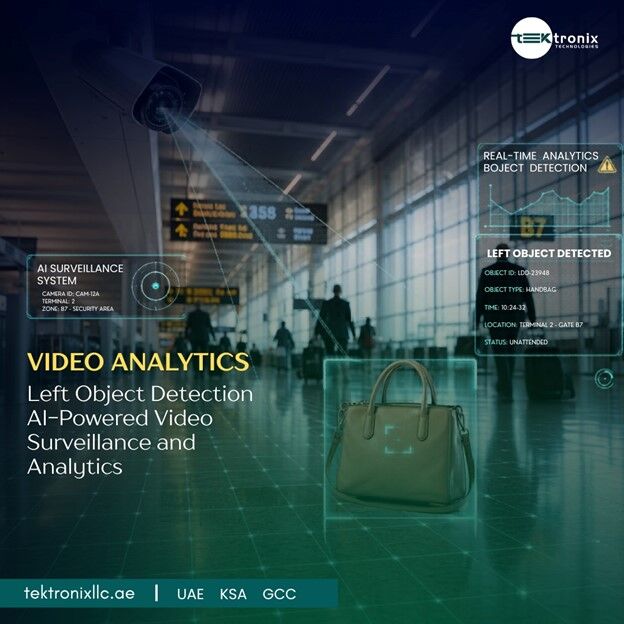
Traditional CCTV was always a recording tool first and a detection tool a distant second — footage existed mainly to be reviewed after an incident had already occurred. Left object detection flips that model, turning every camera into an active sensor that continuously evaluates the scene and raises a flag the instant something changes. This article covers how the technology works, what makes a deployment reliable in the UAE's specific operating conditions, and why Tektronix has become a trusted integration partner for facilities across the Emirates.
The stakes for getting this right are higher in the UAE than in many markets, given the concentration of high-footfall venues — mega-malls, transit hubs, and large-scale event spaces — that host tens of thousands of visitors daily. A security guard reviewing a bank of forty camera feeds cannot realistically notice a single unattended bag among a moving crowd, but an AI model watching every feed simultaneously never loses attention and never needs a coffee break.
What Is AI-Powered Video Analytics and Why It Matters
AI-Powered Video Analytics applies machine learning models directly to a camera's live feed, allowing the system to distinguish between a person walking through frame, a vehicle passing by, and an object that has been placed down and left unattended. Earlier generations of motion-based analytics could only detect that something moved — they had no concept of what that something actually was, which led to a flood of alerts for anything from a shifting shadow to a plastic bag blowing across a parking lot.
Modern AI models are trained to recognize object categories, track them across frames, and understand context — a bag carried by a person is simply luggage in motion, but the same bag set down and left stationary while its owner walks away becomes a flagged event. This contextual understanding is what separates a genuinely useful analytics platform from a basic motion sensor with a camera attached.
Beyond left object use cases, the same underlying platform typically supports a broader library of detection rules — perimeter line-crossing, loitering, crowd density thresholds, and wrong-direction movement through a controlled corridor. Facilities investing in AI-powered analytics for left object detection usually find it makes sense to activate several of these complementary rule sets at the same time, since the camera infrastructure and processing capability are already in place regardless of how many rule types are switched on.
Common Rollout Pitfalls to Avoid
The most frequent issue is leaving default sensitivity settings unchanged after installation, which generates enough false alarms in the first weeks that security staff begin dismissing every notification without checking it. The second common pitfall is placing cameras purely for general surveillance coverage rather than specifically for left object detection, resulting in angles that technically show the area but perform poorly for tracking stationary objects on the ground.
A third pitfall is skipping staff training on how to act once an alert arrives. A perfectly tuned detection system still fails operationally if the guard receiving the notification does not know the facility's standard response procedure — whether that means a visual check from a distance, a controlled evacuation of the immediate area, or an immediate call to local authorities depending on the nature and location of the flagged item.
Measuring Success After Go-Live
Facility and security teams typically track three numbers in the first 90 days after deployment: the ratio of confirmed genuine alerts to total alerts generated, average response time from alert to security staff arrival at the location, and the number of manually reported incidents that the system also caught automatically. A rising confirmed-alert ratio alongside falling response times is the clearest sign the platform has been tuned correctly for the site.
Longer-term, many facilities also track how detection performance holds up across seasonal changes — the shift in lighting conditions between summer and winter, or the sharp rise in footfall during major UAE events and holiday periods. A platform that maintains consistent accuracy through these swings, without needing a full recalibration every few months, delivers materially lower ongoing management overhead than one that requires frequent manual adjustment to stay reliable.
For a tailored deployment plan covering camera placement, threshold configuration, and alert routing, reach out through our video analytics solutions team.
Conclusion
Video Analytics gives UAE facilities the ability to catch unattended items the moment they appear rather than after the fact. Built on AI-Powered Video Analytics and Real-Time Object Detection, supported by Advanced AI Recognition and Prolonged Detection thresholds, alerts arrive with confidence thanks to False Alarm Reduction tuning and reach staff instantly through Instant Alerts and Notifications. For facilities seeking a proven Video Analytics UAE partner, Tektronix combines site-specific tuning with hands-on local deployment experience.
For more information contact us on:
Tektronix Technology Systems Dubai-Head Office
[email protected]
+971 50 814 4086
+971 55 232 2390
Office No.1E1 Hamarain Center 132 Abu Baker Al Siddique Rd – Deira – Dubai P.O. Box 85955