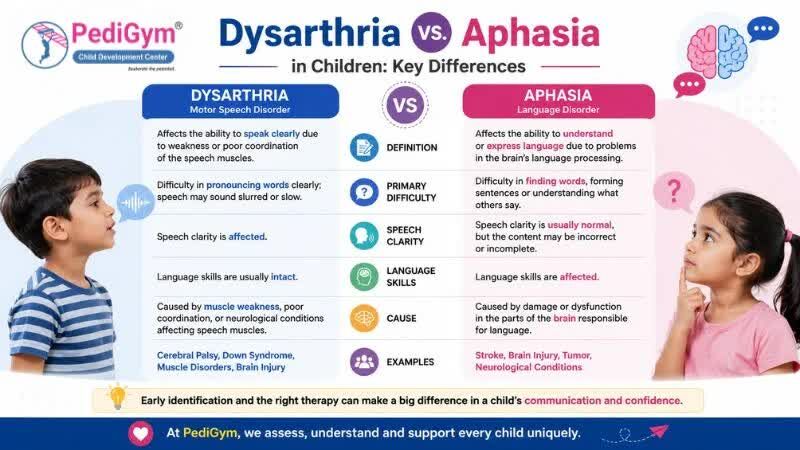
Dysarthria and aphasia can both affect a child’s ability to communicate, but they involve very different aspects of speech and language. Dysarthria primarily affects the muscles and coordination needed to produce clear speech, which may result in slurred, slow, weak, breathy, or difficult-to-understand speech, while a child’s understanding and thoughts may remain intact. Aphasia, on the other hand, affects the brain’s ability to understand, process, or use language and may make it difficult for a child to find the right words, follow instructions, form meaningful sentences, or express ideas. The blog also explains childhood apraxia of speech, a condition involving difficulty planning and sequencing speech movements even when the speech muscles are not weak. Understanding these differences is important because each condition requires a different assessment and therapy approach. The article discusses common causes, including neurological conditions, cerebral palsy, traumatic brain injury, pediatric stroke, and other conditions affecting the brain or speech motor system, along with the signs parents may notice at home. It explains how a speech-language pathologist evaluates speech clarity, oral-motor coordination, language comprehension, vocabulary, sentence formation, communication during everyday activities, developmental milestones, and medical history to identify the underlying difficulty. The blog also highlights how speech therapy can support children with dysarthria by working on speech clarity, breath support, oral coordination, voice quality, and communication strategies, while language therapy for aphasia may focus on vocabulary, sentence formation, comprehension, word retrieval, functional communication, and age-appropriate reading and writing skills. Parents can also support communication at home by giving children enough time to speak, using simple sentences, reducing background noise, encouraging communication through play and books, and praising their communication efforts rather than constantly correcting mistakes. Early assessment is especially important when communication difficulties persist, worsen, interfere with daily interactions, or are accompanied by sudden loss of speech or language skills. With an accurate assessment and individualized support, children can receive therapy that addresses their specific communication needs and helps them participate more confidently in everyday life.
Visit Us For More Information:-
https://pedigym.com/dysarth ...Address: 382, Sector 17, Faridabad, Haryana 121007
Phone: 9873971012
Email:
[email protected]Concerned about your child’s speech or language development? Get a professional speech and language assessment for the right guidance.