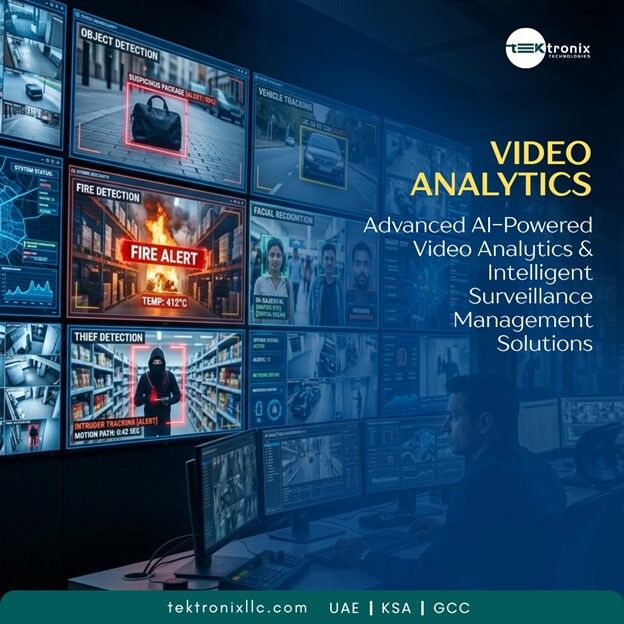
This guide explores how intelligent camera systems work, what separates a genuinely capable platform from a basic recording setup, and how security teams in the Kingdom and across the region can deploy these tools to move from reactive monitoring to proactive protection.
The Shift from Passive Recording to Intelligent Monitoring
For decades, a security camera's job ended at capturing footage. Someone still had to watch the feed live or scrub through hours of recording after the fact to find anything useful — a process that is slow, labour-intensive, and prone to human fatigue during long, uneventful shifts. AI-Powered Video Analytics changes that equation entirely by processing every frame as it happens, automatically identifying faces, counting people, tracking movement patterns, and surfacing only the events that actually require human attention.
This shift matters enormously for Saudi Arabia's rapidly expanding smart-city and giga-project landscape, where the sheer scale of new infrastructure — from transit hubs to entertainment districts — makes manual, human-only monitoring practically impossible to scale cost-effectively.
Video Analytics Software: The Intelligence Layer Behind Every Camera
The camera itself is only the sensor; the real capability lives in the Video Analytics Software processing what it captures. Modern platforms run deep-learning models trained to distinguish a person from a shadow, a genuine intruder from a stray animal, and a loitering individual from someone simply waiting for a ride — distinctions that dramatically reduce the false alarms that once made security teams tune out camera alerts altogether.
Edge processing has become a defining feature of leading platforms, allowing analysis to happen directly on or near the camera rather than routing every frame to a distant cloud server. This reduces latency for time-sensitive alerts and keeps facilities operational even during a temporary network interruption.
Video Analytics Solutions Across Saudi and GCC Industries
The strongest Video Analytics Solutions are rarely generic — they are tuned to the specific risks of the environment they protect. A retail mall in Riyadh needs crowd-density monitoring and queue analysis; a hospital in Jeddah needs restricted-zone alerts around pharmacies and neonatal units; a logistics hub needs vehicle and license-plate recognition at gate checkpoints. Deploying the right configuration for each environment is what separates a genuinely useful system from an expensive camera network that nobody actively uses.
● Retail and hospitality: queue length monitoring, crowd density alerts, and loss-prevention analytics.
● Healthcare: restricted-zone access alerts around pharmacies, labs, and patient-only areas.
● Transportation and logistics: vehicle recognition, license-plate capture, and gate-checkpoint automation.
● Government and critical infrastructure: perimeter intrusion detection and watchlist screening.
● Education: unauthorized visitor alerts and after-hours campus monitoring.
Best Practices for Deploying Video Analytics Successfully
● Pilot analytics at a small number of high-value cameras before a full-site rollout.
● Tune false-positive thresholds specifically for each site rather than using default factory settings.
● Review facial-enrollment consent language to ensure it satisfies Saudi PDPL requirements before go-live.
● Integrate alerts directly into existing security operations workflows so staff are not monitoring a separate screen.
● Schedule periodic model updates to keep anti-spoofing and detection accuracy current against new techniques.
Facilities that treat intelligent video security as an evolving program — rather than a one-time camera installation — see the strongest long-term accuracy and the fastest return on their security investment.
Conclusion
Video Analytics is redefining physical security across Saudi Arabia and the GCC, turning passive cameras into active protection. AI-Powered Video Analytics built on capable Video Analytics Software enables sector-specific Video Analytics Solutions, powered by Real-Time Identity Verification, AI-Powered Threat Detection, and reliable Anti-Spoofing safeguards. Organizations pursuing Video Analytics KSA compliance or a coordinated Video Analytics GCC rollout achieve the strongest results with an experienced regional integration partner.
For more information contact us on:
Tektronix Technology Systems Dubai-Head Office
[email protected]
+971 55 232 2390
Office No.1E1 Hamarain Center 132 Abu Baker Al Siddique Rd – Deira – Dubai P.O. Box 85955