This guide breaks down the physical and digital layers that make up a resilient data center defence strategy, the standards that govern facility design in the region, and how to select the right security partner for a mission-critical UAE deployment.
What Does Data Center Security Actually Cover?
Effective Data Center Security is never a single product — it is a layered strategy that combines the physical facility, its network perimeter, and the people who manage it. A resilient design assumes that no single control is perfect, so each layer is built to catch what the previous one might miss, from the outer fence line down to the individual server rack.
Industry frameworks such as ANSI/TIA-942 formalize this approach, defining physical security, access control, and monitoring requirements alongside power, cooling, and cabling standards, and rating facilities across four tiers of redundancy and resilience. Facilities pursuing Tier 3 or Tier 4 status carry correspondingly stricter security expectations, since the data they host is typically classified as mission-critical.
Cybersecurity for Data Center Environments
Physical barriers alone cannot stop a network-based attack, which is why Cybersecurity for Data Center operations must run in parallel with physical controls. This includes network segmentation between colocation tenants, continuous vulnerability management, hardened operating system baselines, and strict change-control procedures for any equipment connected to production infrastructure.
A mature program treats physical and digital security as one connected discipline: a compromised badge reader or an unmonitored maintenance port can just as easily open the door to a network breach as a phishing email, so both domains need to be governed by the same risk framework.
Data Center Encryption for Data at Rest and in Transit
Even with strong perimeter defences, sensitive information must be protected in case a device or storage medium is ever physically removed or intercepted. Data Center Encryption protects information both while it sits on disk and while it moves across internal or external networks, ensuring that data remains unreadable to anyone without the correct decryption keys.
● Encryption at rest for storage arrays, backup media, and decommissioned drives.
● Encryption in transit for data moving between racks, sites, or cloud connections.
● Centralized key management with strict rotation and access-logging policies.
Data Center Firewalls and Network Segmentation
At the network edge, Data Center Firewalls inspect and filter traffic entering and leaving the facility, blocking unauthorized connections before they reach production systems. Next-generation firewall appliances add deep packet inspection, intrusion prevention, and application-aware filtering, while internal segmentation firewalls limit how far an attacker can move laterally even if one segment is compromised.
For multi-tenant colocation facilities, firewall policies must also enforce strict isolation between customer environments, ensuring that a security incident affecting one tenant's infrastructure cannot cascade into another's.
Data Center Access Control: Layered Physical Entry Security
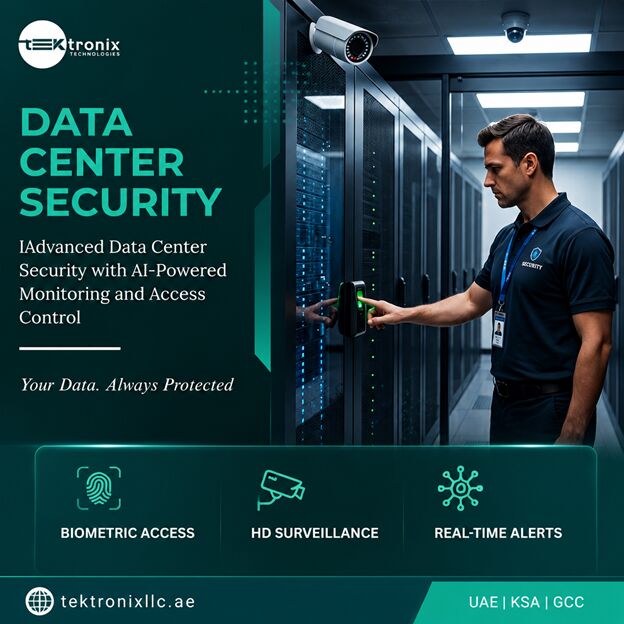
Every credible facility design build Data Center Access Control around multiple concentric layers rather than a single locked door. A typical model moves from a monitored perimeter fence, to a staffed lobby with visitor screening, to biometric or multi-factor verification at each secure zone, down to individually locked server cabinets that log every open event.
● Perimeter layer: fencing, vehicle barriers, and controlled parking access.
● Building layer: staffed reception, visitor badges, and mantrap entry vestibules.
● Zone layer: biometric or card-based verification for server halls and network rooms.
● Cabinet layer: individually locked and logged racks for the highest-sensitivity equipment.
Conclusion
Data Center Security is no longer optional for UAE facilities hosting critical infrastructure and sensitive data. A resilient facility pairs Cybersecurity for Data Center operations with Data Center Encryption and Data Center Firewalls to defend the network perimeter. Strong Data Center Access Control, Data Center Surveillance, and Data Center Intrusion Detection protect the physical facility around the clock. Centralized Data Center Threat Detection ties these layers together into one coordinated response strategy. For a compliant, well-engineered Data Center Security UAE rollout across Data Center Security Dubai and Data Center Security Abu Dhabi facilities, Tektronix LLC is a trusted regional partner.
For more information contact us on:
Tektronix Technology Systems Dubai-Head Office
[email protected]
+971 50 814 4086
+971 55 232 2390
Office No.1E1 Hamarain Center 132 Abu Baker Al Siddique Rd – Deira – Dubai P.O. Box 85955