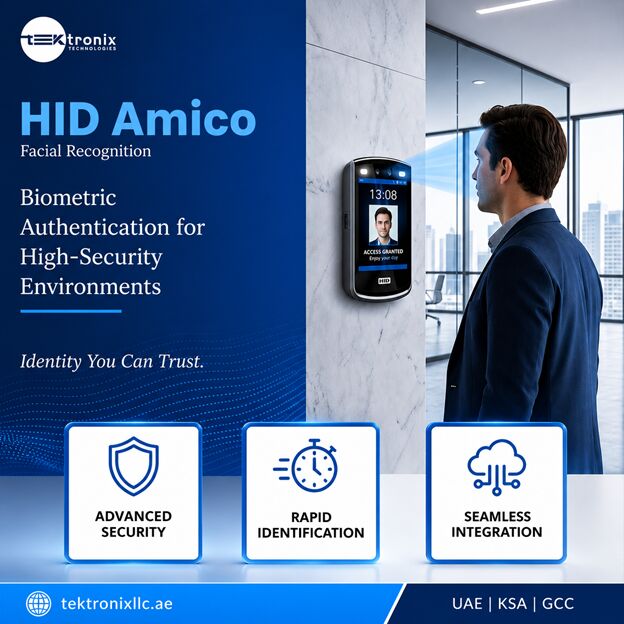
This guide explains how the reader works, how it pairs with HID's controller hardware, and what campus facility teams in the UAE should evaluate before specifying it for a new or upgraded entry system.
Why UAE Campuses Are Moving Toward HID Amico Facial Recognition
Card-based access has served campuses for decades, but it carries a persistent weakness: a card can be lost, shared, or lent to a friend heading into a building they should not be entering. HID Amico Facial Recognition removes that loophole by tying access directly to the person rather than to a piece of plastic they are carrying, which is particularly valuable for university libraries, exam halls, and residence buildings where identity verification actually matters.
For facility teams managing large, high-traffic entrances between lectures, the appeal is also operational: no printing replacement cards for freshers each intake, no help-desk queue for forgotten PINs, and an access log that shows exactly who entered a building and when, without relying on a credential that could have been handed to someone else.
Inside the HID Amico Facial Recognition Reader
The HID Amico Facial Recognition Reader is available in compact and larger touchscreen formats, giving campuses flexibility depending on where it is mounted, a slim corridor door versus a manned reception turnstile. Both versions are built around dual camera sensors, combining visible-light and near-infrared imaging so recognition stays reliable in the mixed lighting common to glass-fronted UAE campus buildings, from bright daylight lobbies to dimmer evening entrances.
The reader supports several authentication methods beyond face matching, including card, PIN, QR code, and mobile credential, so a campus can configure stricter multi-factor checks at sensitive entrances such as server rooms or research labs while keeping general building access to a fast single-glance verification.
Deployment Formats Suited to Campus Buildings
● Compact touchscreen models for standard corridor and classroom-building entrances with moderate daily traffic.
● Larger touchscreen models for main lobbies and reception areas where a visible, self-service interface helps visitors and new students.
● Outdoor-rated housings for perimeter gates and covered walkway entrances exposed to UAE heat and dust.
Planning a HID Amico Abu Dhabi Campus Rollout
Abu Dhabi's growing academic sector, from established universities to newly built research campuses, presents its own planning considerations: larger site footprints, a mix of indoor and outdoor entry points, and often a phased construction timeline where new buildings come online over several years. A HID Amico Abu Dhabi deployment needs a controller architecture that can expand alongside that phased growth rather than requiring a full system replacement each time a new building opens.
Facility planning teams should map out which buildings need only standard reader coverage and which sensitive areas, research labs, server rooms, or record-storage facilities, warrant the stricter multi-factor authentication the reader supports, before finalising a hardware order.
Deploying HID Amico Dubai-Wide Across Free-Zone Campuses
Dubai's academic free zones, including Dubai International Academic City and Dubai Knowledge Park, host multiple independent institutions often sharing a single campus precinct, which adds a layer of complexity that a single-building deployment does not face. A HID Amico Dubai installation in this kind of shared precinct typically needs to segment access by institution while still allowing shared facilities, such as a common library or sports centre, to recognise credentials from every affiliated institution.
Getting this right depends on the access-control software's ability to manage multiple tenant groups from one platform, which is why institutions in shared precincts are encouraged to consult Tektronix's Dubai HID reader and controller integration page early in the planning process, before lease agreements finalise which entrances belong to which tenant.
Conclusion
UAE campuses adopting HID Amico gain a contactless, audit-ready entry experience built on HID Amico Facial Recognition and paired with a scalable HID Aero Controller platform, AI-Powered Anti-Spoofing, and Liveness Detection that together keep entrances fast and genuinely secure. Institutions that plan hardware and software around their real campus layout, rather than a generic template, position themselves for a smoother rollout and a system that scales cleanly as enrolment grows.
For more information contact us on:
Tektronix Technology Systems Dubai-Head Office
[email protected]
+971 50 814 4086
+971 55 232 2390
Office No.1E1 Hamarain Center 132 Abu Baker Al Siddique Rd – Deira – Dubai P.O. Box 85955