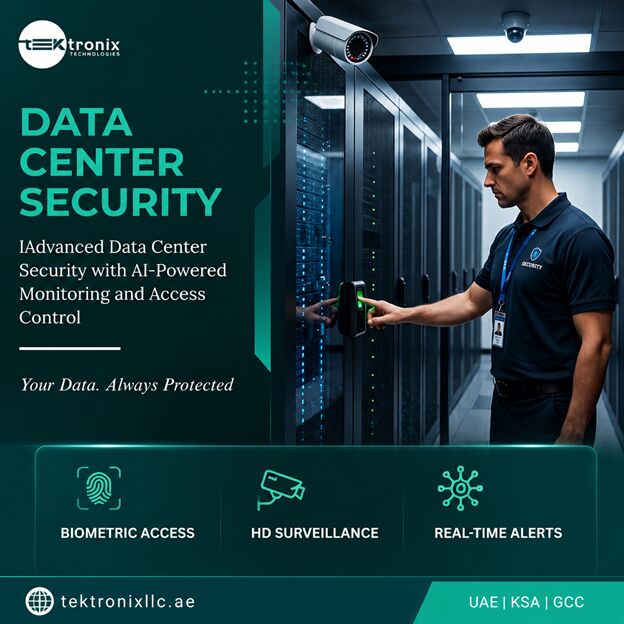
This guide walks through the physical and digital layers that make up a modern data centre security programme in the UAE, what regulators and enterprise tenants now expect, and how facility operators can plan a defence that scales with the country's growing cloud footprint.
Why UAE Data Centres Face a Uniquely High Threat Profile
The UAE's ambition to become a regional cloud and AI hub means its data centres now house workloads with genuine national and commercial significance, from banking core systems to government cloud tenancies. That concentration of high-value data makes UAE facilities an attractive target for both physical intruders and sophisticated cyber actors, and it raises the stakes for every layer of the security stack far above what a typical regional office building would face.
Facility operators are also under growing pressure from enterprise tenants themselves. Banks, healthcare providers, and government entities leasing colocation space increasingly demand documented proof of both physical and digital controls before signing a contract, turning security posture into a genuine commercial differentiator rather than a background compliance checkbox.
Building Cybersecurity for Data Center Environments from the Network Up
Physical barriers alone cannot protect a facility that is, at its core, a dense concentration of networked computer and storage. Cybersecurity for Data Center operations covers everything from network segmentation between tenant environments to hardened management interfaces on the building's own physical security systems, since a poorly secured camera or access controller can itself become an entry point into the wider network.
A mature programme treats the facility's operational technology, cameras, door controllers, environmental sensors, as part of the same attack surface as the servers themselves, applying the same patching discipline, network isolation, and monitoring that the IT side of the business already expects from its production systems.
Data Center Encryption as the Last Line of Defence
Even with strong perimeter and network controls, a defence-in-depth strategy assumes that some layer will eventually be tested. Data Center Encryption protects data at rest on storage arrays and in transit between racks, ensuring that even a successful intrusion into a storage system does not hand an attacker usable, readable information.
For UAE facilities hosting regulated data, financial records, health information, or government workloads, encryption is increasingly a contractual requirement from tenants rather than a discretionary hardening measure, with key-management practices, hardware security modules, and rotation policies now routinely reviewed during tenant security audits before a lease is signed.
Planning Data Center Security Abu Dhabi Facilities Need for Certification
Abu Dhabi's growing cluster of government-adjacent and enterprise data centres often needs to satisfy stricter certification and audit requirements than a typical regional facility, given the concentration of public-sector and financial workloads hosted in the emirate. A Data Center Security Abu Dhabi deployment should be planned with Tier III or Tier IV uptime and security requirements in mind from the earliest design stage, rather than retrofitting compliance features after construction is complete.
Facility planning teams should confirm early whether their target tenant base requires specific audit certifications, since designing access-control zoning and surveillance coverage around those requirements from day one is significantly cheaper than reconfiguring a live facility later.
Scaling Data Center Security Dubai Operators Can Grow Into
Dubai's data centre market is expanding quickly across free zones such as Dubai Silicon Oasis and the wider DIFC-adjacent business districts, with new facilities regularly adding capacity in phases rather than opening at full scale on day one. A Data Center Security Dubai operator specify today needs the headroom to add cages, tenants, and monitoring capacity without a disruptive system replacement each time the facility expands.
Before finalising a vendor, operators should confirm the access-control and surveillance platform's licensing model scales cleanly with added doors and cameras, and that the monitoring software can absorb new tenant zones without re-architecting the entire system. Teams ready to plan a deployment can consult Tektronix's Dubai data centre security integration page for a site-specific assessment.
Conclusion
UAE data centres now sit at the centre of the region's cloud and financial infrastructure, and a properly layered Data Center Security programme is what keeps that trust intact. From encrypted storage and segmented Data Center Firewalls to biometric Data Center Access Control and correlated Data Center Threat Detection, operators that plan every layer around their certification goals and tenant mix build facilities that scale safely as the country's cloud footprint continues to grow.
For more information contact us on:
Tektronix Technology Systems Dubai-Head Office
[email protected]
+971 50 814 4086
+971 55 232 2390
Office No.1E1 Hamarain Center 132 Abu Baker Al Siddique Rd – Deira – Dubai P.O. Box 85955