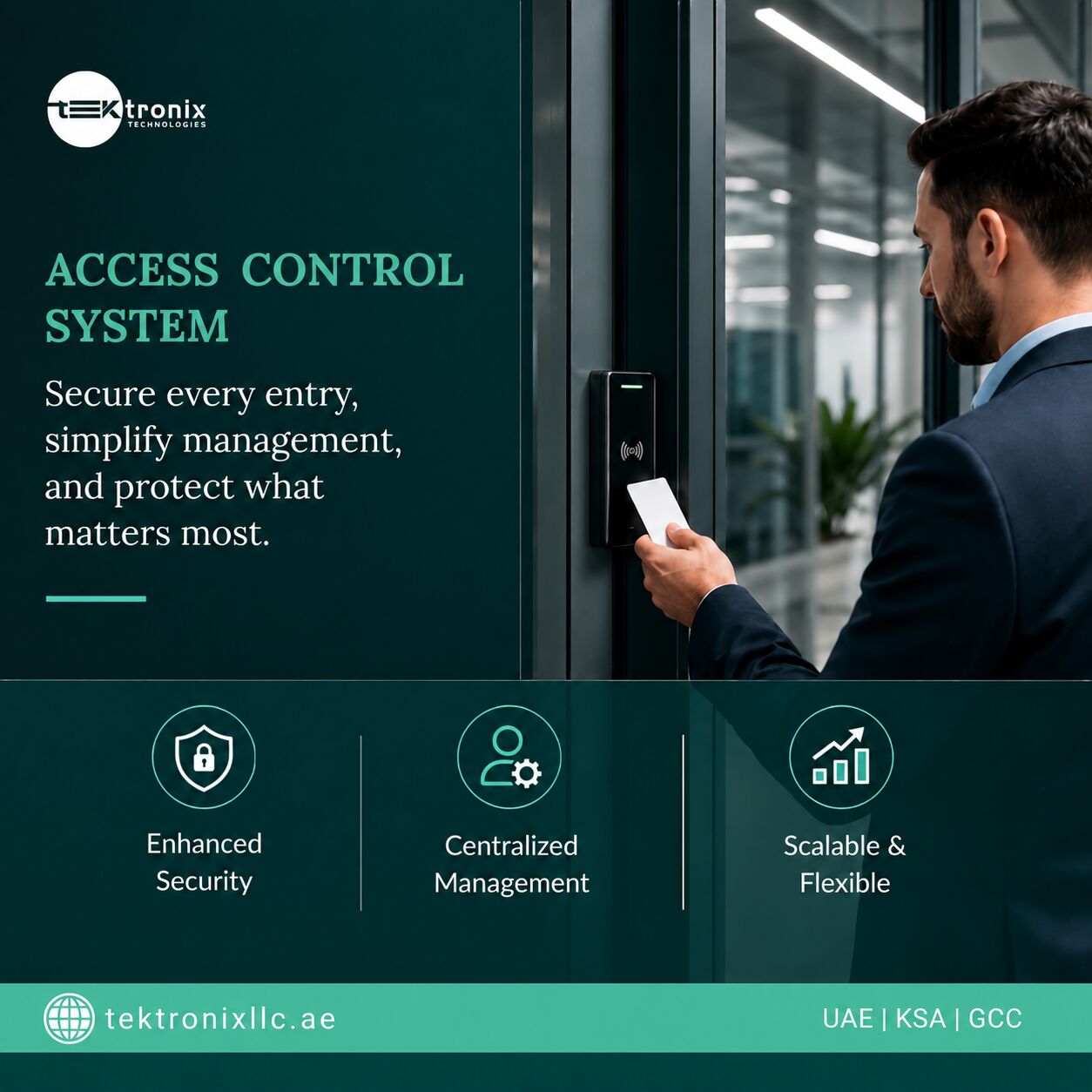
Large UAE organizations rarely operate out of a single building. Banks run branch networks, logistics companies manage distributed warehouses, healthcare groups run multiple clinics, and government-adjacent entities operate campuses spread across several emirates. Managing security consistently across that footprint with mechanical locks or disconnected, site-by-site systems is close to impossible. This article covers what enterprise-grade access control looks like at scale, the architecture decisions that matter most, and why Tektronix has become a trusted integration partner for large, multi-site UAE organizations.
What Makes an Access Control Deployment Truly Enterprise-Grade?
Scale changes the requirements fundamentally. A single-office deployment might manage a few dozen doors and a few hundred credentials; an enterprise deployment across a UAE-wide branch network can mean thousands of doors, tens of thousands of credentials, and dozens of independent administrators who each need visibility into only their own site while a central security team retains oversight across everything.
Consistency of policy is just as important as scale. An enterprise security lead needs confidence that the access rules applied to a server room in Dubai match the rules applied to an equivalent server room in Abu Dhabi or Sharjah, rather than each branch manager configuring security independently based on local preference. A properly architected enterprise platform enforces baseline policy centrally while still allowing each site to layer on its own specific requirements.
Reporting and audit readiness scale up correspondingly. A regulator or internal auditor reviewing a national branch network expects a single, consolidated access report covering every site, not a request that has to be routed to forty separate branch managers each pulling their own local logs in a different format.
Vendor and support continuity also matter more at scale than it might for a single site. An enterprise organization needs an integration partner capable of supporting hardware and software across every emirate the business operates in, with a consistent service level agreement and a single point of escalation, rather than juggling a different local vendor relationship for each regional office and hoping their individual response times align during a genuine incident.
Security Access Control System Architecture for Multi-Site Organizations
A Security Access Control System at enterprise scale is typically built on a hierarchical architecture: a central management server or cloud platform sits above regional or site-level controllers, which in turn manage the individual door hardware. This layered design keeps day-to-day access decisions fast and local while still giving head office a single point of policy control and reporting.
● Central policy management with delegated, site-level administrative permissions
● Role-based access templates applied consistently across every branch or facility
● Consolidated, exportable reporting spanning the entire portfolio
● Resilience at each site so local doors keep functioning during a head-office network outage
Delegated Administration Without Losing Central Control
Enterprise platforms typically implement a permissions model where a branch manager can add a new local employee or issue a visitor pass for their own site, but cannot alter the security tier assigned to a restricted door or override a group-wide policy set by head office. This balance — local operational flexibility within centrally defined guardrails — is what allows a security team of a handful of people to responsibly oversee a network of dozens or hundreds of locations.
Access Control System UAE Deployments Spanning Multiple Emirates
An Access Control System UAE rollout for a national organization has to account for real operational differences between emirates — different building stock, different landlord base-building systems, and in some cases different free zone or regulatory requirements layered on top of the organization's own security policy.
For an Access Control System Dubai headquarters coordinating branches elsewhere in the country, the head office deployment typically becomes the reference template — the security tiering, credential types, and reporting structure proven at HQ is then replicated to each additional site as the network expands, rather than each new branch reinventing its own approach from scratch.
Biometric Access Control Dubai for High-Security Enterprise Zones
Biometric Access Control Dubai deployments are increasingly standard at the highest-security points within an enterprise network — data centers, cash handling rooms, pharmaceutical storage, and executive floors — where a shared or lost card credential represents an unacceptable risk regardless of how strong the surrounding building security is.
At enterprise scale, biometric enrollment data needs to be managed centrally so an employee transferring between branches, or a regional auditor visiting from another site, does not need to re-enroll their fingerprint or face at every location. A single enrollment synced across the entire network keeps the experience seamless for staff who travel between sites regularly, which is common at large UAE organizations with a mobile regional management structure.
Sector-specific regulatory expectations also shape where biometric verification becomes mandatory rather than optional. Banking operators, for instance, often apply biometric or dual-factor verification uniformly to every branch's cash handling area regardless of that branch's individual risk assessment, simply because the regulatory and internal audit expectation is for a consistent, demonstrable standard across the entire network rather than a patchwork of differing controls from branch to branch.
Door Access Control Standardization Across Every Site
Standardizing Door Access Control hardware across an enterprise portfolio simplifies both procurement and ongoing maintenance. Rather than each branch selecting its own reader and lock hardware independently, a centrally approved hardware list ensures spare parts, technician familiarity, and firmware update cycles remain consistent no matter which site a maintenance visit covers.
Consistent Fire and Life-Safety Compliance
Fail-safe and fail-secure lock configuration need to follow the same civil defense compliance logic at every site, and a standardized hardware and configuration approach makes it far easier for a facilities team to confirm compliance across dozens of locations rather than auditing each site's door hardware individually against differing historical installation choices.
Centralized Firmware and Lifecycle Management
Enterprise deployments benefit from being able to push firmware updates and