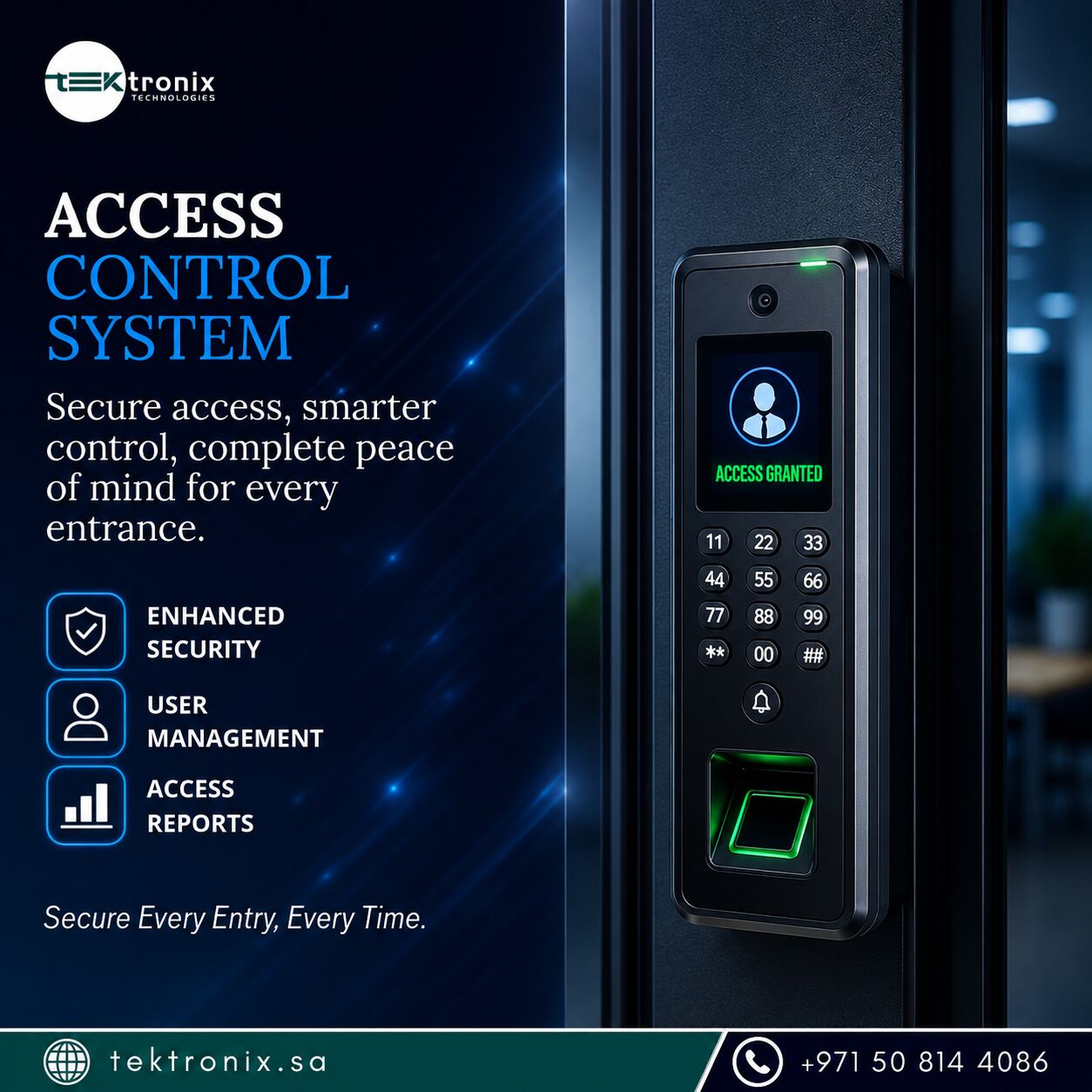
Enterprises across Riyadh, Jeddah, and the wider Kingdom are upgrading to a high-performance Access Control System as physical security expectations rise alongside Vision 2030's rapid pace of commercial and industrial expansion. From corporate towers to critical infrastructure sites, Saudi organisations can no longer rely on basic lock-and-key security when regulators such as the National Cybersecurity Authority (NCA) and the Saudi Data and Artificial Intelligence Authority (SDAIA) hold facility operators to an increasingly structured standard for physical and digital security convergence.
This guide explains how modern access control technology is reshaping enterprise security across the Kingdom, what capabilities facility and security managers should prioritise, and how to deploy a compliant, scalable solution with minimal disruption to daily business operations.
Why Saudi Enterprises Are Upgrading Their Access Control Infrastructure
Mechanical locks and shared physical keys create three recurring problems for enterprise security teams: no record of who entered a space or when, no ability to revoke access instantly when an employee departs, and no way to restrict entry by time, role, or zone. A modern Security Access Control System replaces this uncertainty with a digital, credential-based framework that logs every entry and exit, enforces role-based permissions, and produces an auditable record that satisfies both internal security policy and the compliance expectations of regulators overseeing critical and commercial facilities across Saudi Arabia.
The upgrade also delivers operational efficiency. Lost keys no longer require a full lock replacement, new employees can be provisioned in minutes rather than days, and facility managers gain a single point of control across a multi-building or multi-city footprint instead of managing physical keys site by site.
Biometric Access Control System: Eliminating Credential Sharing
Card-based credentials can be lost, duplicated, or shared between employees, quietly undermining the integrity of any access log. A Biometric Access Control System removes this weakness entirely by verifying identity through fingerprint, facial recognition, or iris scanning — ensuring the person granted access is always the person actually present at the door. For Saudi enterprises managing sensitive data rooms, server facilities, or restricted operational zones, biometric verification provides a level of assurance that card or PIN-based systems cannot match, while still integrating with existing credential infrastructure for lower-risk areas.
Door Access Control: The Physical Layer of Enterprise Security
At the most granular level, every secured entry point in a building represents a decision point that must be enforced consistently. Door Access Control hardware — electronic strikes, magnetic locks, and smart readers — converts each doorway into a managed checkpoint governed by centrally defined rules rather than a shared physical key. This allows facility managers to restrict specific doors to specific roles, shifts, or departments, and to instantly lock down any door remotely in the event of a security incident, something a mechanical lock simply cannot support.
Mobile Access Control: Credentials Employees Already Carry
Physical access cards are easy to forget, lose, or leave behind, creating daily friction for reception and security staff issuing temporary passes. Mobile Access Control solves this by turning an employee's smartphone into their credential, using secure Bluetooth or NFC communication to unlock doors with a tap or automatic proximity detection. Beyond convenience, mobile credentials are easier to issue, revoke, and audit remotely, making them particularly well suited to Saudi enterprises with distributed teams, frequent contractor turnover, or multi-site operations across different cities.
Access Control Device Options for Every Facility Type
Deployment flexibility matters across different building types and security tiers. An Access Control Device can range from a simple standalone card reader for a single door to a fully networked biometric terminal integrated with the enterprise's central security platform. Selecting the right device profile depends on the sensitivity of the area being protected, expected traffic volume, and whether the organisation requires real-time monitoring or simpler, offline-capable entry control for lower-risk zones.
Regulatory Alignment for Access Control in the Kingdom
Physical security in Saudi Arabia increasingly operates within a structured regulatory framework. The National Cybersecurity Authority (NCA) sets the Essential Cybersecurity Controls (ECC) and Critical Systems Cybersecurity Controls (CSCC) that govern the security of connected systems, including networked access control infrastructure, for regulated entities. The Saudi Data and Artificial Intelligence Authority (SDAIA) oversees data governance expectations relevant to biometric and credential data handling, while government and critical-infrastructure-adjacent organisations often also align with ICTD and iGA guidance where applicable. An Access Control System KSA deployment supports alignment with these frameworks by producing exportable, tamper-resistant access logs and enforcing consistent identity verification across every facility, reducing audit preparation time and strengthening the organisation's overall security posture.
Access Control System
Access Control System KSA
Security Access Control System