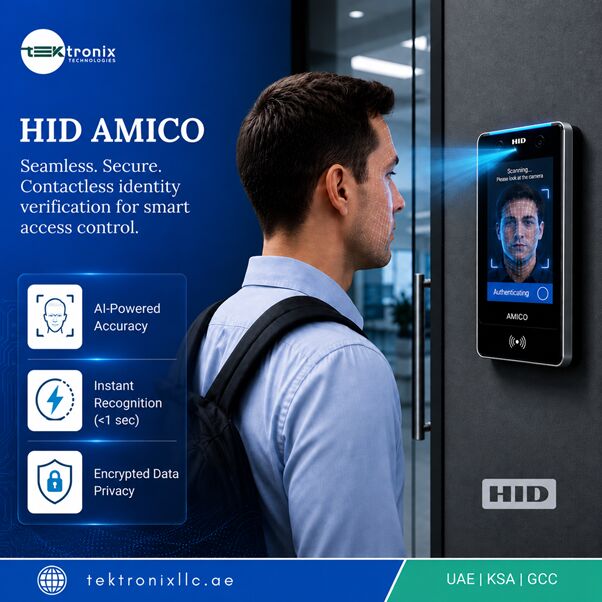
1. What Is HID Amico and Why Does the UAE Market Take It Seriously?
At its core, the platform is HID Global's convergence device: facial biometrics, mobile credentials, and smart-card reading combined into a single wall-mounted unit. Rather than bolting together separate readers for separate credential types, the device was built as one intelligent endpoint, with matching and credential evaluation happening at the edge rather than depending on a constant cloud connection.
That edge-first design matters more in the UAE than in most markets. Free-zone data-residency rules, the UAE Personal Data Protection Law (PDPL), and the network segmentation typical of high-rise towers all favour a device capable of enforcing policy autonomously while still reporting rich event data back to a central security operations centre. It's a big part of why the platform has been specified so widely across:
● Grade-A commercial towers in DIFC, Downtown Dubai, and Abu Dhabi Global Market (ADGM)
● Federal ministries and semi-government authority campuses
● Healthcare and pharmaceutical facilities regulated by DHA and the Department of Health
● Data centres and critical national infrastructure sites
● Hospitality, retail, and entertainment districts
● University and school campuses across all seven emirates
2. HID Amico Facial Recognition: The Intelligence Layer at the Door
The engine underneath every deployment is HID Amico Facial Recognition, a deep-learning model trained and validated across a globally diverse dataset spanning lighting conditions, skin tones, age groups, and partial face obstruction. In practice that translates to sub-one-second verification with False Acceptance and False Rejection Rates benchmarked against the strictest enterprise security standards used in UAE procurement.
2.1 Liveness Detection and Anti-Spoofing
A recognition engine is only as trustworthy as its resistance to presentation attacks. The liveness engine differentiates a live human face from a photograph, printed mask, or replayed video using 3D infrared depth sensing paired with texture analysis — an approach aligned with the anti-spoofing benchmarks of ISO/IEC 30107-3, a standard increasingly referenced in UAE government tenders.
2.2 Privacy-First, Template-Based Architecture
Every biometric template is encrypted at capture using AES-256 and stored locally inside a hardware-secured enclave. Raw facial imagery never leaves the device. That data-minimisation approach maps directly onto the purpose-limitation principles written into the UAE PDPL and the privacy-by-design posture the Abu Dhabi Digital Authority has been pushing across government procurement.
2.3 Built for Masks, Sunglasses, and Modesty Wear
Because surgical masks, sunglasses, and modesty clothing are an everyday reality across the region, the recognition model has been specifically tuned to keep accuracy high even with a significant portion of the face obscured — which keeps throughput steady at busy lobby choke points without forcing occupants to remove anything.
3. HID Amico Facial Recognition Reader: Hardware Built for Gulf Conditions
The physical HID Amico Facial Recognition Reader hardware was engineered around the UAE's climate as much as its regulatory environment. A wide operating-temperature tolerance, an IP65-rated outdoor variant, and anti-glare infrared illumination keep reads accurate in direct sunlight — a condition that knocks out many competing biometric readers installed in al-fresco lobbies, parking structures, and outdoor turnstile lanes across the Gulf.
●Dual-band infrared LED array for consistent illumination, from bright lobbies to dim basement car parks
●Wide dynamic range (WDR) camera module calibrated for the region's high ambient light levels
●Capacitive touchscreen for PIN backup and accessibility modes
●Integrated NFC, Bluetooth Low Energy (BLE), and 13.56 MHz smart-card reading for multi-credential flexibility
●Single-cable PoE+ installation, simplifying retrofits inside existing buildings
●Tamper-detection sensor with instant alert propagation to the access-control server
The slim architectural profile and brushed-metal finish are a large part of why UAE interior designers and fit-out contractors keep specifying it — lobby aesthetics no longer have to be traded off against security performance.
Conclusion
The convergence of facial biometrics, mobile credentials, and cloud-managed control at the heart of this platform isn't a preview of the future — it's already the operating reality for UAE organisations that treat physical security as core infrastructure. From the instant recognition of the facial engine to the policy depth of the controller layer, every layer is built to reduce friction for people who belong and raise a real barrier against those who don't. Layer in video analytics and the picture gets sharper still: identity at the door, behaviour across the estate, all correlated in one view. Whether the estate is a single headquarters in Dubai Media City or a multi-site portfolio spanning Abu Dhabi's government quarter and Sharjah's industrial zones, the ecosystem scales to match the ambition.
With regional compliance expertise, climate-hardened hardware, and a locally certified integration partner in Tektronix LLC, UAE organisations have what they need to make access control as smart and future-ready as the rest of their digital transformation agenda. Reach out through our access control and biometric readers page to start a site assessment.
For more information contact us on:
Tektronix Technology Systems Dubai-Head Office
[email protected]
+971 50 814 4086
+971 55 232 2390
Office No.1E1 Hamarain Center 132 Abu Baker Al Siddique Rd – Deira – Dubai P.O. Box 85955