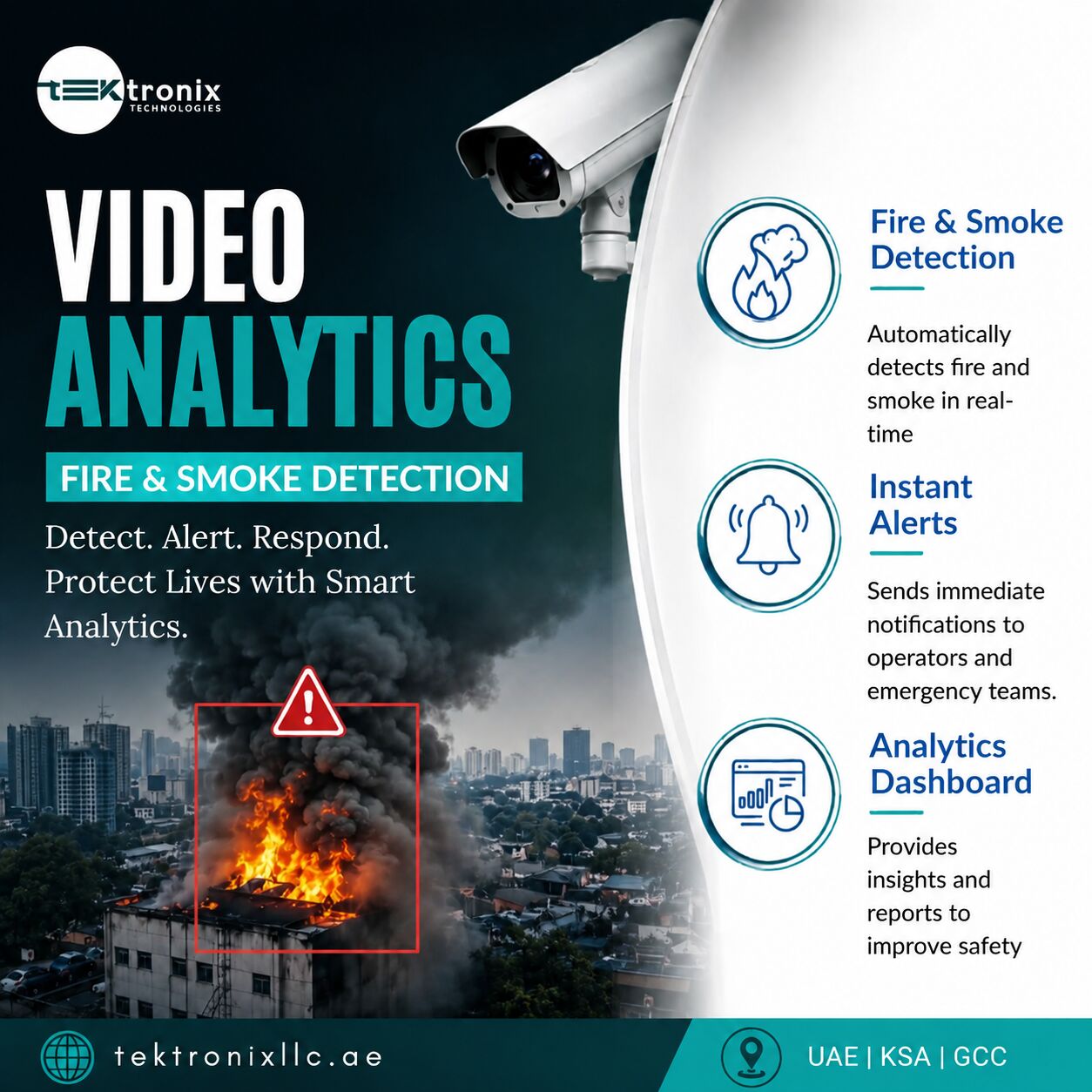
This guide walks through how modern video intelligence works, what distinguishes a UAE-calibrated deployment from a generic off-the-shelf platform, and where Tektronix has proven the technology across the country's roads, transit systems, and critical infrastructure.
Why UAE Driving and Environmental Conditions Demand Local Calibration
A platform trained on European or North American driving data will misread the Gulf almost immediately. Federal speed limits of 120–160 km/h compress the window available for incident detection to a matter of seconds; an unusually high proportion of SUVs, pick-ups, and heavy commercial vehicles demands classification models tuned to the region's actual vehicle mix rather than a generic global average; and sandstorm visibility events, extreme midday contrast, and inconsistent night-time illumination all stress computer vision models that were never tested against those conditions.
Tektronix builds a UAE-specific scene calibration phase into every deployment, adapting detection algorithms to local vehicle types, lane discipline patterns, and lighting conditions before a single camera goes live — so the platform understands what it is watching from day one rather than learning on the job at the client's expense.
Licence plate recognition adds a further layer of regional complexity. Vehicles from all seven emirates, GCC neighbours, and diplomatic corps carry varied plate formats and character sets, and a recognition engine trained only on a single format will silently fail on a meaningful share of the vehicle population it is meant to track. Building a unified recognition model across this variation is one of the more technically demanding aspects of a UAE deployment, and one that generic global platforms routinely underestimate.
What Powers a Smart Video Analytics Platform?
The defining shift in this technology is from simple rule-based triggers to genuinely cognitive systems. A Smart Video Analytics platform uses convolutional neural networks, transformer architectures, and multi-object tracking algorithms to model scene context, object relationships, and behaviour over time — rather than firing an alert every time a pixel change.
This is what separates AI-Based Video Analytics from legacy motion detection: every object in frame is classified by type, sub-type, colour, orientation, and speed vector simultaneously, across multiple overlapping camera feeds, in real time. That granular classification is the foundation every higher-level behavioural model — stopped-vehicle detection, wrong-way driving, crowd density analysis — is built on.
Dubai, Abu Dhabi, and Sharjah: Three Distinct Operating Environments
Dubai's scale — over 1,500 signalised intersections, a 75-kilometre metro network, and the world's busiest international airport — demands platforms architected for massive horizontal scalability without proportional growth in operator headcount. Abu Dhabi's profile, shaped by sovereign government campuses, energy-sector infrastructure, and the cultural district of Saadiyat Island, requires the same detection capability balanced against tighter privacy and data governance standards. Sharjah and the Northern Emirates present a different challenge again: high cross-emirate traffic volumes and extensive industrial and logistics activity, prioritised by Sharjah Police General Headquarters and Sharjah Municipality as core components of the emirate's digital transformation programme. Tektronix maintains delivery and support capability across all seven emirates, ensuring implementation quality does not vary by geography.
Cross-jurisdiction handover is one of the more distinctive requirements this geography creates. A vehicle or person of interest tracked across cameras in Dubai frequently continues into Sharjah, or from Abu Dhabi toward Al Ain, and a platform that treats each emirate's camera network as an isolated silo loses that continuity at the boundary. Tektronix designs alert-handover logic so that a tracked object crossing an emirate boundary automatically notifies the relevant authority's control room, preserving situational continuity rather than requiring a fresh manual handoff between agencies.
Why Tektronix LLC
Tektronix LLC is a UAE-registered systems integrator with a decade-plus track record designing, deploying, and managing AI-powered video intelligence for transport authorities, government entities, and commercial enterprises across the country. Our certified integration engineers hold current qualifications from Genetec, Milestone, Avigilon, Brief Cam, and Bosch VMS, our in-house data science team develops custom model training and scene calibration for each client's specific environment, and our 24/7 bilingual Arabic and English operations support is built around response SLAs suited to critical infrastructure requirements.
Conclusion
The shift from passive CCTV to cognitive video intelligence is not a distant aspiration for the UAE — it is an active national programme measured in cameras installed, incidents prevented, and response times reduced. From the driving patterns of an eight-lane expressway to the crowd dynamics of a weekend event and the perimeter of an industrial facility, every camera feed the country generates carries value that only correctly calibrated analytics can unlock. Tektronix LLC brings the technology expertise, regional calibration knowledge, and integration engineering capability to make that transition seamless, across a single site or a city-scale rollout.
For more information contact us on:
Tektronix Technology Systems Dubai-Head Office
[email protected]
+971 50 814 4086
+971 55 232 2390
Office No.1E1 Hamarain Center 132 Abu Baker Al Siddique Rd – Deira – Dubai P.O. Box 85955