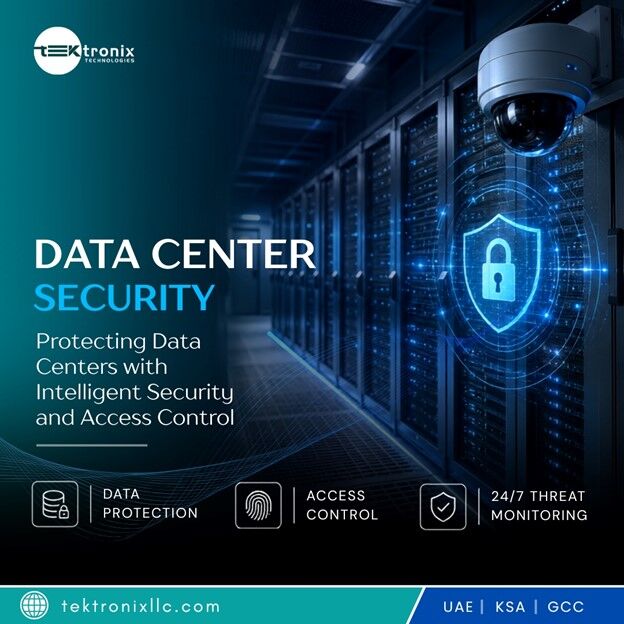
Why Layered Data Center Security Matters More Than Ever
A single point of failure is all it takes to compromise a data hall holding payment records, national identity data, or oil-and-gas SCADA telemetry. Regulators across the region — including Oman's Information Technology Authority guidance, Saudi Arabia's SAMA and NESA frameworks in the UAE — now expect operators to demonstrate a layered, auditable security posture rather than a single control. A six-layer model spreads risk across perimeter, access, network, cyber, data and monitoring domains, so that if one layer is probed or bypassed, five others remain standing between an attacker and the server room.
This is the philosophy behind Tektronix's approach to Data Center Security Oman and Data Center Security GCC deployments: no single technology is trusted in isolation, and every layer is independently tested, monitored and reported on.
The Gulf region presents a unique combination of risk drivers that make this layered discipline non-negotiable. Rapid smart-city development in Oman, Saudi Arabia and the UAE is concentrating more government, healthcare and financial workloads into fewer, higher-value facilities — which means each facility now represents a bigger single target for both cybercriminals and physically motivated adversaries. At the same time, extreme heat, dust ingress and power-grid variability common to the region place additional stress on facility hardware, creating maintenance windows and vendor-access events that, if not tightly governed, can become security blind spots. A layered strategy accounts for all of this: it does not assume ideal operating conditions, and it does not assume any single vendor, employee or system will behave perfectly one hundred percent of the time.
Compliance, Standards and Regional Regulatory Alignment
Every layer described above is mapped against the compliance expectations that matter most to GCC operators — ISO 27001, PCI-DSS for payment environments, national critical-information-infrastructure directives, and Uptime Institute Tier standards for facility resilience. This gives compliance officers and auditors a ready reference point when demonstrating due diligence to regulators, insurers and enterprise customers.
Documentation generated by each layer — surveillance logs, access-control audit trails, firewall change records, encryption key-rotation histories and intrusion-detection incident reports — is retained according to regionally appropriate retention schedules and made available in a format auditors can review without requiring a separate translation or reformatting exercise. This reduces the time and cost of annual compliance cycles significantly, since evidence collection becomes a matter of exporting existing records rather than reconstructing them under deadline pressure.
Industries That Depend on Six-Layer Data Center Protection
Banking and financial services operators rely on this framework to protect payment-switching infrastructure and customer data under PCI-DSS obligations. Telecom carriers use it to safeguard core network infrastructure and subscriber data against both cyber intrusion and physical sabotage. Government and public-sector facilities apply it to national identity systems and citizen-service platforms where uptime and confidentiality are treated as matters of public trust. Oil, gas and energy operators extend it to protect SCADA and industrial-control environments, where a security failure can have consequences well beyond data loss alone.
Conclusion
Data Center Security is no longer optional infrastructure spend — it is the foundation on which digital trust in Oman and the GCC is built. Tektronix's six-layer framework unites Data Center Surveillance, Data Center Access Control, Data Center Firewalls, Cybersecurity for Data Center operations, Data Center Encryption, and Data Center Intrusion Detection with continuous Data Center Threat Detection into one coordinated defence. For organizations pursuing serious Data Center Security Oman and Data Center Security GCC strategies, this layered model delivers measurable, auditable resilience rather than isolated point solutions.
For more information contact us on:
Tektronix Technology Systems Dubai-Head Office
[email protected]
+971 55 232 2390
Office No.1E1 Hamarain Center 132 Abu Baker Al Siddique Rd – Deira – Dubai P.O. Box 85955